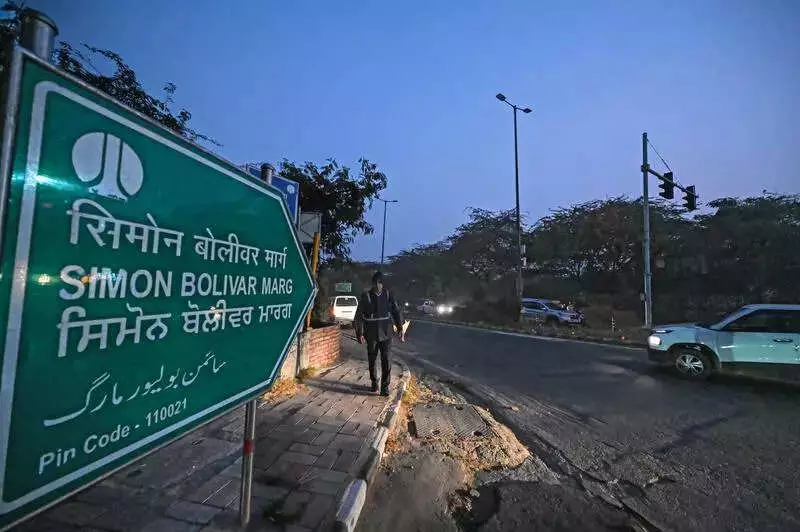
While recent US military strikes on Venezuela capture global headlines, a quiet street in India's capital serves as a lasting reminder of a deeper, historical bond. In the diplomatic heart of New Delhi, Simon Bolivar Marg stands as a tribute to Venezuela's iconic liberator, symbolising India's long-standing engagement with anti-colonial struggles worldwide.
The Symbolic Street in Chanakyapuri
Tucked away in the leafy diplomatic enclave of Chanakyapuri, Simon Bolivar Marg runs from Kautilya Marg to Sardar Patel Marg. Lined with dense trees and surrounded by embassies, this arterial road blends into Delhi's everyday chaos. Yet, its green signboard transforms into a poignant symbol during global crises, echoing shared histories and ideologies.
Historians confirm that the road's name is no accident. Delhi's post-Independence planners consciously etched global history into the city's map, choosing to honour leaders who symbolised freedom from colonial rule. This practice was part of a broader diplomatic strategy to build friendships with the newly decolonised nations of the Global South.

Bolivar's Legacy and India's Anti-Colonial Affinity
Simon Bolivar, known as 'El Libertador', was a monumental figure in South American history. Born in 1783, he led movements that freed nations like Colombia, Ecuador, Peru, and Venezuela from Spanish rule. His vision extended beyond military victory; he advocated for the abolition of slavery, land rights for indigenous communities, and even a united Latin America.
Historian Swapna Liddle explains that India, as a new nation after 1947, actively sought ties with countries that had also 'threw off the colonial yoke'. Honouring figures like Bolivar on Delhi's streets was a conscious acknowledgment of these shared struggles. Professor Minni Sawhney of Delhi University adds that this trend peaked during the era of the Non-Aligned Movement, particularly under Prime Minister Indira Gandhi's leadership, when India strengthened bonds with Latin America based on shared socialist and secular ideals.
Diplomatic Ties and Contemporary Echoes
This symbolic connection was reinforced through direct diplomacy. The late Venezuelan President Hugo Chavez paid a state visit to Delhi in March 2005, meeting with then Prime Minister Manmohan Singh and President A P J Abdul Kalam. Years later, in August 2012, Nicolas Maduro, then Venezuela's foreign minister, visited for the India-CELAC Troika meeting.
Today, as Venezuela grapples with dramatic events including US strikes and the capture of President Maduro, the quiet boulevard in Delhi remains unchanged. It stands as a physical testament to how global histories of liberation and resistance continue to intersect on the streets of India's capital, far from the immediate sound of conflict but close to the heart of a shared post-colonial identity.