

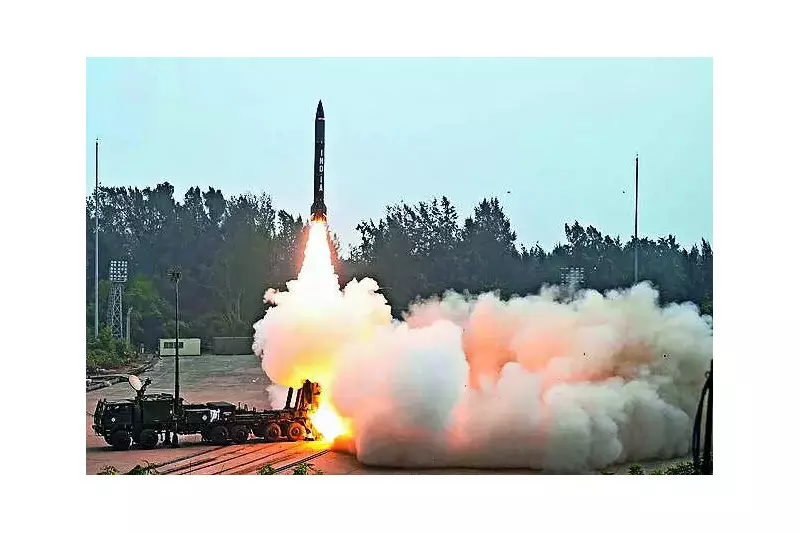
In a significant demonstration of its indigenous missile capabilities, India's Defence Research and Development Organisation (DRDO) successfully carried out a salvo launch of two 'Pralay' missiles on Wednesday morning. The back-to-back firings from a single launcher took place at the Integrated Test Range in Chandipur, off the coast of Odisha.
A Milestone in User Evaluation Trials
The flight test, conducted around 10:30 am, was a crucial part of the user evaluation trials for the armed forces. According to an official statement from the defence ministry, both missiles followed their intended flight path perfectly and met all mission objectives. The successful completion of this salvo launch, which involves simultaneous or rapid sequential firing, has firmly established the reliability of the weapon system for the users.
Tracking sensors deployed across the test range at Chandipur confirmed the missiles' trajectory. The final impact events were monitored by telemetry systems installed on a ship positioned near the designated target points in the Bay of Bengal.

Advanced Technology and Imminent Induction
The Pralay missile is an indigenously developed, solid-propellant, quasi-ballistic system. It employs a sophisticated guidance package featuring an advanced Inertial Navigation System (INS) and a radio frequency seeker. This combination ensures high precision and accuracy in striking targets at varying ranges. The missile is designed to be versatile, capable of carrying different types of warheads to engage a variety of targets.
Defence Minister Rajnath Singh congratulated the DRDO, the Indian Air Force, the Indian Army, defence public sector units, and the industry partners on this successful test. He stated that the salvo test marks a key step towards the system's readiness for induction.
Echoing this sentiment, DRDO Chairman Samir V Kamat praised the teams involved and indicated that this achievement signals the imminent readiness of the Pralay system for deployment with the armed forces. The missile has been developed primarily by the Research Centre Imarat in Hyderabad, in collaboration with other DRDO laboratories.
Part of a Broader Missile Testing Surge
This test is part of a concentrated series of missile trials conducted by India recently, underscoring its focus on strengthening strategic and tactical defences. The Pralay launch came just a day after India successfully conducted the first flight test of the Pinaka Long-Range Guided Rocket from the same Chandipur facility on Monday.
Furthermore, on December 23, India test-fired the K-4 submarine-launched ballistic missile, which has a reported range of 3,500 kilometres, from the nuclear-powered submarine INS Arihant in the Bay of Bengal. These developments highlight India's concerted efforts to build a diverse and potent array of missile systems to deter hostile forces and ensure robust counter-strike capabilities.
The latest Pralay trials were specifically aimed at validating the missile's navigation and precision strike capabilities under realistic operational conditions, paving a clear path for its formal induction into India's military arsenal.






