

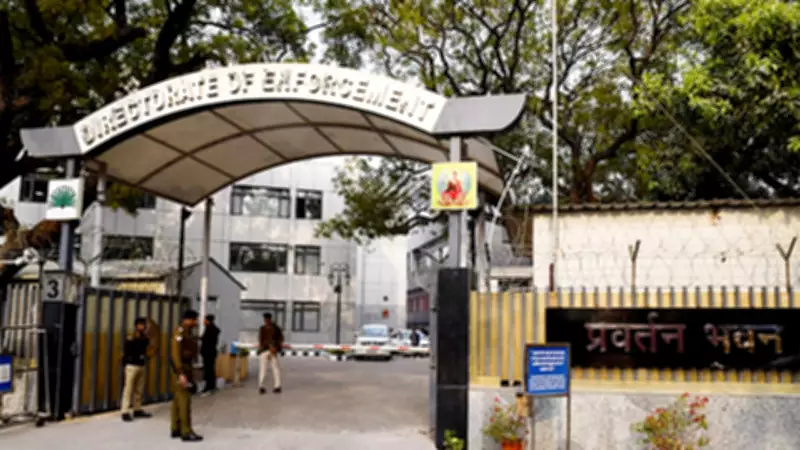
The Enforcement Directorate (ED) on Thursday countered the West Bengal government and Chief Minister Mamata Banerjee's plea before the Supreme Court, arguing that the state's objection to the agency's writ petition is contradictory. The state had claimed that a writ petition filed by the ED and its officers is not maintainable as only individuals can assert violation of fundamental rights.
ED's Argument on Writ Petitions
Appearing before a bench of Justices Prashant Kumar Mishra and N.V. Anjaria, Solicitor General Tushar Mehta pointed out that several states, including Tamil Nadu, Odisha, and West Bengal itself, have previously filed writ petitions. He argued that it is inconsistent for West Bengal to now claim that only individuals can file such petitions. 'After filing itself a writ petition, it cannot say that only individuals can file the petition,' Mehta stated, responding to the submission that an Article 32 petition cannot be filed by an investigating agency or its officers as they do not possess a fundamental right to investigate.
Rule of Law and Fundamental Rights
Mehta further contended that the rule of law is an integral part of fundamental rights under Article 14, which guarantees equality before the law. He argued that a writ petition can certainly be filed in case of a breakdown of the rule of law, as allegedly occurred in West Bengal, where the ED was prevented from discharging its duties and carrying out a probe. The ED has alleged that Mamata Banerjee used state machinery to obstruct its January 8 probe at the office of political consultancy firm I-Pac in Kolkata, in connection with a coal smuggling case.

Fundamental Rights of Officers
Justifying the petition filed by ED officers, Mehta asserted that officers do not forfeit their fundamental rights after donning uniforms and cannot be prevented from filing a petition solely because of their official capacity. He emphasized that their identity as individuals and officers is inseparable, and it would be a travesty of justice if they were barred from approaching the court when falsely implicated in a case like the present one.
Court's Concerns on Floodgate of Litigation
At this stage, the bench observed that there is an inherent danger if such a petition is filed and entertained, as it could lead to a floodgate of litigation, with states continuously filing such petitions. The court expressed concern that allowing the ED's petition might set a precedent encouraging similar actions.
Statutory Remedy vs. Article 32
The state government had submitted that a statutory remedy is available for the ED by filing an FIR instead of invoking Article 32 in this case. However, Mehta raised the question of how an FIR can be filed before the state police seeking a probe against the Chief Minister, Director General of Police, a Police Commissioner, and a Deputy Commissioner of Police. 'That is why an independent neutral agency under court supervision will have to go into it. This is the fight where a central agency is investigating with proper documentation and the political executive supported by the highest echelons of the police department comes and takes away the incriminating material on the ground that I-Pac is also our (TMC) political adviser and you wanted some secret documents from I-Pac regarding our political party,' he said.






