

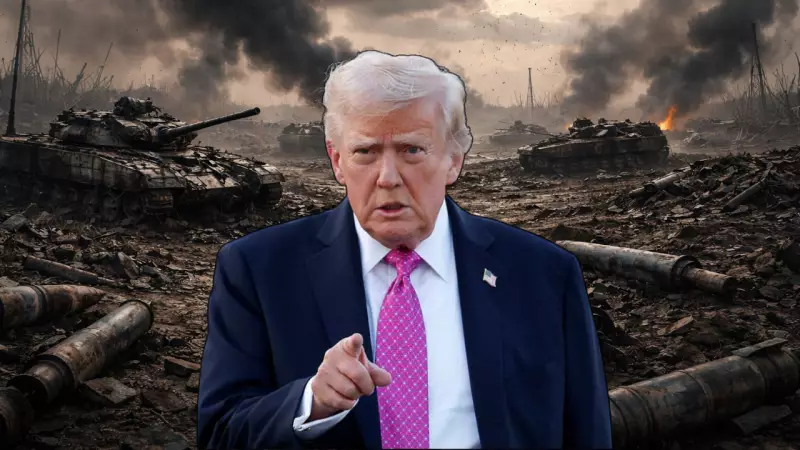
The haunting question from the HBO series Chernobyl – "What is the cost of lies?" – finds a disturbing echo in today's political theatre. Since his return to the White House in January 2025, former President Donald Trump has relentlessly promoted an image of himself as a global peacemaker, claiming singular credit for ending multiple wars. The central boast, repeated in speeches and on Truth Social, is of "ending eight wars in ten months." But how many of these claims withstand factual scrutiny? A detailed examination reveals a pattern of overstated announcements, fragile ceasefires, and in some cases, conflicts that were never wars to begin with.
The Claims Under the Microscope: From Asia to Africa
Let's dissect the eight conflicts Trump cites as evidence of his diplomatic prowess.
India-Pakistan: A Claim Met with Contradiction
Following a terrorist attack in Kashmir in April 2025 that killed 26 tourists, India launched Operation Sindoor on May 7. After Pakistan's retaliatory air raids were thwarted, Trump announced a ceasefire via Truth Social on May 10, citing US-mediated talks. He later asserted that trade pressure was his key tool, warning both nations that future deals depended on peace.

While Pakistan's leadership publicly thanked Trump and even proposed a Nobel nomination, India's response was a firm rebuttal. Prime Minister Narendra Modi told Parliament that no foreign leader asked India to halt its operation. External Affairs Minister S. Jaishankar denied any "third-party intervention" and decoupled the ceasefire from trade talks. The claim rests entirely on Trump's announcement, directly contradicted by one of the principal parties involved.
The Illusory Ceasefires: Thailand-Cambodia & Rwanda-DRC
In July 2025, after fierce border clashes between Thailand and Cambodia displaced 300,000 people, Trump proclaimed a ceasefire and peace via social media, calling himself the "President of PEACE!" An October ASEAN summit produced the Kuala Lumpur Peace Accord. However, the ceasefire repeatedly collapsed. By December 2025, heavy fighting had resumed, with Thailand's Prime Minister Anutin Charnvirakul explicitly stating, "Thailand had not agreed to a ceasefire." Trump's announcement proved to be a temporary pause, not a lasting peace.
The story was similar in Central Africa. After a June 2025 Washington summit between the leaders of Rwanda and the Democratic Republic of Congo, Trump hailed the end of a decades-long war. Yet, within hours, M23 rebels (excluded from talks) attacked again. Fighting and displacements continued through late 2025. Analysts concluded the US diplomacy merely "paused an escalation" without addressing root causes like mineral control and rebel alliances.
The Middle East Quagmire: Gaza and Iran
Trump's 20-point Gaza peace plan, unveiled in October 2025, led to a signed agreement and a phased ceasefire. While daily missile attacks largely stopped, sporadic strikes and allegations of violations continued. The core issues of Hamas's governance, Israeli security, and Palestinian statehood remain unresolved, making this a fragile truce, not a conclusive end to the conflict.
His claim regarding an Israel-Iran war is particularly bold. After a twelve-day exchange of strikes in June 2025, Trump announced a ceasefire, boasting he had destroyed Iran's nuclear capability. While major battles stopped, there was no formal treaty. Iran's Supreme Leader claimed victory, and experts noted the nuclear program was not defeated. The conflict was pushed into "a state of dormancy" without solving the underlying geopolitical rivalry.
The Formal Deal, The Non-Wars, and The Ongoing Fight
Amidst the shaky claims, one formal agreement stands out. The Armenia-Azerbaijan peace deal, signed at the White House in August 2025, is Trump's most concrete achievement. It commits both sides to end fighting and open relations, though its long-term durability remains to be tested.

Other claims, however, stretch the definition of "war." The Egypt-Ethiopia dispute over the Nile dam was a diplomatic standoff, not an armed conflict. Ethiopian officials rejected the suggestion of US involvement. Similarly, Serbia and Kosovo have had no direct war since 1999, though tensions persist. Trump's claim of averting a war there lacks a factual basis in recent fighting.
Finally, the largest conflict—Russia-Ukraine—rages on. Despite Trump's envoys and initiatives, no ceasefire is in place. Ukraine has reportedly dropped its NATO bid for security guarantees, but negotiations on occupied territory are deadlocked. The Kremlin has stated it will not halt the war for short-term truces without a full peace deal.
The Final Tally: Announcements Are Not Peace
So, what is the final score on the claim of "eight wars ended"? The evidence shows:
- One formal peace treaty signed (Armenia-Azerbaijan).
- Several fragile, often violated ceasefires (Gaza, Thailand-Cambodia, Rwanda-DRC, Israel-Iran).
- Claims directly contradicted by a involved nation (India-Pakistan).
- Diplomatic disputes recast as "wars" (Egypt-Ethiopia, Serbia-Kosovo).
- One major war ongoing despite diplomatic pushes (Russia-Ukraine).
The pattern is clear. While the Trump administration has engaged in high-profile diplomacy, the results are frequently temporary, contested, or mischaracterised. As history teaches, speeches are not settlements, and announcements are not peace. The cost of lies, or even of significant exaggerations, in global diplomacy is a eroded trust and a misunderstanding of what truly builds lasting stability.





