

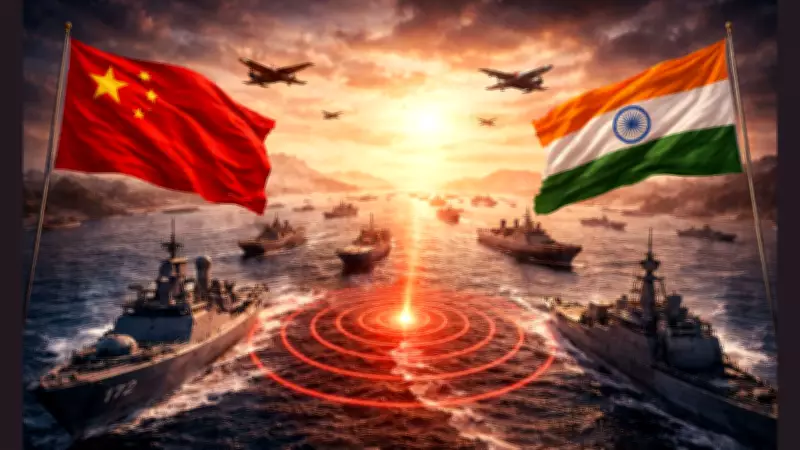
The Strait of Hormuz Crisis: A Global Warning Signal
The ongoing conflict between the United States and Iran has thrust the Strait of Hormuz into the geopolitical spotlight, serving as a stark reminder of a fundamental truth: when a narrow maritime passage is threatened, the repercussions extend far beyond immediate battle zones. The current situation demonstrates how tanker movements slow, insurance premiums skyrocket, freight costs escalate, and global energy markets experience significant volatility.
Reuters reported this week that the US-Iran confrontation has pushed the Strait of Hormuz toward effective closure, disrupting approximately 20 million barrels per day of oil and fuel supply. This represents roughly one-fifth of global seaborne energy trade, highlighting the waterway's critical importance to international commerce and energy security.
Beyond Hormuz: China's Strategic Maritime Vulnerability
While Hormuz represents an immediate crisis, the deeper strategic implications lie thousands of kilometers to the east in Southeast Asia. For China, the true long-term maritime vulnerability exists not in the Persian Gulf but at the Strait of Malacca, the narrow sea lane connecting the Indian Ocean to the Pacific Ocean that carries an enormous share of East Asia's energy imports and commercial trade.

Although India does not control the Strait of Malacca, its geographical position provides something nearly as significant during potential crises: strategic proximity. From the Andaman and Nicobar Islands, India maintains close access to the western approaches of the strait, enabling monitoring capabilities, pressure application, operational complications, and, in extreme conflict scenarios, potential denial of access to one of the world's most vital shipping corridors.
This geographical advantage transforms China's vulnerability into India's strategic opportunity in potential standoffs with Beijing. As Dr. Ashok Sharma, visiting fellow at the University of New South Wales Canberra at the Australian Defence Force Academy, explains, India's real advantage lies not in completely halting maritime traffic but in "creating uncertainty and strategic pressure rather than fully stopping maritime traffic."
The Malacca Dilemma: China's Strategic Nightmare
The Strait of Malacca represents far more than just a busy shipping route—it serves as Asia's most critical maritime artery. According to the latest EIA World Oil Transit Chokepoints analysis, the strait carried 23.2 million barrels per day of oil during the first half of 2025, accounting for 29% of total global maritime oil flows. This volume makes it the world's largest oil chokepoint, surpassing even the Strait of Hormuz.
The same report indicates that approximately 9.2 billion cubic feet per day of liquefied natural gas flowed through the strait during the same period. According to think tank ORF, China's energy imports reached $390 billion in 2024, with nearly 80% ($312 billion) transported through the Malacca Strait.
This scale creates what experts term the "Malacca Dilemma"—China's persistent concern that too much of its economy depends on a narrow sea lane it cannot control. Beijing has attempted to mitigate this risk through various initiatives including the Belt and Road Initiative, pipeline construction, overland corridor expansion, port investments, and route diversification strategies. However, none of these alternatives can fully replicate the Malacca route's scale, speed, and cost-efficiency.
India's Geographical Advantage: The Andaman and Nicobar Islands
India's strategic role in potential Malacca-related crises derives not merely from naval strength but from geographical positioning. The Andaman and Nicobar Islands sit deep in the eastern Indian Ocean, positioned close enough to the western approaches of Malacca to provide significant strategic value. The Strait of Malacca lies less than a day's steaming distance from Port Blair, underscoring these islands' importance.

This positioning essentially transforms the Andaman and Nicobar chain into what strategists might describe as an "unsinkable aircraft carrier." Unlike naval vessels, islands require no deployment—they remain permanently in position and cannot be sunk. They can host aircraft, surveillance systems, missiles, drones, logistics nodes, and naval detachments, with this permanence proving particularly valuable during maritime crises.
At the southern tip, INS Baaz—India's southernmost military air station at Campbell Bay—provides a forward operating position near the Six Degree Channel and close to the western approaches of Malacca-bound sea lanes. Dr. Sharma emphasizes that installations like INS Baaz strengthen India's ability to monitor key sea lanes, deploy air and naval assets, and maintain forward presence during crises.
The Economic Dimensions of Chokepoint Crises
A Malacca crisis would likely begin not with military strikes but with economic calculations. The most immediate damage in chokepoint crises often emerges from war-risk insurance adjustments rather than direct military action. The current Hormuz situation provides a clear example: Reuters reported that war-risk premiums for vessels in the Gulf jumped to approximately 3% of a ship's value in early March, up from roughly 0.25% before the conflict.
For large tankers valued between $200 million and $300 million, this translates to approximately $7.5 million per voyage compared to about $625,000 previously. When areas are declared unstable or become conflict zones, underwriters can sharply increase premiums for transiting vessels. Some operators may avoid the route entirely, while others may demand higher freight rates or reroute through longer alternatives.
According to EIA chokepoint analysis, disruption of major transit routes leads to supply delays and higher shipping costs even when alternative routes exist. For China, this would create multiple challenges: energy imports would become costlier and slower, factory input timelines less reliable, export delivery schedules more vulnerable, and freight costs higher across manufacturing supply chains.
India's Strategic Infrastructure Development
One of India's most promising strategic advantages in the region centers on Great Nicobar Island, situated at the southernmost part of the Andaman archipelago. The Indian government is planning the "Great Nicobar Project" with an estimated budget ranging from ₹75,000 crore to ₹92,000 crore.
This ambitious initiative includes development of a major International Container Transhipment Terminal at Galathea Bay, along with comprehensive infrastructure and connectivity upgrades. While not transforming India into "the new Singapore" overnight, this project would strengthen India's presence at the mouth of one of the world's busiest sea systems, pushing the country further into regional shipping, transshipment, and maritime leverage.
India's strategic positioning extends beyond its own territories. In 2018, India and Indonesia agreed to cooperate around Sabang, a strategically located port near the western entrance to the Strait of Malacca. Additionally, the Malabar exercises involving India, the United States, Japan, and Australia demonstrate increasing naval interoperability and strategic alignment in the Indo-Pacific region.
The Broader Strategic Implications
The real story surrounding Malacca involves dependency rather than war fantasies. The Hormuz crisis demonstrates what occurs when global systems rely too heavily on narrow channels, while Malacca reveals similar vulnerabilities at a different scale—one tied not merely to oil prices but to Asia's entire economic bloodstream.
For China, the Strait of Malacca remains more than a shipping lane—it represents a strategic dependence that no amount of rhetoric or alternative infrastructure has fully resolved. For India, the Andaman and Nicobar chain represents more than distant island territory—it provides geographical advantages that grant New Delhi proximity, surveillance reach, and latent leverage over one of the world's most critical maritime corridors.
The crucial question in potential future crises is not whether India can literally padlock Malacca—that represents an oversimplification. The more unsettling question for Beijing becomes: Can China afford even partial disruption, temporary slowdown, or sharp risk increases along the one sea route it cannot ignore?
This represents the true lesson emerging from the Hormuz crisis. While global attention focuses on one chokepoint in the Persian Gulf, strategic observers must also look eastward toward the strait that may ultimately matter even more for Asia's economic and security landscape.





