

The year 2025 presented a formidable test for India's diplomatic machinery. Amidst aggressive trade tariffs from the United States and significant geopolitical instability in its immediate neighbourhood and West Asia, New Delhi navigated a period of intense global volatility. This crucible tested India's ability to uphold its strategic autonomy while responding to rising international expectations for its leadership.
A Year of Calculated Diplomacy and Strategic Outreach
India's foreign policy response was marked by caution, flexibility, and carefully measured engagement. Prime Minister Narendra Modi capped the year with a significant three-nation tour to Jordan, Ethiopia, and Oman in December 2025. This journey was a clear move to solidify India's strategic influence in the vital regions of West Asia and the Horn of Africa.
Beyond high-profile visits, a "carefully calibrated outreach" to Afghanistan and a notable reset in strained ties with Canada emerged as key diplomatic victories. However, the neighbourhood presented mixed results. Relations with Bangladesh saw a downturn following the ouster of Sheikh Hasina in August 2024, with recent envoy-level developments worsening ties. India also faced a four-day military confrontation with Pakistan in May, a direct response to the devastating Pahalgam terror attack in Jammu and Kashmir on April 22 that claimed 26 lives. In contrast, efforts to improve relations with major neighbour China continued, building on over a year of stability since disengagement along the Line of Actual Control (LAC).

Economic Statecraft Amidst Trade Wars
On the economic front, India faced a direct challenge when the United States imposed steep tariffs of up to 50 percent on its goods. New Delhi stood its ground, responding not with retaliation but with a vigorous diversification strategy. It intensified efforts to fast-track Free Trade Agreements (FTAs) with other nations.
While negotiations for a US-India trade deal continued, India successfully advanced key pacts with the United Kingdom, the European Free Trade Association (EFTA), and, in December 2025, with New Zealand. Experts noted India's focus on protecting domestic manufacturing under its self-reliance push while expanding export markets in Asia, Africa, and Latin America. A significant year-end achievement was Oman's offer of zero-duty access on 98 percent of its tariff lines as part of a Comprehensive Economic Partnership Agreement (CEPA), finalized during PM Modi's visit.
In strategic partnerships, India deepened defence and technology cooperation with the US and Quad allies, while simultaneously maintaining crucial engagement with Russia, particularly in energy and defence, highlighted during President Vladimir Putin's visit.
Managing Regional Conflicts and Championing the Global South
The persistent Israel-Gaza war and the Iran-Israel conflict in June 2025 added layers of complexity, creating uncertainty for India's regional connectivity projects like the India-Middle East-Europe Economic Corridor (IMEC) and the Chabahar port. However, a potential easing came late in the year with a peace plan proposed by US President Donald Trump. Prime Minister Modi welcomed the Israel-Hamas agreement on the plan's first phase in October, acknowledging Israeli leadership while expressing hope for relief in Gaza.
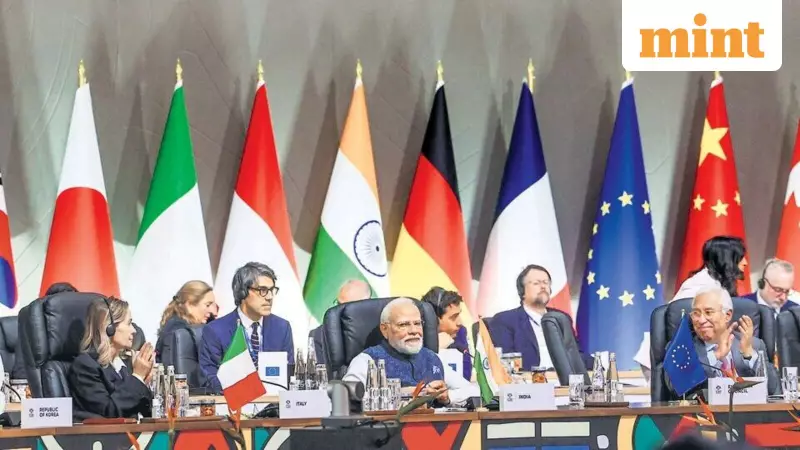
Throughout the year, India amplified its voice as a champion of the Global South. It pushed for reforms in international financial institutions, highlighted debt distress, and advocated for equitable climate action frameworks. At the G20 Summit in South Africa in November, PM Modi underscored the growing threat of narcotics like fentanyl, proposing a G20 Initiative to counter the drug-terror nexus.
Technology emerged as a key strategic pillar, with cooperation in semiconductors and AI gaining prominence. Climate diplomacy focused on balancing development with global commitments, a point emphasized by Union Environment Minister Bhupender Yadav at the UN COP30 summit.

The Road Ahead: Influence Without Alignment
As 2025 concluded, India's foreign policy reflected a nation skillfully navigating a fractured world order. The approach underscored a determination to influence global outcomes without formal alignment, achieve growth without overdependence, and exercise leadership without overreach. Amidst widespread uncertainty, New Delhi positioned itself as a confident, yet invariably cautious, power poised to protect its interests while shaping the evolving international system.





