

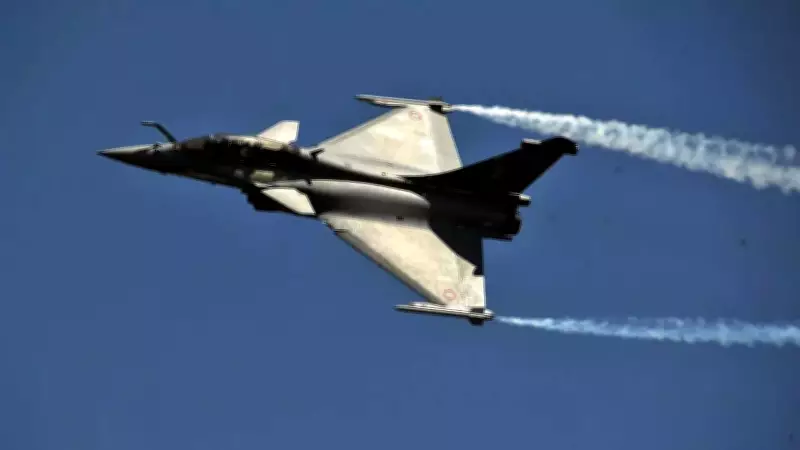
India's Defence Acquisition Council Greenlights Major Missile Procurements
The Defence Acquisition Council (DAC) has granted approval for the acquisition of long-range SCALP missiles for Rafale fighter jets and additional missiles for the Russia-made S400 aerial defense system, according to a government source. This decision comes as India continues to strengthen its defense capabilities with strategic weapon systems.
Rafale Manufacturing Milestone and Delivery Timeline
Defence Secretary Rajesh Kumar Singh announced on Friday that this marks the first time French fighter jets will be manufactured outside France. The delivery of 114 Rafale jets to India is scheduled to commence from 2028 onwards, beginning with naval variants followed by Indian Air Force variants. This follows the DAC's approval for the purchase of these advanced aircraft.
Strategic Capabilities of SCALP and S400 Systems
The 250-kilometer range SCALP air-launched cruise missiles are designed for deep-penetration attacks and were previously deployed by Rafale jets during Operation Sindoor to target terror headquarters of Jaish-e-Mohammed and Lashkar-e-Taiba in Pakistan's Muridke and Bahawalpur districts. These sophisticated missiles utilize a combination of inertial navigation, GPS, terrain-reference navigation, and an infrared imaging seeker in the terminal phase, enabling pinpoint accuracy against Pakistan's terror and military bases.

Meanwhile, missiles of the S400 system have demonstrated their effectiveness by thwarting aerial attacks, including cruise missiles from Pakistan in May of last year. The additional missiles approved will further enhance India's aerial defense capabilities.
Government-to-Government Deal with Full Transparency
Defence Secretary Singh emphasized that the acquisition of 114 Rafale jets will be a government-to-government deal with no intermediaries, ensuring full transparency throughout the project. Crucially, India will have complete authority to integrate Indian weapons and systems into the aircraft, addressing previous limitations.
In earlier French deals for 36 Rafale jets and 26 marine Rafales, the French government did not provide India with the critical source code for the aircraft's radar and weapon systems. This restriction limited India's ability to independently integrate indigenous missiles like the Astra and perform unilateral upgrades, necessitating reliance on French firms for future improvements. However, Singh clarified that for the 114 Rafale jets, India will not face any source code problems and will have full integration authority.
Clarifications on Manufacturing Partnerships
Despite previous reports mentioning a "Dassault-HAL collaboration" for Rafale jet production, Hindustan Aeronautics Limited (HAL) has clarified that it has not received any communication from either the defence ministry or Dassault regarding local production. Dassault Aviation will need to make a decision regarding its India partner for this significant manufacturing initiative.
French Industry Commitment to Indian Production
In Paris, French engine manufacturer Safran's CEO Olivier Andries announced on Friday that the company is prepared to establish an engine assembly line in India to meet the country's requirements for local production. This development comes as Indian and French governments prepare to discuss the purchase of 114 additional Rafale jets during President Emmanuel Macron's upcoming visit.
Safran, which manufactures M-88 engines for Dassault Aviation's Rafale jets, has also committed to purchasing parts from local suppliers, thereby supporting the growth of India's aerospace industry and contributing to the "Make in India" initiative in the defense sector.






