

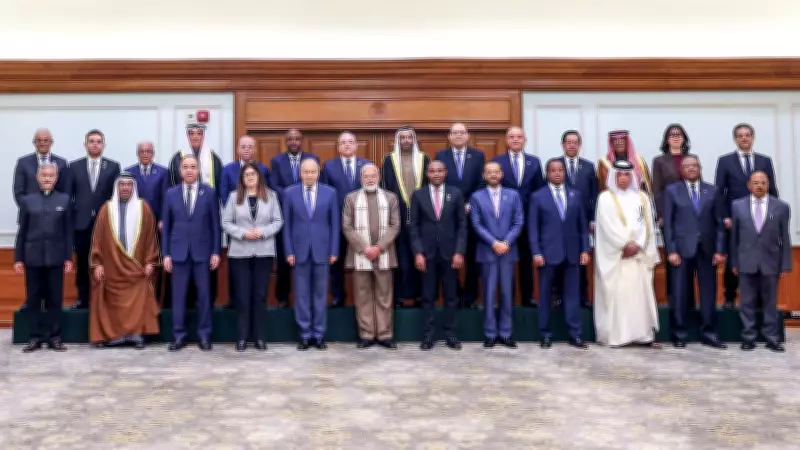
Prime Minister Narendra Modi on Saturday met with a high-level delegation of Arab leaders in New Delhi, reaffirming India's steadfast support for the people of Palestine and endorsing ongoing peace initiatives, including the Gaza peace plan. The meeting, part of the second India-Arab Foreign Ministers' Meeting (FMM), highlighted the deepening ties between India and the Arab world, described by Modi as an 'extended neighbourhood' with strong civilisational and brotherly bonds.
Modi's Message of Solidarity and Cooperation
In a statement following the meeting, Modi expressed appreciation for the Arab League's role in promoting regional peace and stability. He emphasized that enhanced cooperation in areas such as technology, energy, trade, and innovation would unlock new opportunities and elevate the partnership to greater heights. Modi's remarks come amid global discussions on the Gaza peace plan, with India yet to decide on its involvement in initiatives like the US-proposed Gaza Peace Board.
Jaishankar's Focus on Peace and Security
External Affairs Minister S Jaishankar, speaking at the ministerial meeting, underscored the importance of advancing a comprehensive peace plan based on UN Security Council Resolution 2803 to resolve the Gaza conflict. He noted that multiple significant developments in the Middle East have had far-reaching impacts, necessitating strengthened efforts towards stability, peace, and prosperity.

Jaishankar also addressed the critical issue of terrorism, calling for unified global action. He stated, 'Cross-border terrorism is particularly unacceptable as it violates fundamental principles of international relations.' This comment was widely interpreted as a pointed reference to Pakistan, emphasizing India's zero-tolerance stance on terrorism and the right of affected societies to defend themselves.
Strengthening Bilateral and Regional Ties
The India-Arab FMM, co-chaired by India and the UAE, serves as the highest institutional mechanism for this partnership, formalized in March 2002. India holds Observer status in the League of Arab States, a pan-Arab body comprising 22 member nations. The meeting saw participation from all Arab countries, including Foreign Ministers from Oman, Palestine, Sudan, Comoros, Somalia, and Libya, with other nations represented by deputy ministers and senior diplomats.
Jaishankar highlighted the multifaceted nature of India-Arab relations, noting strong partnerships in expatriate communities, energy sources, trade, and emerging technology initiatives. He added that shared interests in food and health security further cement this crucial relationship, with the discussions expected to boost bilateral ties across various sectors.
Navigating a Transforming Global Landscape
Reflecting on the geopolitical environment, Jaishankar remarked that the global order is undergoing significant transformation due to political, economic, technological, and demographic shifts. He emphasized that these changes are particularly evident in West Asia, impacting India as a proximate region and influencing its relations with Arab nations. India's evolving capacities in technology and people-centric applications were also discussed as areas for mutual benefit through experience sharing.
This high-level engagement underscores India's proactive diplomacy in fostering regional peace and addressing global challenges, while reinforcing its commitment to a stable and prosperous partnership with the Arab world.






