

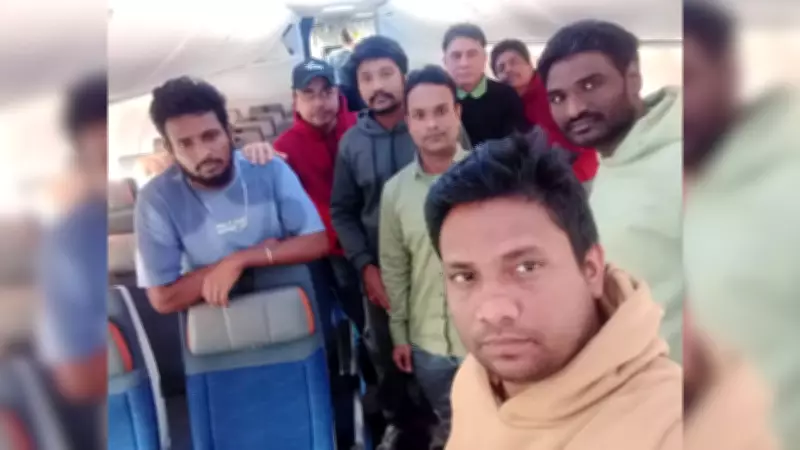
Indian Sailors Stranded in Iran Since December Finally Return Home to Mumbai
After a long and anxious wait, the families of eight Indian sailors stranded in Iran since last December breathed a collective sigh of relief on Sunday morning. All eight sailors have safely reached Mumbai, concluding a difficult journey across a conflict-hit region that tested their resilience and endurance.
Emotional Reunions and Family Relief
For Mukesh Mehta, a resident of Ghaziabad's DLF Colony, the moment brought immense relief, though the physical reunion is still a day away. His son, Ketan Mehta, is among the eight sailors who have finally returned to home soil after months of uncertainty, detention, and a perilous evacuation.
Ketan, 27, managed to speak to his father through a borrowed phone. "Ketan called me and said, 'Papa, we are finally in India'. We had been waiting to hear these words from him for a long time," Mukesh shared. Ketan's phone was confiscated by Iranian authorities when their ship was seized on December 8, leaving his family, including his mother and two sisters, in a state of constant worry, hoping for any sign of his safety.

The Ordeal of Detention and Release
The sailors' return follows a tumultuous ordeal that began with their capture and imprisonment, leading to eventual release through diplomatic intervention. Ketan was part of the crew of the oil tanker MT Valiant Roar, which was intercepted in international waters near the port of Dibba in the UAE and taken to Iran on December 8. The vessel had 18 crew members on board, including 16 Indians, one Sri Lankan, and one Bangladeshi.
Iranian authorities later split the team, moving 10 to Bandar Abbas prison, where Ketan was lodged, while eight were kept confined on the ship. The authorities alleged that the vessel was involved in smuggling around 6,000 tonnes of fuel, a claim strongly contested by the families and crew representatives. They maintained that the tanker was carrying only very low sulphur fuel oil (VLSFO), which is standard, legally loaded cargo.
Captain's Perspective and Mental Toll
Vijay Kumar, 40, the captain of the ship, was also among those who returned. His family resides in Meerut. Speaking from Mumbai on Sunday, Vijay described the ordeal as taking a significant toll on their mental and physical wellbeing. "It has been a long and tiring journey. We will only be arriving in Delhi after completing all formalities on Monday night. After that, we will head to our respective homes and finally meet our families," he said.
Vijay likened the last three months to a "movie," filled with action, emotion, and reaction. "We faced gunshots, missiles, and bombs. When the war began, just a day before we were going to be evacuated, it felt like a dead end. But finally, we are happy to be back in our country," he recounted.
Diplomatic Efforts and Evacuation Challenges
After intervention by the Indian embassy, eight crew members were released on February 3 and returned to India on February 11. Of the 10, five were imprisoned and five were on the vessel, with no official word from Iran on this split. A second breakthrough came on February 27, when Iranian agencies released the five Indian sailors lodged in the prison. They were shifted to a hotel while documents for their return were being processed.
However, the conflict escalated the very next day, derailing evacuation plans and snapping communication. After unsuccessfully waiting for the war to stop, the Indian embassy advised the sailors to travel to Armenia by road from Bandar Abbas. Their journey began on the evening of March 22.
Perilous Journey Through Conflict Zones
After reaching the Iran-Armenia border on March 24 following a 2,000-km road journey, the group had to wait two more days before they could cross over. They remained on the Iranian side during this period, staying at a hotel near the border while exit and entry formalities were completed. It was only on March 26 that they received Armenian visas and were finally able to cross into Armenia.

On March 27, the sailors travelled to the capital, Yerevan, and reached Zvartnots International Airport. The next day, they boarded a flight to Dubai, from where they took a connecting flight to India, landing in Mumbai on Sunday morning. The final leg of their journey—the road trip out of Iran—came amid active hostilities, with the sailors travelling through a war-hit landscape marked by checkpoints, restricted movement, and the constant threat of airstrikes.
Family Support and Legal Efforts
Like Ketan's family, Vijay's relatives have also been on edge, waiting to find out his whereabouts. His cousin, Vinod Kumar, a Noida-based Merchant Navy officer, was among the petitioners who moved the Delhi High Court in January seeking urgent consular access and repatriation. "Vijay's elderly parents, his wife, Siniya, and children—a 10-year-old son and 14-year-old daughter—in Meerut had been worried sick for the last three months. The only hope was that he remained in intermittent contact with us over the phone. Now that they have reached India, the family cannot wait to see him," Vinod said.
Formalities and Future Steps
The sailors met with the Forward Sailors Union of India on Sunday and will meet the director general of shipping in Mumbai as part of formalities before heading home. The sailors who have arrived include Captain Vijay Kumar from Meerut, Anil Kumar Singh from Uttar Pradesh, Satish Kumar from Haryana, Ketan Mehta from Ghaziabad, Masood Alam from Bihar, and Nandiki Venkatesh, Jammu Venkatrao, and Rajshekhar Dunga from Andhra Pradesh.
This harrowing experience underscores the challenges faced by seafarers in conflict zones and highlights the critical role of diplomatic efforts in ensuring their safe return. As the sailors prepare to reunite with their loved ones, their journey serves as a testament to resilience and hope amidst adversity.





