As 2025 draws to a close, India's foreign policy landscape appears defined by a strategic recalibration aimed at asserting autonomy while navigating unprecedented turbulence. The year was marked by a potent mix of diplomatic outreach, successful trade negotiations, and significant strains in its immediate neighbourhood and with key partners.
Trade and Tariffs: Navigating Protectionism and Seizing Opportunities
Despite facing steep US tariffs of up to 50% imposed in August, India stood firm on its core interests and aggressively pursued alternative free trade agreements (FTAs). This strategy yielded substantial results, diversifying economic partnerships and mitigating risks.
In a significant move, India and the UK signed the Comprehensive Economic and Trade Agreement (CETA) in July 2025. This pact granted India duty-free access for most exports to the UK, a crucial relief for labour-intensive sectors like textiles, leather, and gems hit hard by the US tariffs. India, in turn, reduced its average duties on British goods from about 15% to just 3%.

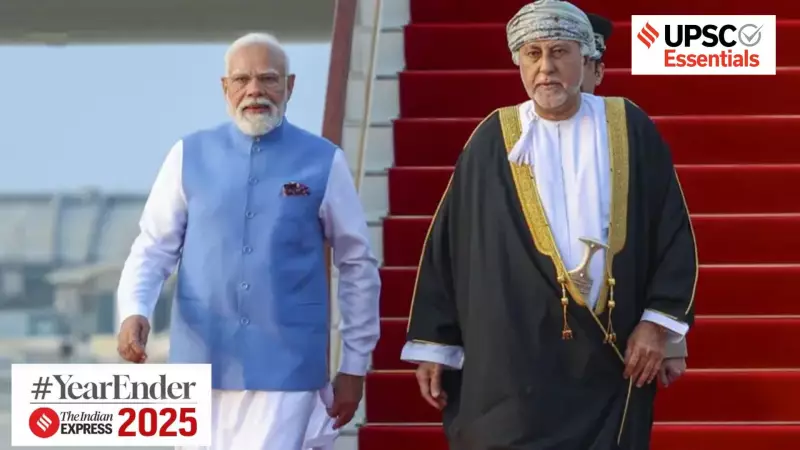
The year also saw the implementation of the trade deal with the four-nation European Free Trade Association (EFTA) in October, promising $100 billion in investments and 1 million jobs over 15 years. As the year ended, India concluded negotiations with New Zealand and signed a pivotal Comprehensive Economic Partnership Agreement (CEPA) with Oman in December. The Oman deal offers India zero-duty access on 98% of Omani tariff lines, boosting industrial exports and opening doors for its service sector.
While negotiations with the EU, Canada, and the US continue into 2026, the prospects for an India-US trade pact appear stronger following recent high-level talks. However, tensions persist, especially after the US lowered tariffs on China in November, making India the hardest-hit nation by American protectionist measures.
Diplomatic Gains and Strategic Outreach
Amid global upheavals, India worked to consolidate its strategic footprint. Prime Minister Narendra Modi's December tour to Jordan, Ethiopia, and Oman underscored this push into West Asia and the Horn of Africa. External Affairs Minister S. Jaishankar's visit to Israel further highlighted India's ability to maintain partnerships across regional divides.
Other diplomatic successes included a reset in strained ties with Canada and a strategic recalibration of policy towards Afghanistan, where India upgraded its Technical Mission in Kabul to a full-fledged embassy. The first G20 Leaders' Summit hosted by South Africa also marked a milestone, with the Global South setting the agenda on climate, debt relief, and inequality, continuing a leadership sequence from India (2023) through Brazil (2024).
Turbulence in the Neighbourhood and Beyond
The year witnessed serious security challenges. A four-night military confrontation with Pakistan in May 2025 raised fears of a wider conflict, following a terror attack in Jammu and Kashmir's Pahalgam. Although a ceasefire was agreed on May 10, the incident severely strained relations.
Subsequently, growing US-Pakistan bonhomie, including a trade deal and a defence agreement between Saudi Arabia and Pakistan, emerged as significant strategic irritants for New Delhi. Relations with Bangladesh also dipped further following political changes in Dhaka and cross-border tensions, leading to a tit-for-tat summoning of envoys in December.
In West Asia, the 12-day war between Israel and Iran in June (Operation Rising Lion) and the ongoing volatility threatened India's key interests, including regional connectivity projects like the India-Middle East-Europe Economic Corridor (IMEC) and the safety of its expatriate community. While a US-brokered ceasefire took hold and a Trump-led Gaza peace plan showed tenuous hold, the region's instability prompted India to deepen its engagements.
Overall, 2025 was a year where India demonstrated agility in trade diplomacy and strategic outreach while confronting persistent and new security dilemmas in an increasingly multipolar and unpredictable world.