

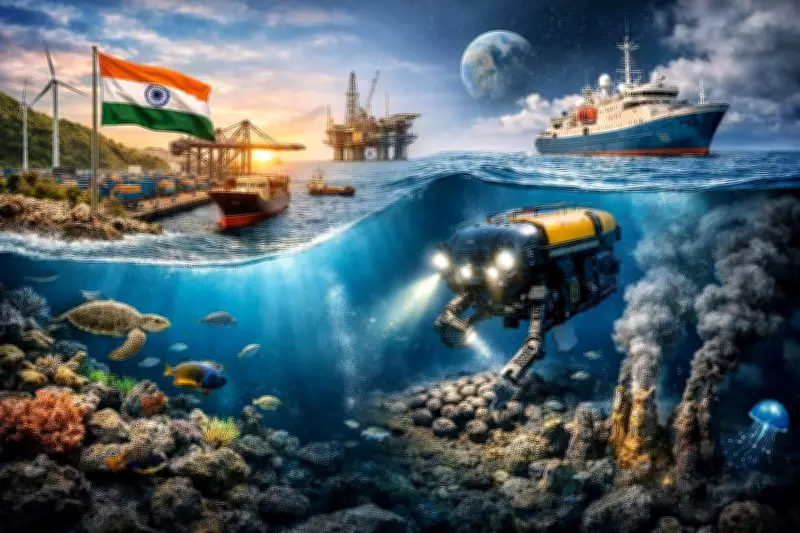
India's Blue Economy: The Next Frontier for Growth
The Blue Economy represents the sustainable utilization of ocean resources to drive economic growth, enhance livelihoods, and create employment while safeguarding marine ecosystem health. For India, with an extensive coastline exceeding 7,500 kilometers and an Exclusive Economic Zone (EEZ) spanning approximately 2.37 million square kilometers, this concept holds transformative potential to reshape the nation's economic landscape.
Why the Blue Economy Matters for India
Economic Growth Engine: India's coastal economy already makes a significant contribution to GDP through sectors such as ports, shipping, fisheries, and tourism. Expansion into deep-sea mining and offshore energy could unlock vast untapped wealth, including polymetallic nodules rich in critical minerals like nickel, cobalt, and rare earth elements.
Employment Generation: Millions of individuals rely on fisheries and coastal activities for their livelihoods. A sustainable Blue Economy has the capacity to generate new jobs in logistics, marine research, eco-tourism, and offshore infrastructure development.

Energy Security: Offshore wind, tidal, and wave energy offer renewable alternatives to traditional fossil fuels. With India's rising energy demands, harnessing ocean-based resources can reduce dependence on imported energy and enhance national security.
Strategic and Geopolitical Importance: Strengthening maritime capabilities bolsters India's position in the Indian Ocean Region (IOR), enabling it to counter rival influences and secure vital sea lanes of communication (SLOCs) for global trade.
Deep-Sea Resources: An Untapped Treasure
Deep-sea resources encompass polymetallic nodules, hydrothermal sulphides, and cobalt-rich crusts. India has been allocated exploration rights in the Central Indian Ocean Basin and is actively investing in advanced technologies to mine at depths reaching 6,000 meters. However, harnessing these resources presents formidable challenges.
Major Geographical Challenges in Deep-Sea Resource Exploitation
- Extreme Oceanic Conditions: The deep sea is characterized by high pressure (up to 1,000 times atmospheric pressure), near-freezing temperatures, and complete darkness, making exploration and extraction technologically demanding and costly.
- Technological Limitations: India is still in the process of developing indigenous deep-sea mining technologies. Dependence on advanced robotics, remotely operated vehicles (ROVs), and submersibles increases expenses and delays scalability.
- Remoteness and Accessibility: Deep-sea resource zones are often located thousands of kilometers offshore, complicating logistics, transportation, and continuous monitoring efforts.
- Geological Uncertainty: Accurately mapping the seabed remains a challenge, with resource estimates being uncertain and uneven distribution making commercial viability difficult to assess.
Environmental Challenges: Sustainability at Stake
Fragile Marine Ecosystems: Deep-sea ecosystems are among the least understood on Earth. Mining activities can destroy habitats, disrupt biodiversity, and cause irreversible ecological damage, with recovery potentially taking centuries.
Sediment Plumes and Pollution: Mining operations generate sediment clouds that reduce water quality, affect marine organisms including fish stocks, and spread pollutants across extensive areas.
Climate Change Linkages: Oceans serve as critical carbon sinks. Disturbing seabeds may release stored carbon, exacerbating global climate change impacts.
Regulatory and Governance Gaps: Global frameworks like the International Seabed Authority (ISA) are still evolving, and a lack of clear environmental safeguards poses risks of unregulated exploitation.

Balancing Growth with Sustainability
India must adopt a cautious and calibrated approach to ensure sustainable development. Key strategies include investing in green technologies for deep-sea exploration, strengthening marine spatial planning, enhancing scientific research and data collection, promoting international cooperation, and ensuring strict environmental impact assessments (EIAs). The focus should be on fostering a sustainable Blue Economy rather than pursuing extractive exploitation.
Way Forward: Strategic Policy Imperatives
- Accelerate the Deep Ocean Mission with a focus on indigenous innovation.
- Build coastal infrastructure under the Sagarmala initiative while incorporating ecological safeguards.
- Encourage public-private partnerships (PPPs) in marine sectors to leverage expertise and investment.
- Develop skilled human resources in ocean sciences through education and training programs.
- Strengthen coastal community participation to ensure inclusive growth and local support.
Why This Topic Matters for Civil Services Aspirants
For General Studies (GS) papers, understanding the Blue Economy is crucial. GS Paper 1 covers geography topics like ocean resources and marine ecosystems, while GS Paper 3 addresses economy (resource utilization), environment (sustainability), science and technology (deep-sea tech), and security (maritime strategy). For the Essay Paper, themes such as sustainable development versus economic growth, oceans as the future of the global economy, and technology and environmental ethics are highly relevant. Grasping these concepts enables aspirants to present multi-dimensional, analytical, and contemporary arguments essential for high-scoring answers.
Probable UPSC Mains questions include: "The Blue Economy presents immense opportunities for India's growth, but its sustainability remains a concern." Discuss in the context of deep-sea resource exploitation. and Examine the geographical and environmental challenges associated with deep-sea mining. How can India address these challenges while ensuring sustainable development?





