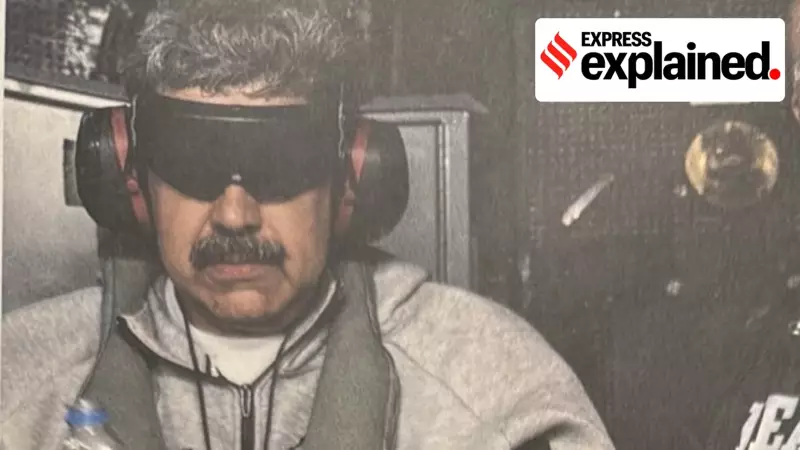
The dramatic announcement by former US President Donald Trump that American forces had attacked Venezuela and captured its President, Nicolas Maduro, has placed India in a complex diplomatic position. The unilateral move by Washington directly challenges New Delhi's longstanding advocacy for a rules-based international order and the principle of non-intervention in sovereign states.
A Clash of Principles and Pragmatism
India, typically conservative in commenting on distant geopolitical issues, finds itself in a bind. Many nations in the Global South are looking towards New Delhi to underscore the critical importance of respecting international law. The US action sets a concerning precedent of foreign military intervention in a country's internal affairs, a principle India has historically opposed.
This dilemma is amplified by India's ongoing negotiations with the United States on a bilateral trade deal. These talks follow Trump's imposition of 50% tariffs, which included a 25% penalty specifically targeting India's purchase of Russian oil. New Delhi has been reducing these imports, though it feels singled out, as similar actions were not taken against China or Europe for their Russian oil purchases.

The Fading Economic Link with Caracas
India's direct political stakes in Venezuela are relatively low, but the two nations share a robust history of energy trade. Bilateral trade peaked at USD 6,397 million in 2019-20, with Indian imports, primarily oil, accounting for USD 6,057 million of that total.
However, US sanctions on Venezuela's oil sector forced India to drastically curtail imports. The trade figures tell a clear story of decline:
- 2020-21: USD 1,271 million (Indian imports: USD 714 million)
- 2021-22: USD 424 million (Indian imports: USD 89 million)
- 2022-23: USD 431 million (Indian imports: USD 253 million)
The political relationship saw its high point in March 2005 when then-President Hugo Chavez paid a state visit to India, holding talks with Prime Minister Manmohan Singh. Nicolas Maduro visited New Delhi as Foreign Minister in August 2012. Following Chavez's death in March 2013, the UPA government sent then Minister of State Sachin Pilot to the state funeral, where he met Maduro.
Engagements continued after 2014, with meetings between External Affairs Ministers Sushma Swaraj and S. Jaishankar and their Venezuelan counterparts on various multilateral sidelines. A significant visit occurred in August 2023, when Venezuelan Executive Vice President Delcy Rodriguez led a delegation to the CII-LAC Conclave in India.
Global Reactions and India's Cautious Stance
The international response has been mixed. Russia was the first to condemn the US, labeling it an "act of armed aggression." The European Union urged respect for international law but stopped short of outright condemnation. Latin American leaders like Chile's Gabriel Boric and Colombia's Gustavo Petro expressed concern and condemnation.
In response to the instability, India's Ministry of External Affairs issued a security advisory on Saturday. It strongly urged Indians to avoid all non-essential travel to Venezuela and advised those already in the country to exercise extreme caution, restrict movements, and stay in touch with the Indian Embassy in Caracas.
The Indian community in Venezuela is minuscule, with embassy records showing fewer than 100 individuals (approximately 50 NRIs and 30 PIOs), further underscoring the limited direct stakes.
For India, the core issue transcends its specific ties with Caracas. The US intervention resurrects fears of overseas adventurism and strikes at the heart of the UN Charter's principles. Observing the cautious or silent responses from other major G-20 powers, New Delhi is carefully weighing its statement, grappling with the dilemma of defending the international order in the face of a violation by a key strategic partner. The moral and strategic dilemma, therefore, remains high, even if the immediate political and economic stakes are not.