

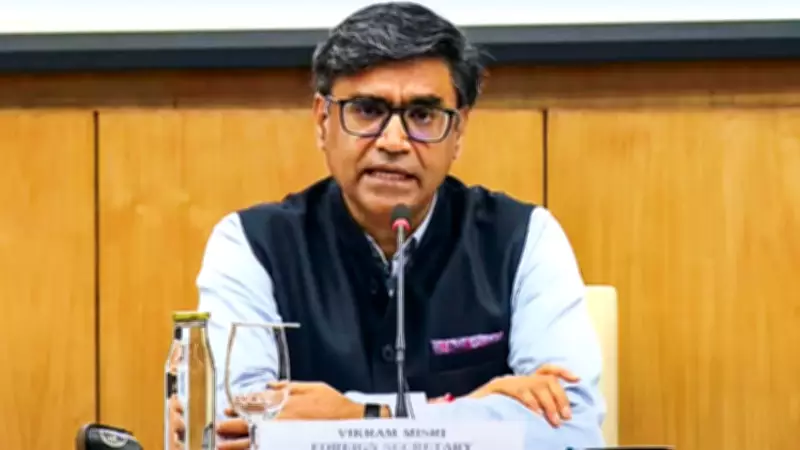
National Interest to Dictate India's Energy Sourcing Strategy, Affirms Foreign Secretary
In a significant statement addressing global energy dynamics, Foreign Secretary Vikram Misri declared that India's approach to sourcing energy will be firmly rooted in national interest. This remark comes shortly after the release of an interim trade framework between India and the United States, where the US asserted that New Delhi has pledged to reduce direct and indirect imports of Russian oil.
First Official Comment from Ministry of External Affairs
This announcement marks the first definitive comment from the Ministry of External Affairs on the highly debated issue of energy sourcing. Previously, Union Commerce Minister Piyush Goyal had deferred questions about India's potential halt on Russian oil purchases to the MEA, highlighting the sensitivity of the matter.
During a press briefing, when queried about Russian oil imports, Misri underscored the principle of diversification, stating, "the more diversified we are, the more secure we are." He did not explicitly confirm or deny whether India would cease importing Russian oil, a topic that has gained urgency following US President Donald Trump's executive order. This order lifted a 25% penalty tariff on India while cautioning against punitive measures if Russian oil purchases continue.

Economic Imperatives and Consumer Protection
Elaborating on India's position, Misri highlighted the country's status as a net importer in the oil and gas sector. "We are a developing economy; we have to be conscious about our resource availability. Naturally, when you are dependent to the extent of 80-85% on an imported resource, you have to have concerns about the possibility of inflation driven by energy costs," he explained.
He emphasized that the government's top priority is to safeguard the interests of Indian consumers by ensuring they receive adequate energy at fair prices through reliable and secure supplies. This focus on affordability and stability is central to India's energy policy framework.
US Claims and Monitoring Mechanisms
Trump's executive order outlined that India has "committed to stop directly or indirectly importing Russian Federation oil" and will purchase US energy products while expanding defense cooperation over the next decade. The penalty tariff was withdrawn effective February 7, 2026, but the order established a monitoring mechanism to track any resumption of Russian oil imports by India, with potential punitive actions in the future.
Misri addressed the broader context, noting, "In recent years, the global economy has faced significant uncertainties which have had a major impact on the stability of global energy markets." He pointed out that India, as one of the largest energy consumers, plays a crucial role as a stabilizing factor in these markets.
Diversification as a Core Strategy
The Foreign Secretary detailed India's strategy of importing crude oil from dozens of countries to mitigate risks. "That's one reason why we import energy from multiple sources… the key drivers of our energy policy are adequate availability, fair pricing and reliability of supply. So, we import crude oil from dozens of countries," he said, adding that India is not dependent on any single source and does not intend to be.
He explained that the mix of energy sources naturally varies based on objective market conditions, and India's approach is to maintain and diversify multiple supply sources to ensure stability. "Therefore, I would say that the more diversified we are in this area, the more secure we are," Misri reiterated.
Role of Oil Companies and Market Dynamics
Misri clarified that actual sourcing decisions are made by oil companies, both public and private sector entities, based on market conditions. "So, there is a rather complex matrix of issues that these companies have to take into account, which—not to disregard it—also includes very, very important financial and logistical aspects," he noted.
In conclusion, he affirmed, "I can firmly and confidently say that whether it is the government or indeed our business, at the end of the day, national interests will be the guiding factor for us in our choices."

Recent Trends in Russian Oil Imports
Recent data indicates a decline in India's Russian oil imports, dropping to a three-year low of 1.16 million barrels per day in January 2026 from a peak of 2.09 million bpd in June 2025, according to commodity market analytics firm Kpler. This reduction follows US sanctions against Russian oil producers Rosneft and Lukoil, reflecting the complex interplay of global sanctions and market adjustments in India's energy procurement.





