

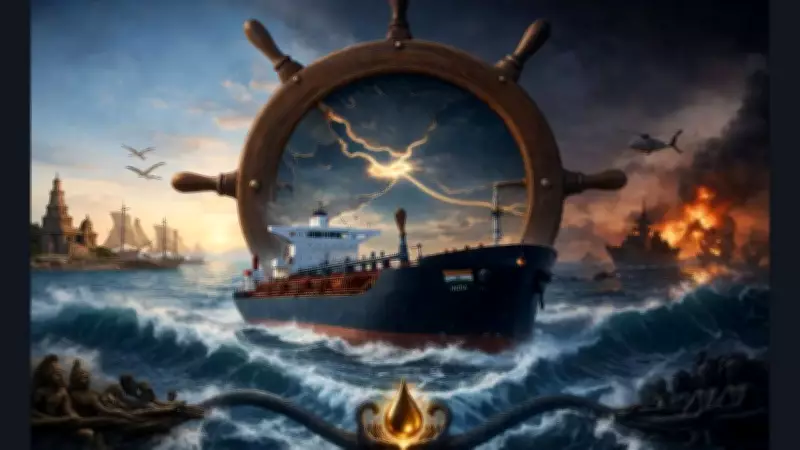
India's Maritime Lifeline: Navigating Global Turbulence on National Maritime Day
On National Maritime Day, India traditionally pauses to commemorate the historic voyage of its first modern merchant ship and celebrate a seafaring legacy that dates back to ancient civilizations. While pride often takes center stage, this year's observance invites a deeper examination of the turbulent seas that sustain the nation's economy. The global maritime landscape is undergoing a profound churn, reminiscent of a modern samudra manthan, where risks and opportunities surface simultaneously, testing national responses with unprecedented urgency.
The Invisible Economic Heartbeat
India's economic vitality largely operates unseen, not through bustling stock exchanges or policy corridors, but across vast, restless oceans where ships silently traverse continents. However, when conflicts erupt in critical chokepoints like the Strait of Hormuz, this invisible system becomes starkly visible as a national vulnerability. Ongoing tensions have forced India to confront a long-managed reality: its growth, energy security, and strategic autonomy are intricately tied to sea lanes passing through some of the world's most volatile regions.
The Strait of Hormuz: A Narrow Artery for a Giant Economy
The Strait of Hormuz is far from an ordinary maritime passage; it serves as a vital artery through which nearly one-fifth of the world's oil flows. For India, its significance is even more acute, with approximately 80 percent of the country's energy imports traversing this corridor. This makes it a single point of failure for one of the globe's largest energy consumers. Recent escalations involving Iran, Israel, and the United States have vividly demonstrated how swiftly this artery can constrict, leading to slowed tanker traffic, stranded vessels, and surging insurance costs.

The numbers underscore India's exposure: the nation imports over 85 percent of its crude oil and a significant portion of its natural gas, with nearly half of that crude and over 60 percent of LNG and LPG historically moving through Hormuz. Disruptions here trigger a cascade of systemic issues, including rising inflation, a weakening rupee, and increased industrial costs, highlighting that this is not merely an energy concern but a broader economic challenge.
Operation Sankalp and Naval Vigilance
In response to escalating tensions, India has deployed diplomatic efforts alongside military presence. Under Operation Sankalp, Indian naval warships maintain a constant vigil in the Gulf region, escorting merchant vessels and ensuring safe passage through high-risk waters. At any given time, dozens of Indian seafarers and vessels operate in and around the Persian Gulf, with several India-bound ships carrying crude oil and LPG recently stranded or forced to alter routes.
The deployment of advanced warships like INS Surat reflects a strategic shift in India's maritime posture, moving beyond coastal defense to protecting sea lines of communication stretching from the Gulf of Aden to the western Pacific. This role involves deterring threats ranging from missile strikes to drone attacks, providing a crucial security umbrella for economic lifelines.
Trade and Ports: The Maritime Backbone
Energy is just one facet of India's maritime dependence; nearly 95 percent of the country's trade by volume moves by sea, encompassing crude oil, LNG, coal, fertilizers, and electronics. While the Strait of Hormuz is central, other chokepoints like the Red Sea and Suez Canal also pose vulnerabilities, forcing ships onto longer routes around the Cape of Good Hope and increasing costs and delays.
India's coastline, spanning over 7,500 kilometers, hosts a network of major and minor ports that serve as gateways to global trade. Ports such as Mumbai, Kandla, Visakhapatnam, Chennai, and Kochi handle millions of tonnes of cargo annually, each specializing in different commodities. Western ports like Kandla and Mumbai manage large volumes of crude oil and petroleum products, while eastern ports such as Paradip and Visakhapatnam are crucial for coal and mineral exports. Southern ports like Chennai and Tuticorin play key roles in container traffic and industrial goods.

Government initiatives like Sagarmala aim to modernize ports and reduce logistics costs, enhancing efficiency but not eliminating risks from external chokepoints. This heavy reliance on imported energy and raw materials amplifies the importance of secure maritime routes for sustained economic prosperity.
Strategic Alternatives and Historical Legacy
The India-Middle-East-Europe Corridor (IMEC) has emerged as a strategic response to these vulnerabilities, combining maritime and overland routes to create an alternative pathway linking India to Europe through the Middle East. While not a complete substitute for existing sea lanes, IMEC offers redundancy, reducing dependence on traditional routes and fostering deeper economic integration with Gulf and European partners.
India's maritime story is deeply rooted in history, stretching back thousands of years to the Harappan civilization, where ports like Lothal served as hubs of international commerce. Ancient texts such as the Rigveda and Arthashastra reference ocean voyages and maritime trade administration. Successive empires, including the Mauryas, Satavahanas, and notably the Cholas, who dominated the Bay of Bengal and extended influence into Southeast Asia, further cemented India's maritime prowess.
Prime Minister Narendra Modi recently highlighted this heritage on National Maritime Day, emphasizing the sector's role in strengthening the economy, trade, and connectivity. This long history underscores that maritime activity has always been central to India's economic and strategic identity, with oceans serving as bridges rather than barriers.
From Decline to Resurgence and Future Challenges
India's maritime power declined during the colonial period but has seen a steady resurgence post-independence, with the Indian Navy evolving into a modern force capable of operating across the Indian Ocean. Initiatives like SAGAR and MAHASAGAR reflect a broader strategic vision focused on security, cooperation, and sustainable development in the region.
The Hormuz crisis highlights a shift in maritime threats, from piracy to state-level conflicts involving advanced weaponry like missiles and drones. This demands enhanced monitoring, intelligence, coordination, and international cooperation. India's response includes diversification of energy suppliers, expansion of strategic petroleum reserves, investment in alternative routes, and strengthened naval capabilities.
National Maritime Day this year carries an urgent message: the seas enabling India's rise also present significant vulnerabilities. As maritime disruptions may become more frequent, securing sea lanes is not just a naval concern but a national priority. India's journey from ancient docks to modern ports must adapt to an era of uncertainty, where resilience and strategy are key to navigating turbulent waters and ensuring economic stability.





