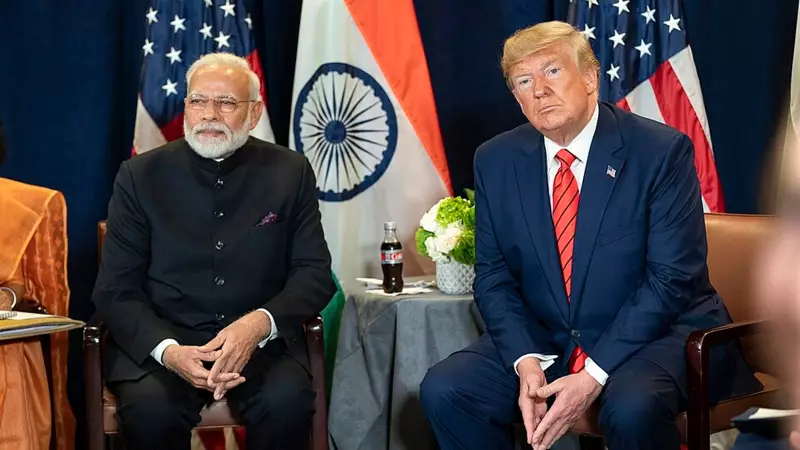
New Delhi has maintained a calculated silence following recent comments by former US President Donald Trump regarding Prime Minister Narendra Modi, choosing diplomatic restraint over a public rebuttal despite growing political pressure for a sharper response.
The Remarks That Caused Disquiet
During a recent address, Trump claimed that Prime Minister Modi approached him saying, "Sir, may I see you please." He further stated that Modi was "not that happy with me" due to tariffs Washington imposed over India's purchase of Russian oil. These tariffs, a 25% penalty, effectively raised the total tariffs on India to 50%.
Trump also made assertions about defense deals, saying India informed him it had been waiting five years for Apache helicopters and that the country had ordered 68 such aircraft. Indian government sources have directly contradicted this claim, clarifying that India has purchased only 28 Apache helicopters from the US—22 for the Indian Air Force and 6 for the Indian Army—and that all have been delivered.

Fact-Checking the Defense Deal Timeline
The record shows a more nuanced picture. The first contract for 22 Apache helicopters was signed during the Obama administration in September 2015, with deliveries completed during Trump's first term. A subsequent deal for 6 helicopters, signed during Trump's visit to India in February 2020, faced delays. These were ultimately delivered by December 2025, not January-February 2024 as suggested. The delivery timeline was reportedly part of discussions during PM Modi's visit to the White House in February 2025.
Diplomatic Counsel for Restraint
Within South Block, the diplomatic establishment has advised against issuing sharp public statements in response to Trump's comments. Sources emphasize the need for "restraint and political maturity," arguing that such reactions are often counter-productive. The prevailing view is that there is "no point in scoring points" verbally, especially while a critical India-US trade deal remains under negotiation.
"There is no need for a ball-by-ball commentary on what the US President has been saying. Instead we should be focussed on our trade negotiations and that is our priority," a senior source told The Indian Express.
This is not an isolated incident. In August 2025, Trump claimed he told Modi the US was "not going to do any deals with you" and threatened tariffs so high "your head's going to spin." He also took credit for ending the India-Pakistan conflict in May 2025—a claim Delhi has fact-checked but which hasn't stopped the former President from repeating it.
A Broader Foreign Policy Perspective
External Affairs Minister S. Jaishankar, speaking in Luxembourg, offered a broader reflection on international diplomacy that contextualizes Delhi's approach. He noted that countries far away often express worry about regional tensions but refuse to examine risks in their own neighborhoods.
"People sitting far away will say things, sometimes with application of mind, sometimes not, sometimes with self-interest, sometimes carelessly. That will happen," Jaishankar stated. He emphasized that in the current age, countries act primarily based on direct benefit to themselves.
Recalling Operation Sindoor, he noted that several countries offered India advice on how to conduct itself. India accepted this as "the way of the world" and moved forward. "People, what they say is not what they do. And we have to accept it in that spirit as well," he concluded, underscoring the pragmatic realism guiding India's external engagements.
This episode highlights the delicate balance India strikes between safeguarding national dignity and pursuing concrete strategic interests, with the ongoing trade negotiations taking clear precedence over public sparring.