

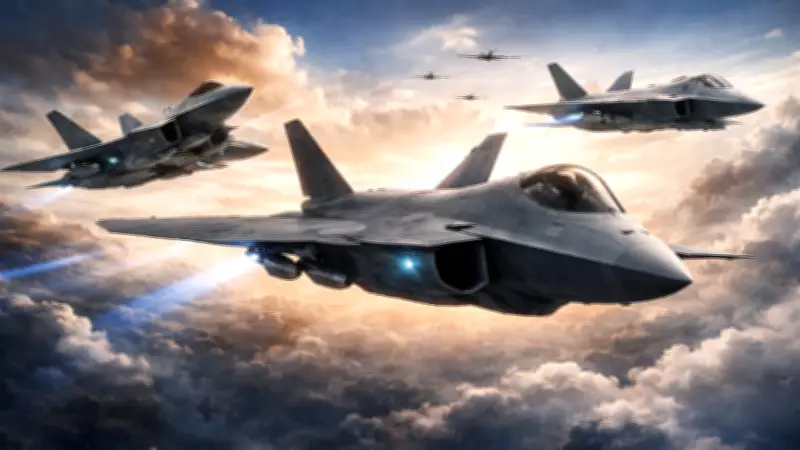
India's Strategic Leap into Sixth-Generation Air Combat Capabilities
India is strategically mapping its next major advancement in air combat capabilities, with a parliamentary committee strongly urging the government to accelerate planning for sixth-generation fighter aircraft. This push comes as global superpowers rapidly progress with their own advanced aerial platforms, creating an urgent need for India to maintain technological parity and strategic air superiority.
Parliamentary Committee Sounds Urgent Warning
The Standing Committee on Defence has presented a crucial report in the Lok Sabha, calling for a clear development "trajectory" for next-generation fighter aircraft. The committee emphasized that modern warfare is becoming increasingly air-centric, making advanced aerial capabilities essential for national security. This recommendation arrives at a critical juncture as the Indian Air Force faces dual challenges of shrinking squadron strength and intensifying regional competition.
Regional Pressures and Global Ambitions
China's simultaneous advancement in both fifth- and sixth-generation fighter programmes, combined with Pakistan's expected induction of advanced stealth jets, has significantly increased pressure on India to enhance its technological competitiveness. Against this backdrop, New Delhi is pursuing a dual-track approach: advancing the indigenous fifth-generation Advanced Medium Combat Aircraft (AMCA) programme while exploring international partnerships for sixth-generation development.

International Collaboration Opportunities
The Defence Ministry has revealed that India may join one of two major European consortia currently developing sixth-generation fighter jets. One consortium includes the United Kingdom, Italy, and Japan, while the other is led by France and Germany. This potential collaboration represents a significant shift toward a more globally integrated defence strategy.
The parliamentary committee report states: "The Committee have been informed that two consortia are working on the sixth-generation aircraft. One is a consortium of the UK, Italy, and Japan and the other is a consortium of France and Germany and both are developing aircraft." The report further notes: "The Committee have also been informed that the Air Force will try to join forces with one of the consortia and begin considering a sixth-generation fighter right away with a view to ensuring that they do not lag behind."
Strategic Shift in Defence Planning
This move reflects a broader transformation in India's defence planning philosophy, balancing indigenous capability development with strategic international partnerships. The future of air superiority is evolving beyond traditional combat power to incorporate data dominance, artificial intelligence integration, and unmanned systems coordination.
Accelerating Sixth-Generation Entry Through Partnerships
India's consideration of joining international consortia aims to fast-track its entry into sixth-generation capabilities, preventing technological lag in a domain where development cycles can span two decades. Early participation would provide India access to cutting-edge technologies including:
- Advanced propulsion systems
- Next-generation stealth design
- Network-centric warfare systems
- Artificial intelligence integration
- Loyal wingman drone technology
- Advanced sensor fusion capabilities
This collaborative approach marks a departure from earlier self-reliant models, acknowledging the immense complexity and cost associated with next-generation fighter programmes.
AMCA: India's Fifth-Generation Foundation
While sixth-generation planning gains momentum, India's immediate focus remains firmly on the AMCA programme. This indigenous fifth-generation stealth fighter features:
- Twin-engine configuration
- Advanced stealth capabilities
- Internal weapons bays
- AI-enabled systems integration
The AMCA is expected to form the backbone of the IAF's future fleet from the mid-2030s, with initial versions powered by GE-F414 engines and later variants utilizing more powerful 110–120 kN engines co-developed with international partners. The programme has received approval for full-scale engineering development, including construction of five prototypes by 2031.

Transforming Production Models
India's fighter aircraft strategy is undergoing significant structural changes, moving away from the traditional public sector-led model. For decades, Hindustan Aeronautics Limited (HAL) served as the primary manufacturer of combat aircraft. Under the new programme execution model approved by the government, private companies can now compete for AMCA development phases.
Several consortia involving major industrial players including Tata, Larsen & Toubro, and Bharat Forge have been shortlisted. This transformation aims to:
- Create a more competitive industrial ecosystem
- Reduce development delays
- Build parallel manufacturing capacity
- Address production bottlenecks
Intensifying Global Competition
India's urgency is amplified by rapid developments among global competitors. China has already showcased sixth-generation fighter prototypes featuring tailless designs with advanced propulsion and stealth characteristics. Reports indicate accelerated development cycles with new prototypes appearing within months.
The United States is progressing with its next-generation fighter programme, planning first flights before decade's end. These advanced aircraft will operate alongside unmanned "loyal wingman" drones, significantly enhancing combat capabilities.
Future Combat Capabilities
Sixth-generation fighters are expected to incorporate revolutionary capabilities beyond traditional benchmarks:
- Directed energy weapons systems
- Advanced cyber warfare integration
- Semi-autonomous operation capabilities
- Real-time decision-making systems
- Seamless multi-platform integration
The emphasis is shifting decisively toward data dominance and network-centric warfare, where information superiority becomes as critical as traditional combat power.
Current IAF Capabilities and Future Needs
The Indian Air Force currently operates a mix of fourth- and 4.5-generation aircraft including Sukhoi-30MKI, Rafale, and Tejas fighters. However, the absence of operational fifth-generation fighters underscores the critical importance of timely AMCA delivery and strategic sixth-generation planning.
India's comprehensive approach—combining indigenous development with international collaboration—represents a sophisticated response to evolving global security challenges, ensuring the nation remains at the forefront of aerial combat technology for decades to come.





