

US-Led Critical Minerals Alliance Presents India with Strategic Opportunities and Challenges
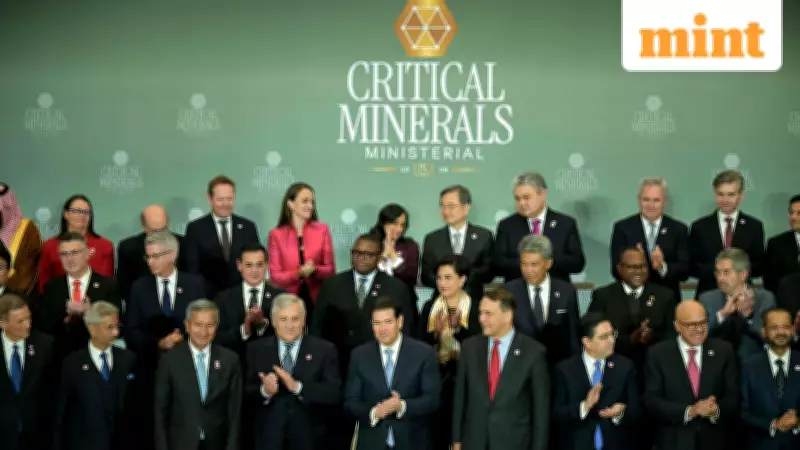
The recent Critical Minerals Ministerial Meeting in Washington D.C. has underscored how resource security has become central to contemporary geopolitics. Hosted by US Secretary of State Marco Rubio, with Vice-President J.D. Vance delivering the keynote address, the gathering brought together representatives from 54 countries and the European Commission, reflecting a growing recognition that access to critical minerals is now a strategic imperative.
China's Dominance and Global Response
At its core, the meeting responded to structural vulnerabilities in global supply chains, particularly China's overwhelming dominance in mining, processing and refining critical minerals. Beijing controls more than 60% of rare-earth production and has demonstrated willingness to weaponize export restrictions on minerals such as gallium and germanium, creating significant anxieties in Washington and allied capitals.
The Trump administration framed this challenge as a strategic liability comparable to OPEC's influence over oil markets, but with far greater implications for high-tech, clean energy and defense sectors. This reveals how deeply resource geopolitics is now intertwined with great-power competition.

Realist Recalibration of Economic Policy
The ministerial reflected a realist recalibration of economic policy. Markets left to themselves have produced outcomes favoring scale, subsidies and state action—areas where China enjoys significant advantages. As Vice-President Vance argued, the flooding of global markets with cheap Chinese minerals has hollowed out domestic production elsewhere, creating politically and strategically untenable dependencies.
Against the backdrop of rising US-China tensions and surging global demand—particularly for lithium—the meeting sought to mobilize collective action around diversification, 'friend-shoring' and supply-chain resilience.
Concrete Outcomes and Strategic Shifts
The meeting produced several significant outcomes indicating this strategic shift:
- The announcement of a $10 billion US Strategic Critical Minerals Reserve under Project Vault signaled Washington's intent to treat minerals as strategic assets rather than just commodities
- Proposals for preferential trade arrangements among allied states, including tariffs and price-stabilization mechanisms
- A proliferation of bilateral and plurilateral agreements with the EU, Japan and several emerging economies
These developments point toward a more heavily managed economic order that blends protectionist instincts with selective multilateralism.
India's Strategic Position and Opportunities
For India, represented by External Affairs Minister S. Jaishankar, the implications are particularly significant. New Delhi positioned itself as a key partner in efforts to mitigate risks arising from excessive supply-chain concentration. India's endorsement of initiatives such as the Forum on Resource, Geostrategic Engagement aligns well with its own National Critical Minerals Mission.
Given that India currently relies on China for the bulk of its critical mineral imports—especially for electric vehicles and renewable-energy technologies—the strategic logic of diversification is compelling. Closer US-India cooperation in this domain dovetails with broader strategic convergence.
India's specific opportunities include:
- Untapped reserves from lithium in Jammu and Kashmir to rare earths in Kerala
- Potential integration into allied manufacturing blocs as a manufacturing hub
- Enhanced role within the Quad framework (with the US, Japan and Australia) on mineral security
- Technology transfer, joint ventures and investment in mining and refining capacities
Challenges and Constraints for India
Despite these opportunities, India faces significant constraints and challenges:

- Limited processing capacity and long project gestation periods
- Ecological sensitivities that could slow progress
- Geopolitical risks from overt alignment with US-led mineral blocs
- Complex relationship with China, which remains India's largest trade partner and a persistent security challenge
Managing the balance between strategic autonomy and strategic alignment will test India's diplomatic agility. The country must navigate between securing critical mineral supplies and maintaining its independent foreign policy stance in an increasingly fragmented global order.
Broader Implications for Global Political Economy
The 2026 Critical Minerals Ministerial meeting highlights how the global political economy is being reshaped by resource nationalism and strategic competition. For India, it presents both an opportunity to enhance self-reliance and a challenge to navigate an increasingly fragmented order.
Whether this emerging framework delivers genuine resilience or merely reconfigures dependencies will depend on implementation, inclusivity, and the ability of participant states to reconcile security imperatives with their goals of sustainable development.
The global competition for critical minerals represents a fundamental shift in how nations approach economic security, with India positioned at a crucial crossroads between opportunity and strategic risk.





