

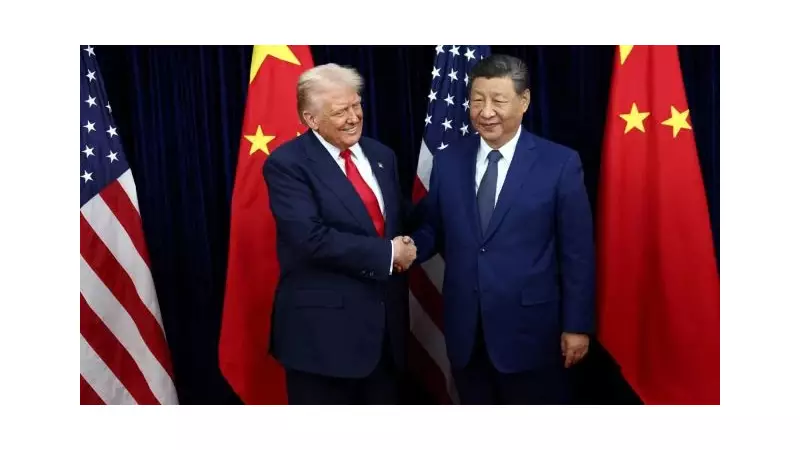
The recent encounter between US President Donald Trump and Chinese President Xi Jinping at the October 2025 APEC Summit in Busan offered more through symbolism and setting than through official declarations. This high-level meeting provides crucial insights for India as it navigates the complex currents of global geopolitics.
The Symbolism Behind the Summit
Diplomatic engagements often resemble theatrical performances, and the Trump-Xi meeting was no exception. The venue choice itself spoke volumes - Gimhae Air Base, a South Korean military facility used by American forces. For China, this location carried uncomfortable historical echoes of the Korean War, when Chinese and US forces directly confronted each other.
Beijing typically insists on visual parity in such high-profile meetings, making their agreement to this military setting particularly significant. President Trump embraced his characteristic showmanship for the cameras, while Xi Jinping appeared distant and preoccupied. Chinese state media attempted to soften the military symbolism by referring to the location simply as "Busan" and carefully cropping out military imagery from their coverage.

Concessions and Strategic Silence
The substantive outcomes followed a pattern of calculated concessions from China rather than displays of strength. China agreed to ease export controls on rare earth minerals, increase purchases of US soybeans, cooperate on controlling fentanyl precursors, and explore buying Alaskan oil. These moves represent pressure management tactics rather than signs of surrender.
More revealing was what China notably avoided discussing: Taiwan, the South China Sea, US semiconductor restrictions, and American nuclear testing. These topics form the core of Beijing's strategic concerns, yet they remained unaddressed. This strategic silence indicates China's primary objective in Busan was to buy time amid domestic challenges.
China's Domestic Pressures
The context for China's recalibrated approach lies in its internal situation. Days before the APEC summit, the Fourth Plenum of the 20th Party Congress convened in a subdued atmosphere. The country confronts multiple economic headwinds including a prolonged property market slump, substantial local government debt, youth unemployment concerns, and declining foreign investor confidence.
This represents a significant shift from China's recent assertive posture characterized by South China Sea island-building and "wolf warrior" diplomacy. Chinese officials now speak openly about needing a "favourable external environment," an unusual admission that external pressures require management.
Deng Xiaoping's Ghost Returns
There are emerging signs of a return to the principles that guided China's rise for decades under Deng Xiaoping. His famous maxim - taoguang yanghui, meaning hide your strength and bide your time - appears to be resurfacing after Xi Jinping's earlier rejection of such caution in favor of global assertiveness.
By late 2025, Beijing's tone shows traces of Deng-style pragmatism: ambition remains intact but the volume has been turned down. This recalibration manifests across three key areas:
Security: The People's Liberation Army has moderated its posture, with military exercises around Taiwan becoming shorter and more predictable. South China Sea patrols maintain presence while avoiding escalation.
Diplomacy: Chinese diplomats have adopted less combative tones, with media outlets like Global Times softening their rhetoric. Phrases like "mutual respect" and "win-win cooperation" have reappeared after being sidelined during China's confrontational phase.
Domestic Politics: The Communist Party has prioritized stability, with campaigns central to Xi's rule - including anti-corruption drives and "common prosperity" initiatives - shifting to steadier, risk-averse implementation.
India's Strategic Imperative
For India, the Busan summit offers a critical moment for introspection and strategic planning. At the concurrent ASEAN Summit, Prime Minister Narendra Modi avoided a public appearance with President Trump. While Washington might interpret this as electoral calculation and Beijing as prudence, many Indians view it as strategic restraint.

China's current pause presents both opportunity and risk for India. A China focused on domestic challenges may prove easier to engage, yet could also demonstrate heightened sensitivity. India should utilize this period to reinforce its economic, military, and technological resilience - not to emulate China's path, but to ensure it isn't caught unprepared if Beijing regains momentum.
India must deepen international partnerships while avoiding triumphalism. Public gloating rarely succeeds in Asia, where face and pride carry substantial weight. Any display of schadenfreude during China's period of introspection could harden Beijing's stance more rapidly than policy disagreements.
India learned from Doklam and Galwan that Chinese insecurity can prove more destabilizing than Chinese confidence. Maintaining open communication channels, avoiding unnecessary friction, and preparing quietly for the conclusion of China's pause represents the wiser course.
Navigating the Trump Factor
Managing relations with President Trump presents a connected challenge for Indian diplomacy. A more experienced Delhi remains wary of being utilized as a prop in American political theater. Trump values loyalty as performance and prefers spectacle, suggesting India gains little by appearing overly eager.
A steadier approach involves cultivating a firm, unsentimental partnership: sufficiently close to maintain influence, yet distant enough to avoid being drafted into someone else's rivalry. Three strategic habits matter:
Engage the broader US system beyond the White House, including Congress, the Pentagon, state governors, technology firms, and think tanks that provide continuity across administrations.
Establish boundaries early and privately. Trump often respects firmness demonstrated behind closed doors more than public praise.
Build cooperation where it serves India's long-term interests - including defense co-production, supply chain resilience, critical minerals access, and skilled mobility - without functioning as America's "China card."
The Busan meeting represents a pause rather than a settlement. Beijing acknowledged that international pushback had intensified and regrouping became necessary. Strategic quiet rarely endures indefinitely - it may lead to renewal, stagnation, or resurgence.
India should employ this interim period to reinforce guardrails, reduce potential flashpoints, and prepare for whatever version of China emerges when the quiet concludes. China's lulls seldom become permanent. The essential skill lies in discerning when silence signals genuine retreat, and when it simply represents the inhale before the dragon's next fiery exhale.





