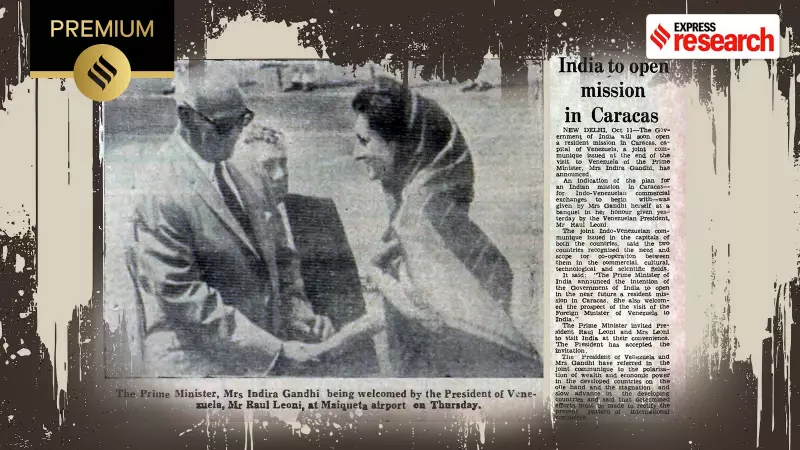
On October 10, 1968, at precisely 12:45 PM, a historic aircraft touched down at Venezuela's Simón Bolívar International Airport. On board was Prime Minister Indira Gandhi, marking the first-ever visit by an Indian head of government to the Latin American nation. Though her stay lasted a mere 18 hours, the event was a significant moment in India's post-colonial foreign policy, showcasing an effort to build bridges with nations sharing similar histories of colonial struggle.
A Warm Welcome and Broken Protocols
The atmosphere at the airport was electric with anticipation. President Raúl Leoni and his full cabinet were present to receive the Indian leader. As she disembarked, military bands played the national anthems of both India and Venezuela. According to accounts published by the Indian Embassy in Caracas, Gandhi was visibly moved to see the airport packed with Venezuelan citizens who admired India's independence struggle.
Dressed in a distinctive green saree with golden threads and wearing pearls, Gandhi immediately displayed her common touch. She requested permission to break protocol to personally accept bouquets from the waiting crowd, which included members of the Indian diaspora and local children. In another spontaneous moment, she paused her official motorcade departure to receive flowers from an Indian girl named M. Rao, daughter of a UNESCO official. The emotional send-off saw the Indian community at the airport bursting into a rendition of the Indian national anthem as her car left for the capital.
Building Bridges in Caracas
In Caracas, Gandhi's first solemn stop was the National Pantheon, where she laid a wreath at the tomb of Simón Bolívar, the liberator of Venezuela from Spanish rule. Once again, she was met by enthusiastic crowds seeking her autograph. In her speech, she articulated the mission of her visit: "I come to build bridges of love between Latin America and my country." She expressed a deep desire for closer people-to-people ties between India and Venezuela.
President Leoni, in his response, underscored the profound common ground between the two nations. He highlighted that both India and Venezuela were grappling with internal economic inequality and were determined to fight poverty and secure self-determination for their people, free from foreign interference. This shared vision of development and sovereignty formed the core of their discussions.
A Joint Vision and Lasting Legacy
The brief but impactful visit culminated in a substantive outcome. Before her departure, Gandhi and President Leoni issued a joint communique. The key announcement was the decision to establish a resident Indian mission in Caracas to boost commercial and cultural exchanges. The document recognized vast potential for cooperation in trade, technology, science, and culture.
It also critically addressed the global economic divide, pointing to the concentration of wealth in developed nations and the slow progress in the developing world. The communique called for determined efforts to reform international trade patterns—a stance that aligned with the Non-Aligned Movement's spirit.
Reflecting on her entire Latin American tour in the Lok Sabha upon her return, Gandhi noted a profound discovery. "We knew less about South America than South America knows about us," she remarked. She found the names of Mahatma Gandhi, Rabindranath Tagore, and Jawaharlal Nehru widely known and respected across the continent. She emphasized the national interest in forging close relations with the "proud and resurgent nations" of South America and the Caribbean.
Despite these promising beginnings, the vibrant connection rooted in anti-colonial solidarity has faded over the decades. Today, traces of this historical encounter linger subtly—in a primary school in a West Bengal village or a street named after Simón Bolívar in New Delhi's diplomatic enclave. Indira Gandhi's 18 hours in Venezuela remain a poignant, nearly forgotten snapshot of a time when India actively sought a shared future with post-colonial nations across the globe.