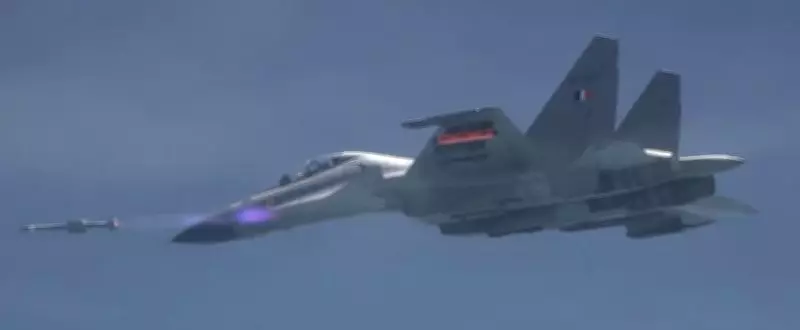
India has agreed to sell the indigenous air-launched Astra missile and additional units of the BrahMos supersonic cruise missile to Indonesia, marking Jakarta as the first export customer for the Astra system. The decisions were part of the outcome of bilateral talks between Prime Minister Narendra Modi and Indonesian President Prabowo Subianto in Jakarta on Tuesday.
Details of the Astra deal
Indonesia seeks 150 units of the Astra-Mark 1A Beyond-Visual-Range Air-to-Air Missile (BVRAAM). The missiles are already integrated onto Russian-origin Sukhoi 30 MKI fighter jets of the Indian Air Force. The Indonesian Air Force also operates a small fleet of Sukhoi jets, and the missiles can be fitted onto these aircraft using existing under-wing weapon bays. India has the technical framework to support Indonesia with aircraft-missile software and hardware integration.
The Astra Mk-1 is an all-weather, radar-guided, beyond-visual-range air-to-air missile developed indigenously by India's Defence Research and Development Organisation (DRDO) and manufactured by Bharat Dynamics Limited (BDL). Indonesia will become the very first export customer for this missile system.

Additional BrahMos missile deal
Signed alongside the Astra agreement was a deal to supply additional BrahMos supersonic cruise missiles to Indonesia. Indonesia had expressed a desire to go beyond the lone BrahMos missile battery it had wanted in March 2026, when the two sides established a preliminary procurement framework. A battery includes launchers, radars and the missiles.
India and Indonesia first discussed the sale of the BrahMos supersonic missile in November 2025 at the Defence Cooperation Dialogue hosted by Defence Minister Rajnath Singh for his Indonesian counterpart Sjafrie Sjamsoedd in New Delhi. In March 2026, Indonesian Defence Ministry spokesperson Rico Ricardo Sirait said the agreement with India on getting the missile system was a "part of the modernisation of military hardware and defence capabilities, especially in the maritime sector."
Maritime and defence cooperation framework
The Astra deal adds to the growing military and maritime collaboration between India and Indonesia. Alongside the missile agreements, the two sides signed a framework on maritime safety near the critical Strait of Malacca and a joint agreement to develop Indonesia's strategically located Sabang Port. India has proposed a 'joint defence industry cooperation committee' to collaborate in areas such as technology transfer and joint research and development. Indonesia is looking at one of its banks to finance the purchase.
BrahMos missile capabilities and export context
Sources said India and Indonesia are working on a phased procurement that would include the BrahMos missile, which can fire at targets 290 km away due to Missile Technology Control Regime (MTCR) restrictions capping the range. The BrahMos is the only supersonic cruise missile in the world that flies at three times the speed of sound. It is a product of a joint venture between India's DRDO and Russia's NPO Mashinostroyeniya, established in 1998.
India has already sold the BrahMos missile systems to the Philippines and Vietnam, both of which are involved in a running maritime territorial dispute with China in the disputed and hydrocarbon-rich South China Sea. Indonesia also has a small coast on the same sea but is not part of the dispute. The Philippines signed a BrahMos contract with India worth $375 million in 2022, with deliveries starting in 2024. It has coast-based batteries which can target ships at sea. Vietnam is reportedly looking at the missile systems, with the contract valued at approximately $620 million, including the supply of mobile coastal defence missile batteries, comprehensive operator training for Vietnamese personnel, and long-term logistics and maintenance support.
Strategic implications
The export of lethal, supersonic "fire-and-forget" systems like the BrahMos to ASEAN nations—especially those with overlapping maritime claims in the South China Sea—highlights a major shift. New Delhi is actively sharing advanced technology with regional partners to secure maritime commons and build resilient, trusted supply chains outside of traditional blocs.