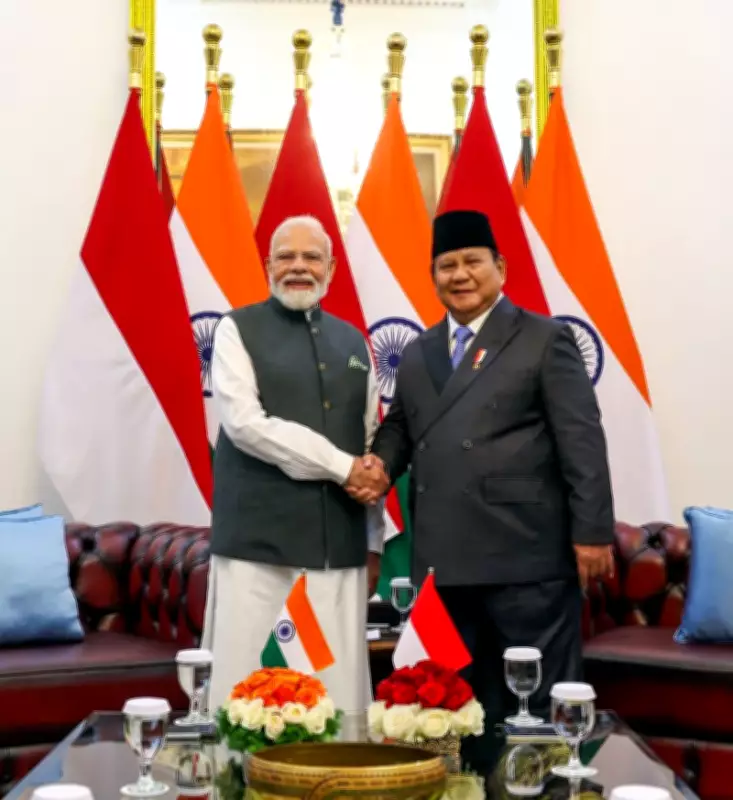
Indonesia has agreed to purchase India's indigenously developed Astra Mk-1A beyond-visual-range air-to-air missile (BVRAAM) and additional units of the BrahMos supersonic cruise missile, following bilateral talks between Prime Minister Narendra Modi and Indonesian President Prabowo Subianto in Jakarta on Tuesday.
Astra Missile Deal: First Export Customer
Indonesia seeks 150 units of the Astra Mk-1A, making it the first export customer for the missile system. The Astra Mk-1 is an all-weather, radar-guided BVRAAM developed by India's Defence Research and Development Organisation (DRDO) and manufactured by Bharat Dynamics Limited (BDL). The missile is already integrated onto the Indian Air Force's Russian-origin Sukhoi-30 MKI fighter jets. Indonesia's Air Force operates a small fleet of Sukhoi jets, and the missiles can be fitted onto existing under-wing weapon bays. India has the technical framework to support software and hardware integration.
BrahMos Missile and Maritime Cooperation
Alongside the Astra agreement, India and Indonesia signed a deal for additional BrahMos supersonic cruise missiles, a framework on maritime safety near the critical Strait of Malacca, and a joint agreement to develop Indonesia's strategically located Sabang Port. Indonesia had earlier expressed interest in a single BrahMos battery, but now seeks a phased procurement of more systems. A battery includes launchers, radars, and missiles. The BrahMos, capable of hitting targets 290 km away due to Missile Technology Control Regime (MTCR) restrictions, is the only supersonic cruise missile flying at three times the speed of sound.

India and Indonesia first discussed the BrahMos sale in November last year at the Defence Cooperation Dialogue hosted by Defence Minister Rajnath Singh. In March, Indonesian Defence Ministry spokesperson Rico Ricardo Sirait said the agreement was "part of the modernisation of military hardware and defence capabilities, especially in the maritime sector." New Delhi has proposed a joint defence industry cooperation committee for technology transfer and joint R&D, with Indonesia looking to finance the purchase through one of its banks.
Regional Context and Export Strategy
India has previously sold BrahMos systems to the Philippines ($375 million contract in 2022, deliveries from 2024) and Vietnam (contract valued at approximately $620 million). Both nations have maritime territorial disputes with China in the South China Sea, though Indonesia has a small coast on the sea but is not part of the dispute. The export of lethal, supersonic fire-and-forget systems to ASEAN nations highlights India's shift towards actively sharing advanced technology with regional partners to secure maritime commons and build resilient supply chains.
Swiggy Becomes Indian-Owned Company
In other news, food delivery firm Swiggy has become an Indian-owned company after domestic ownership surpassed 50%, according to a stock exchange filing on Tuesday. As of July 6, 2026, foreign investment in Swiggy stood at approximately 49.76% of its fully diluted paid-up equity share capital, with domestic ownership at 50.24%. The company is now one step closer to obtaining Indian-owned and controlled company (IOCC) status. Following the announcement, Swiggy shares jumped about 6% on Tuesday, reflecting robust investor sentiment.
India's Manufacturing Growth Rises to 4.15%
According to a new ASSOCHAM study titled 'Global Manufacturing Undergoing Strategic Realignment: India Emerges as a Key Beneficiary of Supply Chain Diversification,' India's average manufacturing growth rose from 3.44% in the pre-pandemic period (2016-19) to 4.15% in 2022-25, moving from below the global average to nearly two percentage points above it. The study, covering the world's ten largest manufacturing economies accounting for nearly 65% of global output, notes that post-pandemic, India joined the US, France, Germany, Italy, and the UK in surpassing the global benchmark. The report attributes this rise to expanding domestic demand, robust infrastructure, improved logistics, the China+1 strategy, and government initiatives like PLI schemes, industrial corridor development, and PM Gati Shakti.