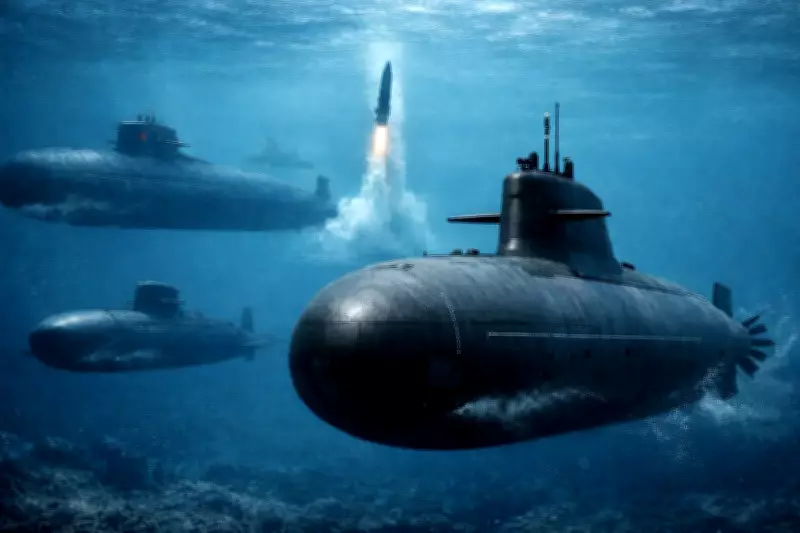
India's Underwater Nuclear Deterrence Enters Critical Phase with INS Aridhaman
India's strategic underwater capabilities are poised for a transformative leap forward with the scheduled induction of INS Aridhaman, the third Arihant-class nuclear-powered ballistic missile submarine, by May 2026. This development marks a decisive advancement in the nation's maritime defense architecture, significantly enhancing its nuclear triad's most secure component.
Strategic Context and Regional Dynamics
At a crucial juncture when China is aggressively expanding both its nuclear and conventional submarine presence throughout the Indo-Pacific region, and Pakistan is incorporating advanced Chinese-origin submarines featuring air-independent propulsion technology, India's defense planners are methodically reinforcing the sea-based leg of its nuclear deterrent. This strategic reinforcement comes through the indigenous development and deployment of increasingly sophisticated submarine platforms.
Once INS Aridhaman becomes operational alongside its predecessors, INS Arihant and INS Arighat, India will maintain three indigenously constructed SSBNs (Ship Submersible Ballistic Nuclear) under the command of the Strategic Forces Command. This represents not merely an incremental addition to naval inventory but a fundamental structural shift in India's overall strategic posture and defense readiness.

INS Arihant: The Pioneering Foundation
Commissioned in August 2016, INS Arihant stands as the culmination of decades of highly classified research and development under the Advanced Technology Vessel programme. Constructed at the Shipbuilding Centre in Visakhapatnam, this submarine displaces approximately 6,000 tonnes and is powered by an 83 MW Compact Light Water Reactor developed with substantial indigenous technological input.
Measuring about 111.6 meters in length, Arihant propelled India into the exclusive group of nations operating nuclear-powered ballistic missile submarines. Its nuclear propulsion system grants virtually unlimited operational range, with endurance primarily constrained by crew supply requirements. Capable of submerged speeds around 24 knots, it is engineered for extended stealth patrols within the Indian Ocean Region.
Armament and Capabilities: Arihant is equipped with four vertical launch system tubes, configurable to deploy either up to twelve K-15 Sagarika submarine-launched ballistic missiles with a range of roughly 750 kilometers, or four K-4 missiles extending to approximately 3,500 kilometers. It also features six 533 mm torpedo tubes for defensive and conventional strike operations. The landmark 2018 deterrence patrol by Arihant operationalized India's sea-based nuclear deterrent, completing the triad alongside land-based missiles and air-delivered systems, thereby establishing a guaranteed retaliatory capability.
INS Arighat: Enhanced and Sustained Deterrence
Commissioned on August 29, 2024, INS Arighat represents a refined and improved iteration of the Arihant-class. While maintaining a similar displacement of around 6,000 tonnes, Arighat incorporates operational enhancements developed from the experience gained with its predecessor.
Built at the same Visakhapatnam facility, Arighat underwent extensive harbor and sea trials before induction. Its nuclear propulsion, based on the pressurized light water reactor design, enables prolonged submerged operations with a minimized acoustic signature. Retaining four vertical launch tubes, Arighat is optimized for deploying the longer-range K-4 missiles, significantly expanding India's maritime strike envelope and reinforcing its protected retaliatory capability from deeper within the Indian Ocean.
The induction of Arighat was strategically vital, as a single SSBN cannot ensure continuous deployment due to maintenance and crew rotation needs. With two operational boats, India moved closer to achieving rotational deterrence patrols, ensuring greater availability of a secure second-strike platform.
INS Aridhaman: The Advanced 7,000-Tonne Evolution
INS Aridhaman embodies the most advanced evolution of the Arihant-class to date. With a displacement of approximately 7,000 tonnes, it is substantially larger than its predecessors, permitting expanded missile capacity and comprehensive system enhancements.
Key Upgrades Include:

- An increase in vertical launch system tubes from four to eight, enabling Aridhaman to carry up to 24 K-15 missiles or eight K-4 intermediate-range ballistic missiles, with potential accommodation for future K-5 missiles boasting ranges up to 6,000 kilometers.
- An upgraded 83 MW Compact Light Water Reactor designed for reduced acoustic emissions, complemented by a seven-blade propeller, advanced sound-dampening measures, and extensive anechoic tiling to enhance stealth characteristics.
- Greater internal volume for improved command-and-control systems, enhanced crew habitability during extended patrols, and advanced combat systems integration.
Strategically, Aridhaman is pivotal for accelerating India's transition toward Continuous At-Sea Deterrence. With three SSBNs, the Indian Navy can maintain at least one submarine on active patrol at any given time, while others undergo maintenance or training, establishing a layered deployment model central to India's assured retaliatory posture.
Broader Naval Framework and Conventional Modernization
India's SSBN fleet operates under the centralized control of the Strategic Forces Command. The sea-based leg is regarded as the most crucial component of the nuclear triad due to the extreme difficulty in detecting and neutralizing submarines operating silently in ocean depths.
These submarines are expected to operate from Project Varsha, a high-security naval base near Visakhapatnam featuring underground pens designed to protect nuclear assets, providing strategic access to the Bay of Bengal and the wider Indian Ocean.
Beyond ballistic missile platforms, India's nuclear submarine ambitions include the planned induction of Chakra III, a Russian Akula-class nuclear-powered attack submarine anticipated by 2027–28, which will focus on anti-ship, anti-submarine, and escort missions.
Parallel Conventional Modernization – Project-75I: Concurrently with SSBN expansion, India is advancing Project-75I, a program to construct six next-generation diesel-electric submarines equipped with air-independent propulsion. Valued at approximately $8 billion, this initiative aims to replace ageing conventional platforms and enhance sea denial capability under the Strategic Partnership Model, featuring German Type-214 Next Generation submarine technology.
Regional Comparisons and Strategic Doctrine
India's expanding SSBN fleet must be contextualized against rapid underwater modernization by regional neighbors. China operates one of the world's largest submarine forces, estimated at over 50 diesel-electric and about 10 nuclear-powered submarines, including Jin-class SSBNs. Pakistan, while smaller in scale, is upgrading its fleet with eight Chinese Yuan-class diesel-electric submarines, many featuring air-independent propulsion.
The strategic distinction lies in composition and doctrine. China maintains a full-spectrum fleet, Pakistan focuses on sea denial, while India's approach centers on a modest but growing SSBN fleet for strategic deterrence, complemented by conventional and future nuclear attack submarines. India's objective remains credible minimum deterrence—ensuring guaranteed retaliation capability rather than numerical parity.
The induction of INS Aridhaman, therefore, represents a qualitative leap in India's underwater strategic capabilities, ensuring that deterrence remains robust and resilient beneath the surface of the Indian Ocean, safeguarding national security interests in an evolving geopolitical landscape.