

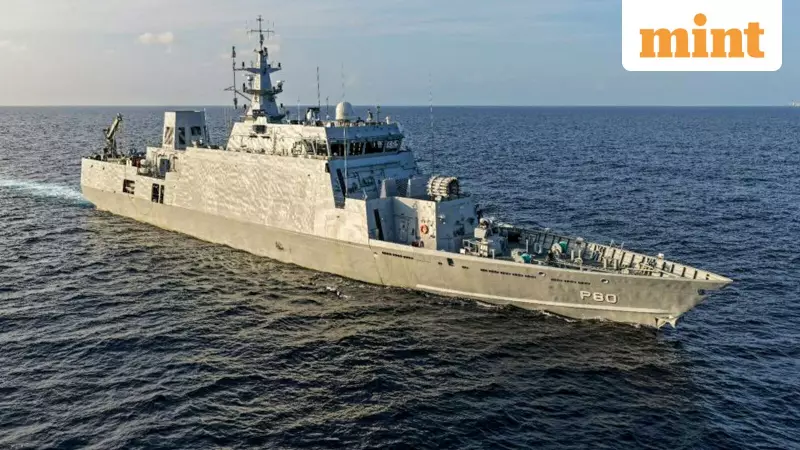
In a significant boost to India's maritime security, the Indian Navy officially commissioned INS Mahe, the first of the new Mahe-class Anti-Submarine Warfare Shallow Water Craft (ASW-SWC), on Monday, November 23. The ceremony, a momentous occasion for the nation's defence capabilities, was held at the Naval Dockyard in Mumbai.
A Ceremony of Strategic Importance
The event was graced by Chief of the Army Staff (COAS) General Upendra Dwivedi, who presided over the commissioning. The ceremony was hosted by Vice Admiral Krishna Swaminathan, the Flag Officer Commanding-in-Chief of the Western Naval Command. This induction marks a pivotal step in strengthening the Navy's prowess in coastal defence and anti-submarine operations.
Unveiling the 'Silent Hunter': INS Mahe
So, what exactly is INS Mahe? It is the lead vessel in a series of eight Mahe-class Anti-Submarine Warfare Shallow Water Craft (ASW-SWC). Designed specifically for operations in shallow waters, this vessel is a formidable asset for detecting and neutralising enemy submarines lurking near India's coastlines.

The ship, constructed by Cochin Shipyard Limited (CSL), was delivered to the Navy on October 23. The Navy plans to induct all eight vessels by 2027, creating a robust network of indigenous shallow-water combatants.
Key Features and Indigenous Prowess
INS Mahe is not just another ship; it is a testament to India's growing self-reliance in defence manufacturing. The Ministry of Defence proudly stated that the vessel boasts over 80 percent indigenous content.
Here are some of its defining characteristics:
- It is equipped with advanced weaponry including torpedoes and anti-submarine rockets.
- The ship is 78 metres long with a displacement of approximately 900 tons.
- It can achieve a top speed of 25 knots.
- The ship's crest features the 'Urumi', a flexible sword from Kalarippayattu, symbolising agility, precision, and lethal grace.
- Its motto, "Silent Hunters", perfectly captures its role in stealthy and vigilant anti-submarine warfare.
Named after the historic coastal town of Mahe on the Malabar coast, the ship embodies India's rich maritime legacy. It will be stationed on the Western Seaboard, serving as a guardian of India's vital maritime approaches.
Strategic Significance in a Tense Geopolitical Climate
The commissioning of INS Mahe carries immense strategic weight. Lt Col JS Sodhi (Retd), a panel member and advisor to the government, highlighted the growing submarine threats in the region.
He pointed out that Pakistan is set to receive six Hangor-class submarines from China, a nation that itself possesses a massive and rapidly expanding submarine fleet. Sodhi noted that 15 submarines are being constructed round-the-clock in Chinese dockyards, aiming for completion by 2030.
This context gives the induction of INS Mahe critical importance. Referencing Army Chief General Dwivedi's earlier statement that a "two-front war on India is no longer a possibility, it's a reality," Sodhi emphasised that the new vessel's capability to operate effectively in both deep and shallow waters makes it a difficult target for adversaries.
Furthermore, the ship stands as a shining example of the success of the Aatmanirbhar Bharat (Self-Reliant India) initiative launched by Prime Minister Narendra Modi, showcasing India's technological and manufacturing prowess in building sophisticated defence platforms at home.






