

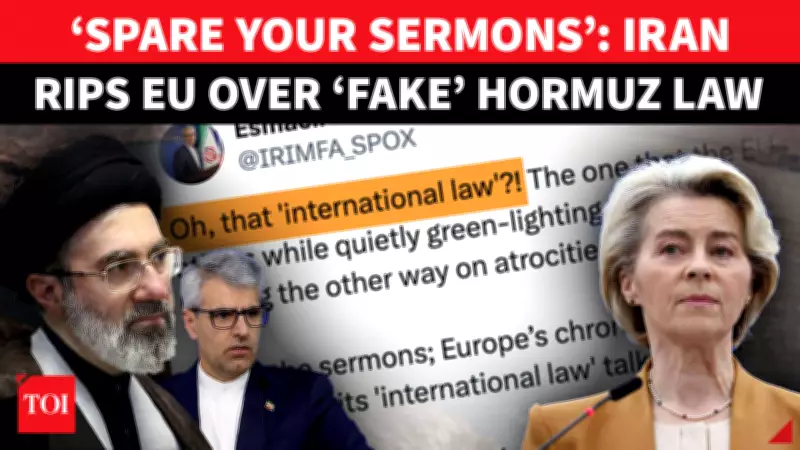
Iran Rebukes EU Over Strait of Hormuz Legal Dispute, Accuses Europe of Hypocrisy
The crisis in the strategically vital Strait of Hormuz has escalated into a sharp legal and diplomatic confrontation between Iran and the European Union. EU foreign policy chief Kaja Kallas recently emphasized that key maritime routes, including Hormuz, must remain open under international law, warning against any attempts to restrict or monetize transit through this critical waterway.
Iran's Forceful Rejection of EU Position
Iran has issued a strong and unequivocal rejection of the European Union's stance. Foreign Ministry spokesperson Esmaeil Baghaei launched a pointed critique, accusing European powers of selectively applying international law. Baghaei argued that Western nations routinely ignore legal violations when it suits their geopolitical interests, only to invoke these same principles against Tehran when convenient.
The core of this intensifying disagreement lies in fundamentally different interpretations of maritime rights and security protocols. The European Union views the Strait of Hormuz as a global chokepoint that must be governed by established norms of free navigation, essential for the uninterrupted flow of global energy supplies and trade.

Diverging Views on Security and Sovereignty
In stark contrast, Iran maintains that legitimate security considerations grant it the authority to regulate access and transit through these waters, especially given the ongoing military tensions and regional instability. Tehran's position underscores its assertion of sovereignty and the right to protect its national interests in adjacent maritime zones.
This diplomatic exchange highlights the broader geopolitical tensions surrounding one of the world's most crucial shipping lanes. The Strait of Hormuz serves as a passage for approximately one-fifth of the world's oil consumption, making any dispute over its governance a matter of significant international concern.
The Iranian spokesperson's remarks, including the pointed rebuke 'Don't lecture us', signal a hardening of Tehran's diplomatic posture. This reflects a broader pattern of Iran challenging Western narratives and legal frameworks, positioning itself against what it perceives as double standards in the application of international law.
As this legal and diplomatic standoff unfolds, the international community watches closely. The outcome could have profound implications for:
- Global energy security and oil market stability
- The interpretation and enforcement of maritime law in contested regions
- Diplomatic relations between Iran and European powers
- Regional security dynamics in the Persian Gulf
This dispute adds another layer of complexity to an already volatile region, where military posturing and diplomatic maneuvering often intersect with critical economic interests.






