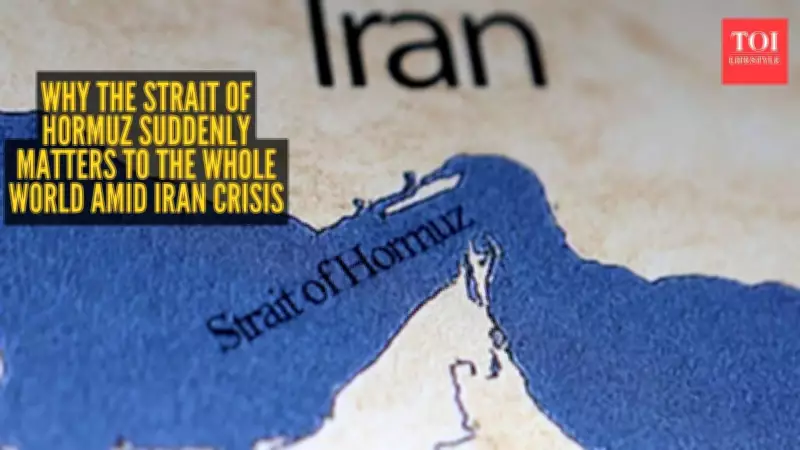
Iran's De Facto Strait of Hormuz Closure Sends Global Shockwaves
The Strait of Hormuz has abruptly transitioned from geography textbooks to breaking news headlines worldwide. Following recent military strikes targeting Iran, emerging reports indicate the nation has effectively restricted maritime movement through this narrow but crucial sea passage. The global response has been immediate and far-reaching.
Oil Prices React Instantly, Airlines Reroute Flights
Oil markets reacted almost instantaneously to the developing situation. Major airlines began adjusting international flight paths to avoid the region. Governments across multiple continents started issuing urgent travel and maritime advisories. This rapid chain of events has prompted a singular question from observers everywhere: how can one slender stretch of water exert such profound influence on the entire planet?
The answer is remarkably straightforward yet deeply unsettling, rooted in geography, economics, and global energy dependence.

Geographic and Economic Significance of the Strait
The Strait of Hormuz is strategically positioned between Iran and Oman, serving as the sole maritime exit from the Persian Gulf into the Arabian Sea and the broader Indian Ocean. Iran borders the northern coastline, while Gulf nations like the United Arab Emirates and Oman lie to the south.
The true story, however, is not merely geographic—it is about traffic volume. Nearly every oil tanker departing from major energy producers such as Saudi Arabia, Iraq, Kuwait, and Qatar must navigate this route before heading toward markets in Asia, Europe, and beyond.
At its narrowest point, the strait measures a mere 33 kilometers wide, with shipping lanes for colossal tankers being even more constrained. While it appears insignificant on a map, economically, it stands as one of the most vital locations on Earth.
Why This Tiny Passage Matters Immensely
The strait's paramount importance stems from the sheer volume of energy commodities flowing through it. Approximately one out of every five barrels of oil traded globally transits the Strait of Hormuz. Additionally, massive quantities of liquefied natural gas, particularly from Qatar, are entirely dependent on this route.
When shipping operates normally, the world scarcely notices. However, when movement slows or halts, global markets react within hours. Oil becomes more challenging and costly to transport, triggering price increases. Shipping expenses rise, airlines face higher fuel costs, and ultimately, consumers feel the impact at petrol pumps and through elevated prices for goods transported globally.
Nations located thousands of kilometers away inevitably experience the economic ripple effects.
Has Iran Officially Closed the Strait?
The current situation is not entirely clear-cut. Iran has not issued an official international declaration legally closing the strait. Nevertheless, on-the-water realities paint a different picture.
Following the military strikes, vessels in the region reportedly received warnings linked to Iran's Revolutionary Guards, advising against transiting the area. Multiple tanker operators have chosen to pause voyages due to mounting safety concerns.
Ship-tracking data indicates a noticeable decline in vessels entering the Gulf, with some ships opting to wait outside rather than risk passage. Security analysts describe this as a de facto closure—not formally announced but effectively limiting traffic because commercial entities are unwilling to gamble with safety.
For global markets, perception often carries as much weight as official policy.
Iran's Strategic Leverage and Motivations
Geography provides Iran with significant leverage. Its position along the northern coastline places it in a prime spot to influence shipping movements. For years, Iranian officials have suggested that controlling access to this route could become a retaliatory measure if military pressure or sanctions intensify.

This action represents a form of strategic signaling. Disrupting shipping does not merely affect a single rival nation; it sends shockwaves through global energy supplies, compelling the international community to pay immediate attention. In essence, the Strait of Hormuz functions as one of Iran's most potent pressure points in global geopolitics.
Historical Context of Tensions
This is not the first instance of instability in the strait. During the Iran-Iraq War in the 1980s, both sides attacked oil tankers in the so-called "Tanker War," leading to naval escorts for commercial vessels.
Since then, periodic incidents involving seized tankers, drone encounters, and naval stand-offs have occurred. Each time tensions escalate, oil markets respond swiftly, underscoring the demonstrated vulnerability of global energy supply at this singular chokepoint.
Why the Current Situation Feels More Severe
What renders the present moment particularly serious is the broader context. The reported disruption coincides with active military escalation involving Iran. Airlines are already avoiding nearby airspace, maritime insurance costs are rising, and energy traders are bracing for potential shortages.
Oil prices surged rapidly because markets fear prolonged instability more than a temporary disruption. Even a brief interruption can strain global supply chains, while a protracted one could force nations to fundamentally reconsider their energy import routes.
Direct Implications for India
For India, developments at the Strait of Hormuz are not distant news but are directly linked to everyday economics. A significant portion of India's crude oil imports originates from Gulf nations whose exports must pass through this route.
If shipments slow or become costlier, India's import bills increase, typically leading to higher domestic fuel prices. Elevated fuel costs subsequently affect transportation, aviation, food logistics, and overall inflation rates. Thus, while the crisis unfolds geographically far away, its economic repercussions can reach Indian households relatively quickly.
Can the Strait Remain Blocked Long-Term?
A prolonged closure is improbable without triggering severe consequences. The Strait of Hormuz is internationally recognized as a critical transit route. Major naval powers maintain a strong presence in the region precisely because global trade depends on unimpeded passage.
An extended blockade risks escalating tensions into a wider regional conflict—a scenario most nations are eager to avoid. Historically, disruptions here have tended to be temporary, even if they provoke immediate market panic. However, temporary does not equate to harmless.
Global Vigilance and Economic Dependence
The Strait of Hormuz may resemble just another line on a map, yet it functions as a critical pressure valve for the global economy. When ships move freely, energy flows smoothly and markets remain calm. When uncertainty emerges, everything reacts—oil prices, airline routes, stock markets, and international diplomacy.
Currently, the situation remains fluid. The strait may not be officially declared closed, but reduced traffic alone has already generated worldwide anxiety. This explains why world leaders, energy traders, and ordinary citizens are all monitoring developments intently.
Ultimately, the stability of the global economy can sometimes hinge on a narrow stretch of water that most people had scarcely heard of until very recently.