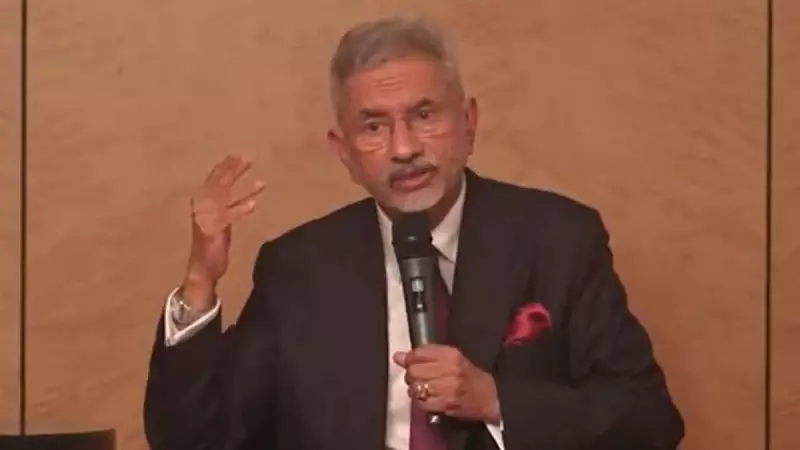
External Affairs Minister Dr. S. Jaishankar delivered a powerful and unequivocal message on the global stage, simultaneously addressing what he termed as unsolicited "free advice" from Western nations and issuing a sharp rebuke to Pakistan for its role in fostering terrorism. The minister's comments, made during a public interaction, underscore India's growing assertiveness in framing its own democratic narrative and calling out cross-border threats.
A Firm Response to Western Perceptions
Dr. Jaishankar directly tackled the tendency of some Western countries to comment on India's internal democratic processes. He emphasized that the health and nature of Indian democracy should be determined solely by the Indian people, who express their will through elections and institutions. The minister questioned the basis and motives behind such external commentary, suggesting it often lacks a deep understanding of India's complex social and political fabric.
The minister asserted that India does not need "free advice" on how to conduct its democratic affairs. He highlighted the robustness of India's electoral system, the independence of its judiciary, and the vibrant public discourse as evidence of a functioning democracy that is accountable to its own citizens first and foremost. This stance marks a clear departure from a traditionally defensive posture to one of confident self-definition.

Direct Accusation Against Pakistan
Shifting focus to regional security, Jaishankar launched a scathing attack on Pakistan's long-standing policy regarding terrorism. He accused Pakistan of "normalising a very wrong policy" which treats terrorism as an instrument of statecraft. This, he argued, has had devastating consequences for the entire region, particularly for India, which has been a repeated victim of cross-border terror attacks emanating from Pakistani soil.
The minister's language was unambiguous in holding Pakistan's establishment responsible. He pointed to the presence of terrorist infrastructure and the safe havens provided to internationally proscribed terror groups as clear indicators of state sponsorship. This rebuke comes amidst ongoing diplomatic efforts where India has consistently maintained that talks and terrorism cannot coexist, placing the onus squarely on Islamabad to create a conducive environment by taking verifiable action against terror groups.
Implications for India's Foreign Policy
This dual-pronged statement from the External Affairs Minister is significant for several reasons. Firstly, it signals India's diminishing patience with what it perceives as hypocritical or uninformed criticism from traditional Western partners, especially on issues of domestic governance. Secondly, it reaffirms, in the strongest terms, that the issue of Pakistan-sponsored terrorism remains a central and non-negotiable concern for Indian foreign and security policy.
The timing and tone of the remarks reflect a confident India that is willing to define its own parameters for engagement on both fronts. On one hand, it seeks relationships based on mutual respect and away from the patronizing dynamics of the past. On the other, it leaves no room for ambiguity regarding the primary source of instability in the region, keeping international attention focused on Pakistan's actions.
Analysts see this as part of a broader pattern where New Delhi is proactively shaping its narrative, refusing to be defensive, and calling out double standards. The message is clear: India's democratic credentials are for its people to judge, and its security challenges, fueled by state-sponsored terrorism from Pakistan, are facts that the world must acknowledge unequivocally.