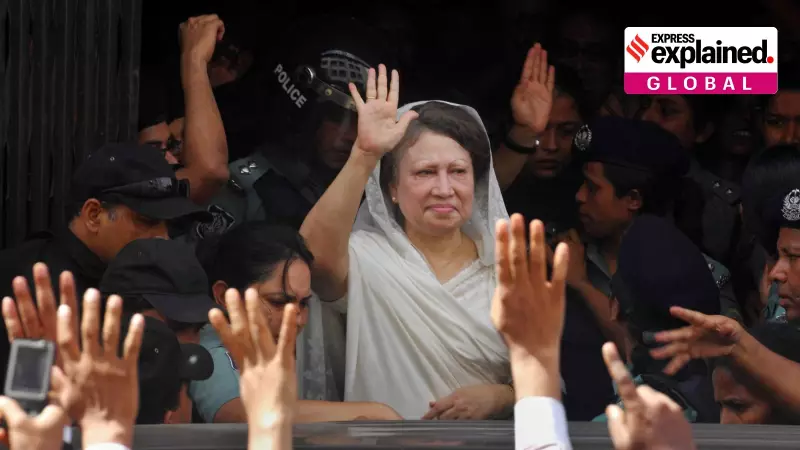
The passing of Bangladesh's first woman prime minister, Begum Khaleda Zia, on Tuesday, December 31, 2025, represents a profound milestone in the country's turbulent political history. Her death arrives at a pivotal moment of transition, as Bangladesh prepares for its first national elections in over four decades where neither she nor her long-time rival, Sheikh Hasina, will be on the ballot. Yet, the political legacies of these two dominant figures are set to cast a long shadow over the nation's future and its critical relationship with India.
India's Diplomatic Outreach and a New Political Chapter
In a clear signal of diplomatic engagement, India has moved swiftly to acknowledge Zia's passing. Prime Minister Narendra Modi expressed his condolences on social media platform X, recalling his 2015 meeting with her and acknowledging her contributions to India-Bangladesh ties. More significantly, External Affairs Minister S. Jaishankar will travel to Dhaka to attend her funeral on Wednesday, January 1. This high-level representation underscores India's intent to build bridges with Bangladesh's evolving political establishment ahead of the crucial general elections scheduled for February 12, 2026.
The political baton within Zia's Bangladesh Nationalist Party (BNP) has now passed to her son, Tarique Rahman. Rahman, the acting chairman of the BNP, returned to Dhaka on December 25 after 17 years of self-imposed exile in the United Kingdom. His return and subsequent leadership of the party into the polls mark a definitive generational shift in Bangladeshi opposition politics.

A Complex Legacy: From Pioneer to Polarizing Figure
Khaleda Zia's political journey was inextricably linked to Bangladesh's founding lineage. As the wife of former President Ziaur Rahman, who took power after the assassination of Sheikh Mujibur Rahman in 1975, she entered politics following her husband's own assassination in 1981. She assumed leadership of the BNP in 1984 and, despite being a political novice, led a formidable movement against General Hussain Muhammad Ershad's military regime.
In a rare moment of unity, she allied with her arch-rival Sheikh Hasina to oust Ershad in 1990. Zia then won the 1991 elections, becoming the nation's first female prime minister. Her first term saw significant constitutional and social changes, including the transition to a parliamentary system, the introduction of VAT, and making secondary education free for girls in rural areas.
However, her relationship with India was complex and often strained, particularly during her second term from 2001 to 2006. Her alliance with the Islamist Jamaat-e-Islami during this period created a permissive environment for anti-India terrorist outfits and insurgent groups targeting India's Northeast, leading to a severe downturn in bilateral relations. This period stands in sharp contrast to the warming of ties witnessed after Sheikh Hasina's return to power in 2008.
The Turning Point and a Parting Wisdom
Many analysts point to Zia's decision in 2013 to boycott national elections as a critical political miscalculation. Her refusal to participate, protesting Hasina's move away from the caretaker government system, effectively ceded the political arena. This allowed Hasina to consolidate power, with the BNP facing intense crackdowns over the next decade. Zia was imprisoned in 2018 on corruption charges related to the Zia Orphanage Trust and, even after a conditional release in 2020, remained confined to her Gulshan home due to ill health.
In an interview with The Indian Express in June 2014, Zia reflected on the perception of dynastic politics in Bangladesh. She argued that political families are respected due to the contributions of their predecessors, drawing a parallel to professions like law or medicine. "And then, it comes to the people — whom do they accept, that is the key. If they don’t accept, they will be out," she stated—a piece of wisdom that now serves as both a defense of her son's political entry and a challenge for his future.

As Bangladesh stands at the cusp of a new electoral chapter without its two most iconic 'Begums' in direct contention, the nation's political trajectory and its delicate balancing act with India enter an uncertain phase. The shadows of Khaleda Zia and Sheikh Hasina will loom large, but the stage is now set for a new cast of actors to determine the next act in Bangladesh's democratic saga.