

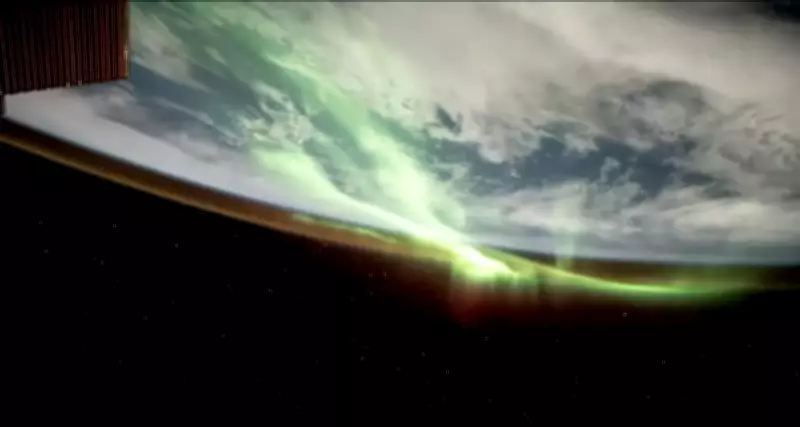
NASA Releases Mesmerizing Auroral Footage from International Space Station
Earlier this month, a captivating stretch of green light was observed sliding along Earth's curvature, captured by cameras aboard the International Space Station. NASA subsequently released this remarkable footage, providing a unique orbital perspective on one of nature's most spectacular displays.
Atmospheric Layers Revealed from Orbit
The video shows auroras flaring quietly across the upper atmosphere, with a distinct thin orange line sitting directly beneath them. This orange band marks the very edge of Earth's atmosphere itself, creating a striking visual contrast against the vibrant green auroral displays above.
From the station's orbital vantage point, approximately 400 kilometers above Earth's surface, the scene appears less dramatic than ground-based observations but more revealing of atmospheric structure. The planet appears surprisingly small, wrapped in faint, layered atmospheric envelopes that respond to cosmic forces arriving without warning.

Solar Activity Connection
The timing of these observations aligns perfectly with recent solar flare activity, as our Sun enters a more active phase of its 11-year cycle. Solar flares propel streams of charged particles outward through space, with some of this material eventually reaching Earth's vicinity.
Earth's magnetic field doesn't stop these particles outright but rather bends and guides them toward the polar regions, where they interact with atmospheric gases to create the luminous displays we recognize as auroras.
Unique Orbital Perspective
From the International Space Station's altitude, auroras don't appear as hanging curtains as they often do from the ground. Instead, they stretch and thin across vast distances, drifting sideways along magnetic field lines. The green glow remains the most prominent feature, but the steady, narrow orange band beneath commands equal attention.
This lower atmospheric glow, created by chemical reactions high above Earth's surface, typically goes unnoticed from the ground but becomes strikingly visible when contrasted against bright auroral activity. The footage makes Earth's atmosphere appear fragile and distinctly layered—more like a boundary than a protective shield.
The Science Behind the Colors
The familiar colors of auroras originate from different atmospheric gases at varying altitudes. Oxygen molecules tend to glow green at certain altitudes and red much higher up, while nitrogen contributes blues and purples closer to the lower edge of auroral displays.
From the orbital perspective, these layers sometimes blur together rather than forming neat, distinct bands. The colors mix, soften, and thin out across the atmospheric canvas, appearing more like a gentle wash than the dramatic flares observed from Earth's surface.
Expanding Aurora Visibility
As solar activity increases during the current active phase, auroras have been drifting away from their usual polar confines. In recent weeks, observers have reported sightings in unusual locations including parts of Missouri and Colorado in the United States, as well as regions of Germany where auroras are typically uncommon.
These expanded sightings depend on multiple factors including precise timing, local cloud cover conditions, and how Earth's magnetic field responds to specific solar events, making them unpredictable but increasingly widespread.
Beyond the Visual Spectacle
While auroras provide breathtaking visual displays, they represent just one visible aspect of space weather phenomena. Increased solar activity can potentially interfere with satellite operations, radio communications, and even power grid systems on Earth.
Fortunately, during this recent event, impacts remained mostly atmospheric. From the International Space Station, the lights appeared routine and almost subdued—a gentle reminder that Earth exists within a dynamic cosmic environment, never completely isolated from events occurring in the space surrounding our planet.
The NASA footage serves as both scientific documentation and artistic inspiration, revealing the delicate beauty of Earth's atmospheric interactions with solar energy while providing valuable data for researchers studying space weather phenomena and atmospheric dynamics.






