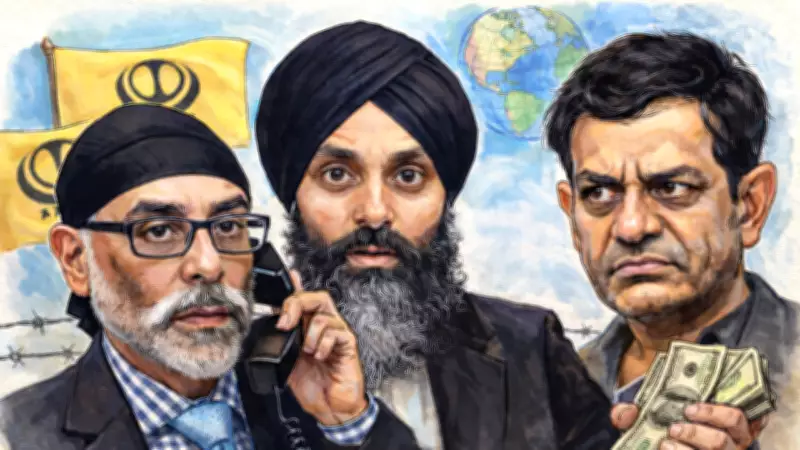
The Nijjar Assassination and Pannun Plot: A Detailed Examination
On June 17, 2023, Hardeep Singh Nijjar, a Khalistani separatist designated as a terrorist by India, reportedly made a fateful phone call to his close associate Gurpatwant Singh Pannun. During this conversation, Nijjar expressed grave concerns about what he described as a "serious threat" to his life. This communication would later become a critical piece of evidence as investigators meticulously reconstructed the final hours leading up to his violent demise.
The Vancouver Shooting and International Fallout
The following day, June 18, 2023, Nijjar was brutally gunned down by assailants in the parking lot of a gurdwara located on the outskirts of Vancouver, Canada. According to witness accounts cited in various media reports, a white sedan pulled up to the scene, after which multiple attackers approached Nijjar and opened fire, discharging dozens of rounds before fleeing the location. The brazen and public nature of this attack immediately elevated the case from a local criminal investigation to an incident of significant international scrutiny and diplomatic consequence.
In the subsequent weeks, diplomatic relations between New Delhi and Ottawa experienced considerable strain. This tension escalated dramatically after former Canadian Prime Minister Justin Trudeau publicly stated that authorities were actively examining allegations of a possible Indian link to the killing—a claim that India vehemently and officially rejected. Around this same period, United States authorities disclosed that they had successfully disrupted what they described as a separate assassination plot targeting Gurpatwant Singh Pannun on American soil.

The Arrest of Nikhil Gupta and US Allegations
Acting on specific intelligence inputs, Czech police arrested Indian national Nikhil Gupta at Prague airport roughly one week after Nijjar's death, initiating a parallel legal and diplomatic track. The United States Department of Justice (DoJ) subsequently claimed that Gupta was intricately involved in an alleged conspiracy, directed by an employee of the Indian government, to target and assassinate Pannun. The DoJ further asserted that Gupta had established links to international narcotics and weapons trafficking networks and was also connected to Nijjar's murder.
India's premier external intelligence agency, the Research and Analysis Wing (R&AW), was thrust into the international spotlight after authorities in both Canada and the United States linked it to the alleged killing plots targeting both Hardeep Singh Nijjar and Gurpatwant Singh Pannun. This raised profound questions about the nature of these operations and their authorization.
Key Figures in the Saga
Hardeep Singh Nijjar: Nijjar was a prominent Sikh separatist initially associated with the Babbar Khalsa International (BKI), an organization listed as a terrorist entity by New Delhi, which alleges it is funded by Pakistan's Inter-Services Intelligence (ISI)—a charge Islamabad denies. He later ascended to become the chief of the militant Khalistan Tiger Force (KTF). A 2020 Indian government statement accused him of being "actively involved in operationalising, networking, training, and financing" its members. India officially categorized him as a terrorist, alleging involvement in sedition and attempts to create communal disharmony.
Gurpatwant Singh Pannun: Pannun is a dual US-Canadian citizen, a lawyer based in the United States, and a close ally of Nijjar. He is also a designated terrorist in India and a vocal advocate for Khalistan. Indian authorities believe he is supported by Pakistan's ISI. Pannun has gained notoriety for posting video messages on social media that often contain threats against Indian leaders, diplomats, and Hindu communities.
Nikhil Gupta: Gupta, who used the alias Nick, described himself as an international dealer in narcotics and weapons. Arrested in the Czech Republic on June 30, 2023, and later extradited to the United States, he is a co-accused in the alleged murder conspiracy targeting Pannun. On February 14, he pleaded guilty to federal charges including murder-for-hire, conspiracy to commit murder-for-hire, and conspiracy to commit money laundering.

Vikas Yadav: Identified in US court documents as CC-1, Yadav is the alleged Indian intelligence officer accused of orchestrating the plot from India. A former member of the Central Reserve Police Force (CRPF), Yadav was arrested by Delhi Police in December 2023 in an unrelated extortion and kidnapping case. He was granted interim bail in March 2024, followed by regular bail a month later, with that case currently under trial.
How the US Sting Operation Unfolded
According to detailed indictments from the US Department of Justice, Nikhil Gupta plotted the assassination of Pannun at the direction and coordination of Vikas Yadav, whom US authorities identified as an Indian government employee. "At the direction and coordination of an Indian government employee, Nikhil Gupta plotted to assassinate a United States citizen on American soil," stated FBI Assistant Director James C Barnacle Jr.
The documents allege that Yadav, employed by the Indian government's Cabinet Secretariat which houses the R&AW, recruited Gupta in or around May 2023 to orchestrate the hit. At Yadav's direction, Gupta contacted an individual he believed to be a criminal associate. This individual was, in fact, a confidential source (CS) working with the US Drug Enforcement Administration (DEA). The CS then introduced Gupta to a purported hitman, who was actually an undercover (UC) DEA officer.
Key operational missteps cited in the DoJ case include:
- Yadav and Gupta allegedly exchanged routine messages on encrypted platforms that were compromised.
- On June 9, 2023, conspirators arranged for an associate to hand over $15,000 in cash to the undercover agent in Manhattan—an act described by officials as "financial Op-Sec suicide."
- Rather than going silent after Nijjar's killing, Yadav allegedly sent Gupta a video of Nijjar's bloodied body with a message stating the New York target was now a "priority," explicitly linking the two operations.
India's Official Stance and the 'Rogue Operation' Theory
A high-powered committee established by the Indian government in 2023—formed after the US raised concerns about criminal and terrorist groups undermining mutual security interests—concluded that while Vikas Yadav had "criminal links," the episode represented a "rogue" operation, denying any state-sponsored intent. The Ministry of External Affairs has reiterated that Yadav, a former CRPF personnel, is no longer in government service.
Security experts and retired officials have expressed astonishment at the operational failures. "Forget a senior—any mid-level officer in an agency in the know would have shut it down instantly given the number of red flags the whole thing generated," a retired government officer told The Times of India. They noted that handlers in genuine covert operations never communicate directly with low-level intermediaries using traceable electronics, yet DoJ documents reveal precisely such communications. "In a real operation, a handler is a ghost; here, Yadav comes across as a digital pen pal. The 'trap' was not just visible; it was screaming," the officer added.
Legal Proceedings and Future Implications
Nikhil Gupta is scheduled to be sentenced by US District Judge Victor Marrero on May 29, 2026. By pleading guilty, he may secure a reduction from the maximum statutory punishment of 40 years in prison through an "acceptance of responsibility" credit under federal sentencing guidelines. Gupta, aged 54, may still have to serve approximately 80% of any awarded jail time, with potential for up to a 15% reduction for good behavior if the sentence exceeds 12 months.
This complex case continues to unfold, weaving together threads of international diplomacy, intelligence operations, alleged extrajudicial actions, and legal accountability, with significant implications for India's foreign relations and internal security protocols.