

Odisha's Mid-Day Meal Kitchens Defy LPG Crisis with Traditional Firewood, Steam Technology
At a time when soaring LPG costs and supply disruptions are forcing numerous mid-day meal kitchens and community feeding programs across India to scale down or shut operations entirely, the central government's PM-Poshan scheme in Odisha, along with the state's flagship Aahaar initiative for providing affordable cooked food to the urban poor, have largely remained unaffected. This remarkable resilience stems from a strategic mix of traditional cooking methods and innovative technological solutions.
Firewood: The Traditional Backbone of School Meals
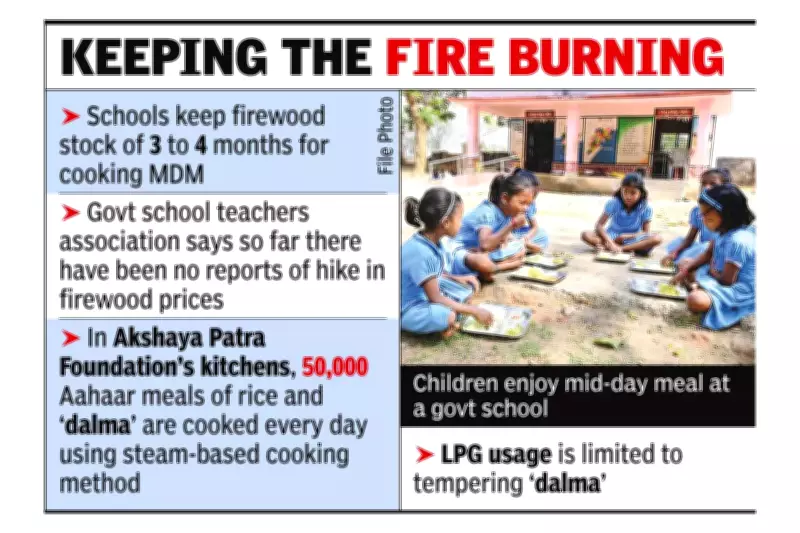
In nearly 98% of the 48,514 government schools across Odisha, the mid-day meal under the PM-Poshan scheme continues to be prepared using firewood. This arrangement serves over 43 lakh students from Sishu Vatika to Class X levels, ensuring uninterrupted food supply despite widespread concerns over sustainability.
"For mid-day meals, almost every school uses firewood because LPG is not a sustainable option," explained Charulata Mohapatra, general secretary of the primary school teachers' association. "Schools procure firewood stocks for three to four months. Though often criticized for its environmental impact, firewood-based cooking has emerged as an unexpected blessing in the current times of LPG uncertainty."

The school and mass education department last year revised the material cost for cooking mid-day meals to Rs 11.15 per primary student and Rs 14.74 per upper primary student. From these amounts, Re 1 is allocated for fuel per upper primary student and 76 paise per primary student specifically for cooking purposes.
Officials noted that while the department attempted to replace firewood with LPG for cooking mid-day meals in school kitchens several years ago, the transition could not be materialized due to the high volume of food being cooked daily and the associated substantial costs.
Steam Technology: The Modern Innovation
On the technological front, the Akshaya Patra Foundation provides mid-day meals to schools in Cuttack, Khurda, Sundargarh, Puri, and Nayagarh districts using centralized kitchens equipped with steam-based cooking technology. This innovative approach feeds 2.5 lakh students across these five districts.
"We burn briquettes, which are compressed blocks of agricultural by-products like husk, to fire steam boilers in our kitchens," said Arabinda Lenka, a general manager with the foundation. "The steam is used to boil rice, dal, and dalma. LPG is only used for tempering the dal and dalma. This method not only reduces dependence on LPG but also enhances efficiency and hygiene significantly."
Extending to Urban Feeding Programs
The same steam-based cooking model is being successfully deployed to support the government's Aahaar meals program in Cuttack, Khurda, Jajpur, Jagatsinghpur, and Puri districts. The foundation provides 30,000 Aahaar meals across these five districts, with 20,000 meals supplied in Cuttack and Bhubaneswar alone.
Lenka acknowledged that the centralized kitchens initially faced LPG shortages when commercial supply was disrupted, but the district administration later regulated the supply to ensure continuity.
Official Recognition of Alternative Arrangements
Officials from both the state urban development agency, which oversees Aahaar implementation, and the school and mass education department have emphasized that these alternative cooking arrangements have played a crucial role in maintaining service continuity, particularly for vulnerable populations who depend on these feeding programs.
The combination of traditional firewood cooking in rural schools and modern steam technology in centralized kitchens has created a robust system that withstands national LGP supply challenges while ensuring that nutritional support reaches millions of students and urban poor residents across Odisha.






