PM Modi and UAE President Hold Crucial Talks on Gulf Security Amid Escalating Tensions
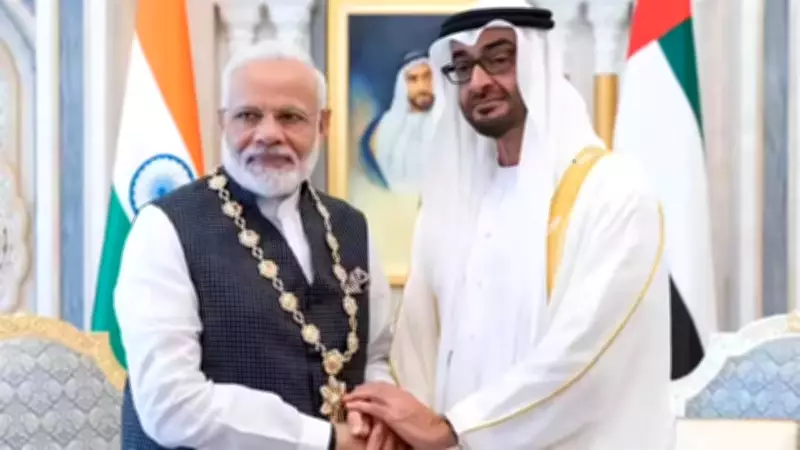
Prime Minister Narendra Modi engaged in a significant telephone conversation with United Arab Emirates President Mohamed bin Zayed Al Nahyan on February 28, marking their second discussion since the outbreak of conflict in West Asia. This high-level diplomatic exchange occurred against a backdrop of heightened regional instability and fresh reports of attacks targeting critical energy infrastructure in the Gulf region.
India's Firm Condemnation of Attacks and Civilian Impact
During their detailed dialogue, Prime Minister Modi unequivocally reiterated India's strong condemnation of all attacks directed at the United Arab Emirates. He expressed profound concern over the tragic loss of innocent civilian lives and the extensive damage inflicted upon civilian infrastructure resulting from these hostilities. The Prime Minister emphasized India's unwavering commitment to regional stability and the protection of human lives.
Strategic Focus on Strait of Hormuz Navigation Security
A central outcome of the leaders' conversation was their mutual agreement on the critical importance of ensuring safe, secure, and unimpeded navigation through the strategically vital Strait of Hormuz. In a post on social media platform X, Prime Minister Modi stated, "We will continue to work together for the early restoration of peace, security and stability in the region." This commitment underscores the waterway's global significance for energy transportation and trade.

The Prime Minister also took the opportunity to extend warm Eid al-Fitr greetings to President Mohamed bin Zayed Al Nahyan and the people of the UAE, highlighting the cordial personal rapport between the two leaders.
India's Critical Energy Partnership with the UAE
The timing of these discussions is particularly crucial given India's profound energy interdependence with the United Arab Emirates. According to official Indian government data, the UAE stands as India's fourth-largest source of crude oil and its second-largest supplier of both liquefied natural gas (LNG) and liquefied petroleum gas (LPG). This partnership forms a cornerstone of India's energy security framework.
India's Diplomatic Approach and Regional Concerns
Beyond the immediate safety and security of the substantial Indian diaspora residing in the Gulf region, India's primary concern revolves around the potential disruption to its LPG supplies traversing the Strait of Hormuz. Recent developments have effectively seen this crucial maritime chokepoint blockaded by Iran, posing a direct threat to energy flows.
In response, the Indian government has explicitly chosen a path of dialogue and diplomacy with Tehran to address these pressing concerns. Officials have confirmed this week that India has firmly rejected any consideration of joining a United States-led military coalition aimed at securing the waterway, preferring instead to pursue peaceful diplomatic resolutions.
BRICS Engagement and Consensus Challenges
Concurrently, India is actively engaged with the UAE, a fellow member of the BRICS grouping, in efforts to forge a consensus for a joint statement addressing the West Asia situation. As the current holder of the BRICS presidency, India faces the complex task of bridging divergent positions among member states directly involved in the conflict.
Ministry of External Affairs spokesperson Randhir Jaiswal acknowledged the challenges on Tuesday, stating, "Look, we hold the Presidency of BRICS. It works on consensus. In this conflict, several members are involved, and it is difficult to bridge the gap in their positions. But we remain engaged with everyone." This statement confirms that while an agreement remains elusive for the moment, diplomatic efforts continue unabated.
The conversation between Prime Minister Modi and President Mohamed bin Zayed Al Nahyan represents a vital diplomatic channel during a period of significant regional uncertainty, reflecting India's proactive and principled approach to international relations and energy security.