

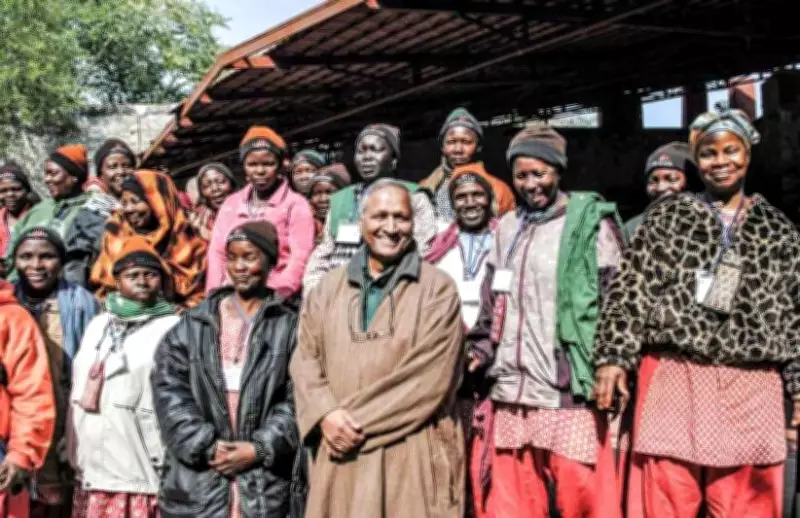
Barefoot College's Radical Bet: Grandmothers as Solar Engineers
At first glance, the concept seems almost like a modern parable: send a grandmother to school, teach her to wire a solar panel, send her back home, and watch an entire village transform. This is precisely the revolutionary wager that Sanjit "Bunker" Roy made in Tilonia, Rajasthan, where Barefoot College has spent decades proving that expertise does not require formal degrees, polished English, or corporate attire.
A College Built on Local Knowledge and Self-Reliance
Founded in 1972 by Bunker Roy, Barefoot College began with a mission to make marginalized communities self-sufficient. The organization grew from a fundamental rejection of conventional development approaches. Instead of assuming rural areas needed outside experts to solve their problems, Roy built an institution centered on local knowledge, practical learning, and genuine self-reliance.
The college's Tilonia campus was designed and constructed using local materials by villagers themselves. The underlying philosophy is straightforward yet profound: solutions to rural challenges must be deeply rooted in rural life. This principle continues to anchor all of Barefoot College's initiatives today.

The Strategic Choice of Training Grandmothers
The most celebrated aspect of Barefoot College is its solar energy program, which trains women from remote, often non-electrified villages to become solar engineers. The organization specifically works with marginalized, illiterate, and semi-literate women from the Global South. These women learn to design, manufacture, install, and repair solar lanterns and home-lighting systems.
Affectionately known as "Solar Mamas," many of these trainees are grandmothers. This selection is not based on sentimentality but on strategic insight. After beginning with semi-literate and illiterate women in the 1990s, Barefoot College discovered that middle-aged women were often the most effective trainees.
They were more likely to remain in their villages, less inclined to migrate for wage labor, and more invested in maintaining systems long after trainers departed. As Roy has emphasized, a young person with new skills might leave for urban opportunities, while a grandmother is more likely to stay and serve the community that raised her.
Hands-On Learning Over Theoretical Instruction
Barefoot College's solar training program spans six months, according to both the college and India's Ministry of New and Renewable Energy. Instruction is entirely practical, relying on demonstration rather than textbooks. Women learn by identifying parts by shape and color, assembling systems through example, and then returning home with necessary tools and spare parts.
This model is specifically designed for individuals who may not read fluently but can learn rapidly through tactile, immediate teaching methods. The approach turns traditional development hierarchies upside down: instead of villages being passive recipients of external knowledge, they become active sites of local expertise.
Measurable Impact and Global Reach
Barefoot College has trained an impressive 1,708 rural women from 96 countries, bringing electricity to more than 75,000 households. India's MNRE reports slightly different figures, citing 1,600 Solar Mamas from 96 countries who have electrified 60,000 houses while saving approximately 45 million liters of kerosene.
While the exact numbers vary, the direction is unequivocal: a village-based training model that delivers tangible access to light, enhanced safety, and increased income. The women are not being rescued; they are being equipped to become technicians, teachers, and problem-solvers in regions often dismissed as too poor, remote, or illiterate for technical work.
A Lasting Legacy of Dignity and Empowerment
What ensures the enduring relevance of Bunker Roy's work is not merely the inspirational narrative but the disciplined methodology behind it. Barefoot College operates on the conviction that dignity itself is a powerful development strategy.

By giving people genuine responsibility, providing proper training, and trusting them to sustain systems, communities often do more than maintain them—they expand, adapt, and pass on knowledge. This explains why the college's influence has extended beyond solar energy into education, healthcare, water management, and livelihood creation.
Roy's ultimate legacy is not simply establishing a college in a Rajasthani village. It is challenging a core assumption of modern development: that expertise must originate externally. In Tilonia, the more effective answer proved both more modest and more radical: begin with the people already present, particularly the women everyone else has overlooked, and empower them to engineer their own futures.





