

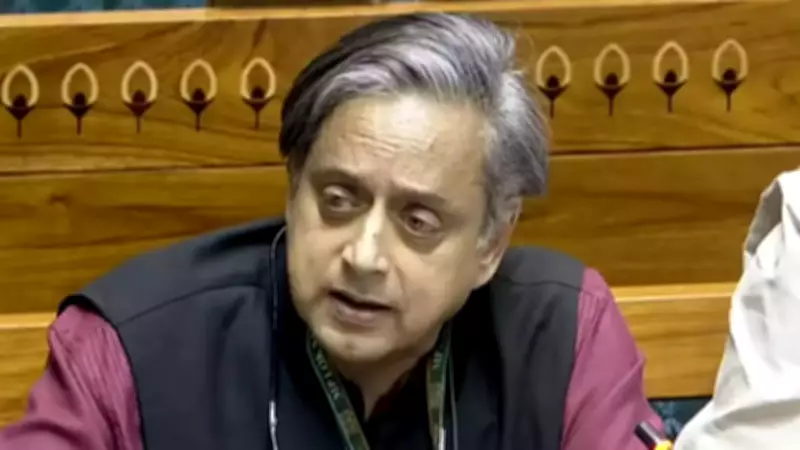
Congress Leader Shashi Tharoor Calls for Government Action to End West Asia Conflict
Congress leader and Lok Sabha MP Shashi Tharoor on Wednesday urged the central government to take a "proactive lead" in demanding an immediate end to the escalating conflict in West Asia. Tharoor emphasized that neither side is benefiting from the ongoing hostilities, while the global community bears the cost through severe disruptions in oil, gas, and supply chains.
Tharoor's Appeal for Diplomatic Intervention
In an interview with news agency ANI, Tharoor stated that both American and Iranian objectives have largely been met, making the continuation of the conflict detrimental to global interests. "I have been calling publicly for the government to now take a lead in demanding an end to this conflict. I think both sides frankly have reached a point where they're not doing anyone any good," he said.
Tharoor elaborated that the United States has achieved its military targets, while Iran has successfully preserved its regime. "The Americans have said they have hit all the targets they want to hit. The Iranians, at the same time, have the success of being able to preserve their regime and keep themselves going. I think between these two, that should be enough," he added.

Global Economic Impact and Supply Chain Disruptions
Tharoor further warned that the instability in the region is affecting the wider world, particularly through disruptions to critical supply routes like the Strait of Hormuz. "The world is suffering. We have real problems in getting supplies, oil, and gas through the Strait of Hormuz. The whole region should not be held hostage to this particular conflict. I think the conflict should be ended," he asserted.
Background of the Conflict
The current round of conflict in West Asia began on February 28 with the assassination of Iran's Supreme Leader Ayatollah Ali Khamenei, triggering fighting between Israel and the United States on one side and Iran on the other. The conflict escalated after the 86-year-old leader was killed in joint military strikes by the US and Israel.
Iran responded by targeting Israeli and US assets in several Gulf countries and Israel, disrupting the Strait of Hormuz and affecting global energy markets and economic stability. Due to the conflict, Iran has effectively restricted movement through the Strait of Hormuz, a key route for global energy supplies.
India's Position and Recent Developments
However, Abdul Majid Hakeem Ilahi, the representative of Iran's Supreme Leader in India, earlier stated that Indian vessels would be allowed to pass through the strategically significant waterway. He added that the Iranian leadership is aware of expressions of sympathy from people in India and remains mindful of India's energy needs.
In a positive development, an Indian LPG carrier, Nanda Devi, arrived at Vadinar port in Gujarat's Jamnagar on Tuesday, carrying 46,500 metric tonnes of LPG for ship-to-ship transfer after successfully transiting the Strait of Hormuz. Additionally, on Monday evening, the Indian carrier LPG Shivalik, carrying 46,000 metric tonnes of liquefied petroleum gas, reached Mundra Port. Of this, 20,000 metric tonnes will be unloaded at Mundra, while the remaining 26,000 metric tonnes is scheduled for Mangalore.
Tharoor's call highlights the urgent need for diplomatic efforts to mitigate the conflict's impact on global stability and India's strategic interests.






