

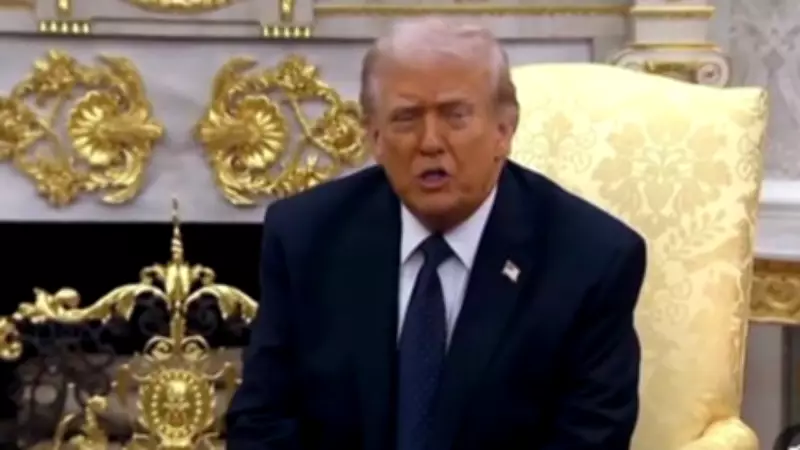
Trump Announces 5-Day Military Pause Following 'Productive' Iran Talks
In a significant development, US President Donald Trump declared on Monday that the United States and Iran have engaged in "very good and productive" discussions over the past two days. This announcement signals a potential de-escalation in the ongoing conflict, as Trump ordered a five-day suspension of planned military strikes against Iranian targets.
Diplomatic Breakthrough Amidst Tensions
Trump shared the update via a post on Truth Social, stating, "I am pleased to report that the United States of America, and the country of Iran, have had, over the last two days, very good and productive conversations regarding a complete and total resolution of our hostilities in the Middle East." He emphasized that based on the constructive nature of these talks, which are set to continue throughout the week, he has instructed the Department of War to postpone all military strikes against Iranian power plants and energy infrastructure for a five-day period. This move is contingent on the success of the ongoing diplomatic efforts.
Background: Ultimatum and Iranian Response
This announcement follows a 48-hour ultimatum issued by Trump the previous day, warning Iran of strikes on its energy infrastructure if Tehran failed to fully reopen the Strait of Hormuz. Trump had asserted, "If Iran doesn't fully open, without threat, the Strait of Hormuz, within 48 hours from this exact point in time, the United States of America will hit and obliterate their various power plants, starting with the biggest one first!"

In response, Iran stated that the Strait of Hormuz would remain open to all shipping except vessels linked to its "enemies," specifically the United States and Israel. Ali Mousavi, Iran's permanent representative to the International Maritime Organization (IMO), highlighted Tehran's willingness to cooperate with the IMO to enhance maritime safety. He noted, "Diplomacy remains Iran's priority. However, a complete cessation of aggression, along with the rebuilding of mutual trust and confidence, is essential. The Israeli and US attacks against Iran are at the root of the current situation in the Strait of Hormuz."
Escalating Conflict and Regional Threats
The conflict has intensified in recent weeks, with Iran disrupting traffic through the Strait of Hormuz in retaliation for joint US-Israeli strikes on February 28. Tehran has also launched attacks on Israeli territory and targeted Gulf states hosting US military bases. Iran's Unified Combatant Command has warned that any attack on its energy infrastructure would trigger retaliatory strikes across the region, threatening to target all US energy assets in the area.
The situation has grown more volatile, with Israel confirming that Iran has deployed long-range missiles for the first time. Israeli military chief Eyal Zamir revealed that two ballistic missiles with a range of 4,000 kilometers were launched towards the US-UK military base on Diego Garcia. Zamir cautioned, "These missiles are not intended to strike Israel. Their range reaches European capitals - Berlin, Paris, and Rome are all within direct threat range."
Human Cost and Ongoing Military Operations
The conflict has resulted in significant casualties, with over 2,000 people reported killed in Iran since US and Israeli strikes began, while Iranian attacks have claimed at least 15 lives in Israel. Recent missile strikes hit southern Israeli cities, including Dimona and Arad, injuring several civilians.
Israeli Prime Minister Benjamin Netanyahu affirmed that the country would persist with its military operations, stating, "This has been a very difficult evening in the battle for our future. We are determined to continue striking our enemies on all fronts."
As diplomatic talks progress, the international community watches closely, hoping for a peaceful resolution to this escalating crisis in the Middle East.






