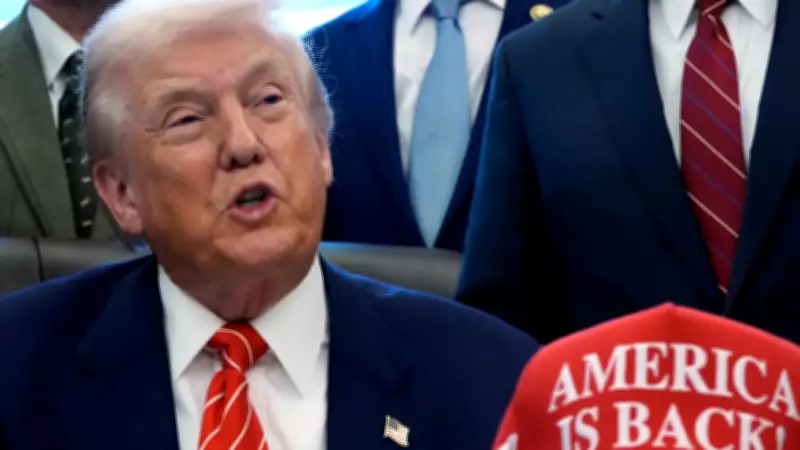
Trump Announces Indirect Role in Upcoming Iran Nuclear Negotiations
Former United States President Donald Trump stated on Monday that he would be involved "indirectly" in the scheduled nuclear talks with Iran, set for Tuesday in Geneva, Switzerland. He publicly urged Tehran to adopt a more reasonable stance during the negotiations.
References to Past Strikes and Negotiation Stance
In his remarks to reporters, Trump referenced the June 2025 B-2 bomber strikes on Iranian nuclear facilities, suggesting that Iran's approach to negotiations had been problematic. "I will be involved in those talks, indirectly, and they will be very important, let’s see what can happen," Trump said. He criticized Iran as a "very tough negotiator" and even labeled them as "bad negotiators," arguing that a deal could have been reached without the need for military action.
Trump expressed hope for a shift in Iran's position, stating, "I hope they’re gonna be more reasonable, they wanna make a deal." He further commented on Tehran's current motivation, adding, "I think they wanna make a deal. I don’t think they want the consequences of not making a deal."

Details of the Geneva Talks and Key Participants
According to CNN reports, the United States and Iran are expected to hold the next round of nuclear talks on Tuesday, local time, in Geneva. US special envoys Steve Witkoff and Jared Kushner are anticipated to attend the meetings. On the Iranian side, Foreign Minister Abbas Araqchi met with the UN nuclear watchdog chief on Monday and posted on social media platform X that he was in Geneva to "achieve a fair and equitable deal."
International Concerns and Iranian Warnings
The International Atomic Energy Agency (IAEA) has been pressing Iran for months to account for its stockpile of 440 kg of highly enriched uranium, following Israeli-US strikes. The agency has also called for the resumption of full inspections at key sites, including Natanz, Fordow, and Isfahan, which were bombed in June last year.
Iran has repeatedly issued warnings that it could close the Strait of Hormuz in response to any attack. Such a move would disrupt approximately one-fifth of global oil flows, potentially leading to a significant increase in crude prices.
Potential Compromises and Historical Context
Meanwhile, Iran’s Deputy Foreign Minister Majid Takht-Ravanchi indicated, as cited by the BBC, that Tehran would consider compromises on its uranium stockpile if Washington lifted sanctions that have adversely affected the country's economy.
Previous rounds of nuclear talks between Iran and the United States were held in April 2025 in Muscat and Rome. However, tensions escalated when the US carried out strikes on Iranian nuclear facilities at Fordow, Natanz, and Isfahan on June 21–22, 2025, under "Operation Midnight Hammer." Iran condemned these strikes as violations of international law and the UN Charter.