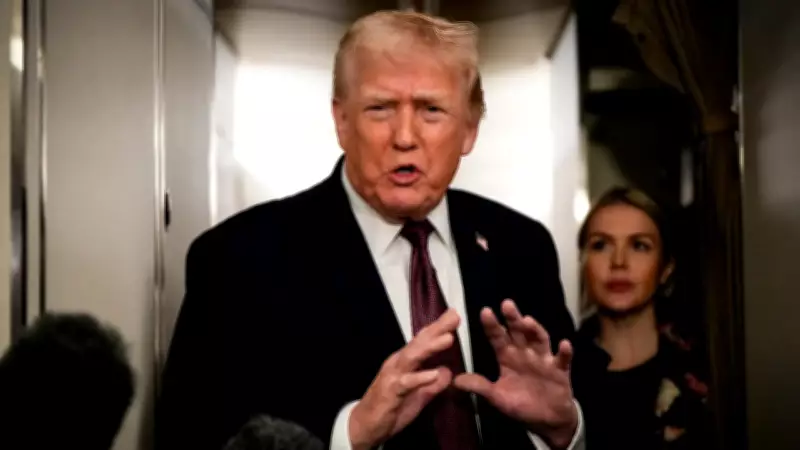
Trump Indicates Khamenei's Demise Could Pave Way for Diplomacy Following Major Strikes
In a significant development, US President Donald Trump remarked on Saturday that the potential death of Iran's Supreme Leader, Ayatollah Ali Khamenei, could establish a new pathway for diplomatic engagement. During a phone interview with CBS News, Trump expressed strong confidence in the outcomes of recent military actions, specifically highlighting the joint airstrikes conducted by the United States and Israel.
"It's a great day for this country, a great day for the world," Trump declared, referring to the coordinated assaults. He emphasized that the prospect of a diplomatic resolution to the escalating crisis has become more feasible in the wake of these operations. "Much easier now than it was a day ago, obviously," Trump stated when questioned about diplomatic possibilities. "Because they are getting beat up badly."
Details of the Military Operations and Retaliatory Strikes
The joint offensive, officially named Operation Epic Fury, commenced at approximately 9:30 AM local time in Tehran. This large-scale assault involved synchronized attacks from land, air, and sea forces. According to US Central Command, there have been no reports of American casualties or injuries during the operation in Iran. However, in Israel, the retaliatory strikes resulted in one fatality and dozens of injuries.

Within the initial twelve hours of the joint operation with Israel, the United States launched nearly 900 strikes. An unnamed US official disclosed to Fox News that these strikes were executed while American forces simultaneously defended against hundreds of incoming Iranian ballistic missiles, showcasing the intensity of the conflict.
Iran's Response and Regional Impact
In retaliation, Iran launched missile and drone attacks targeting Israel and US installations in several Middle Eastern countries, including Bahrain, Kuwait, and Qatar. Bahrain reported that a missile struck the headquarters of the US Navy's Fifth Fleet, though a US official countered this claim, asserting that the strikes hit "empty warehouses" and did not compromise operational objectives.
The regional repercussions were widespread:
- Kuwait experienced a drone strike on its main international airport, injuring several employees, with shrapnel also wounding troops at the Ali Al-Salem air base.
- Explosions were reported in Qatar, and Jordan confirmed intercepting dozens of drones and ballistic missiles.
- Saudi Arabia stated it successfully repelled attacks aimed at Riyadh and its eastern region.
- Inside Israel, the military reported that "dozens" of Iranian missiles were fired, many of which were intercepted, while emergency services noted 89 people sustained light injuries.
Trump's Assessment and Broader Context
Following the retaliatory strikes from Iran, Trump commented, "It's what we expected." He noted, however, that the response has been less severe than anticipated by the US and its allies. "We thought it'd be double," he said, adding that the situation remains fluid. "Thus far, it's been less than we thought," Trump told CBS.
Throughout the day, Trump engaged in discussions with officials and world leaders, continuously monitoring the Iranian response in the region. In an eight-minute video posted online, he framed the operation as part of a broader confrontation with Iran's leadership, tracing back to the 1979 Islamic Revolution. "When we are finished, take over your government," Trump urged, addressing the Iranian people. "It will be yours to take. This will be probably your only chance for generations."
This statement underscores the high stakes and long-term implications of the current military and diplomatic maneuvers, as tensions between the US, Israel, and Iran continue to shape the geopolitical landscape of the Middle East.