

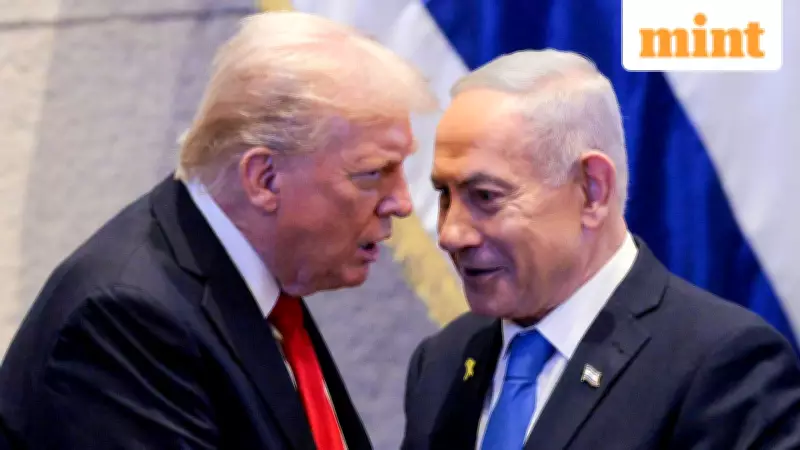
Trump and Netanyahu Hold High-Stakes Meeting on Iran, No Definitive Deal Struck
US President Donald Trump convened with Israeli Prime Minister Benjamin Netanyahu in Washington on Wednesday, local time, marking their seventh encounter since Trump assumed office in January of last year. According to Reuters, the leaders engaged in extensive discussions but failed to reach any "definitive" agreement on the path forward regarding Iran. This meeting occurred against the backdrop of ongoing US-Iran negotiations, following talks held in Oman on February 6 concerning Tehran's nuclear program.
Netanyahu's Push for Broader Diplomacy and Israel's Security Concerns
During the closed-door session, which extended over two and a half hours, Netanyahu aimed to persuade Trump to expand diplomatic efforts with Iran beyond the nuclear issue. He advocated for including stringent limits on Iran's missile arsenal and addressing its support for proxy groups such as Hamas and Hezbollah. Netanyahu underscored Israel's critical security interests, emphasizing that these must be integral to any negotiations. However, he did not secure explicit commitments from Trump on these points, leaving Tel Aviv apprehensive about a potential narrow nuclear deal that might exclude missile restrictions.
In a statement released post-meeting, Netanyahu's office highlighted, "The Prime Minister emphasized the security needs of the State of Israel in the context of the negotiations, and the two agreed to continue their close coordination and tight contact." This reflects ongoing collaboration but stops short of concrete outcomes.

Trump's Stance: Continued Negotiations and Conditional Preferences
President Trump characterized the meeting as "very good" but clarified that no major decisions were finalized. He reiterated his insistence on continuing negotiations with Tehran to explore the possibility of a deal. On Truth Social, Trump elaborated, "I have just finished meeting with Prime Minister Netanyahu, of Israel, and various of his Representatives. It was a very good meeting, the tremendous relationship between our two Countries continues. There was nothing definitive reached other than I insisted that negotiations with Iran continue to see whether or not a Deal can be consummated. If it can, I let the Prime Minister know that will be a preference. If it cannot, we will just have to see what the outcome will be."
Trump's position aligns with his earlier comments in an interview with Fox Business, where he defined a "good deal" with Iran as entailing "no nuclear weapons, no missiles." He also hinted at potential military escalations, mentioning considerations to deploy a second aircraft carrier strike group near Tehran as part of a US buildup.
Iran's Red Lines and the Impending Second Round of Talks
As Washington and Tehran prepare for a second round of negotiations to avert conflict, Iran has firmly stated its non-negotiable stance on missile capabilities. Ali Shamkhani, an adviser to Iran's Supreme Leader Ayatollah Ali Khamenei, asserted that the country's missile arsenal is a red line, not subject to discussion. Iran has expressed willingness to discuss nuclear program restrictions in exchange for sanctions relief but rejects linking these to missile issues.
Trump has issued threats of strikes against Iran if an agreement remains elusive, while Tehran has vowed retaliation. In his social media post, Trump referenced past actions, noting, "Last time Iran decided that they were better off not making a Deal, and they were hit with Midnight Hammer — That did not work well for them. Hopefully, this time they will be more reasonable and responsible." He also mentioned progress in Gaza and regional peace efforts, adding, "There is truly PEACE in the Middle East."

Uncertain Future and Ongoing Diplomatic Efforts
The outcome of the Trump-Netanyahu meeting underscores the complexities of US-Iran relations and the challenges in achieving a comprehensive deal. With both sides holding firm on key issues—the US and Israel pushing for broader restrictions, and Iran defending its missile sovereignty—the second round of negotiations holds significant implications for regional stability. The close coordination between the US and Israel will continue, but definitive agreements remain elusive as diplomatic efforts persist amid heightened tensions and potential military posturing.





