

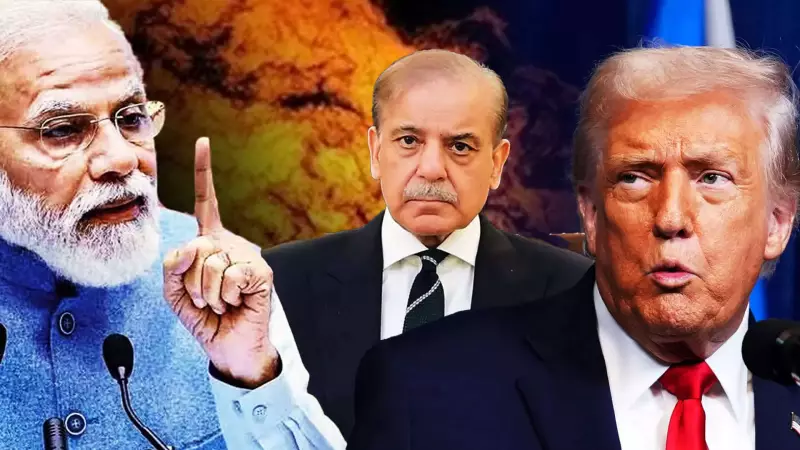
In a recurring claim that has drawn sharp rebuttals from New Delhi, former US President Donald Trump has once again asserted his role in halting a military confrontation between India and Pakistan. The latest instance occurred during discussions with Israeli leadership, where Trump cited the episode as one of several conflicts he claims to have stopped.
The Claim and Its Context
Speaking to Israeli Prime Minister Benjamin Netanyahu, Donald Trump referenced the tense standoff between India and Pakistan that followed Operation Sindoor. He positioned this as the 70th time he has taken credit for such an intervention, weaving it into a narrative of his foreign policy achievements. The remarks were made on December 30, 2025, continuing what has become a familiar saga of ceasefire credit-taking by the former American leader.
India's Firm Rejection of External Mediation
The Indian government has consistently and firmly pushed back against this narrative. Official sources in New Delhi stress that the de-escalation and understanding to halt military action was reached bilaterally between India and Pakistan. This agreement came after days of intense cross-border strikes, with diplomatic and military channels operating directly between the two nations.

Indian authorities have explicitly stated that there was no third-party mediation involved in the process. Furthermore, they have denied any suggestion of trade-based pressure influencing the decision to pause hostilities. This stance underscores a core principle of India's foreign policy: strategic autonomy in matters of national security.
The Widening Gap Between Narrative and Reality
As Trump repeats this claim, potentially for the last time in the year 2025, the chasm between political posturing and on-ground diplomatic reality becomes starkly evident. The episode highlights the frequent tension between international political credit-taking and the complex, often quiet, work of bilateral diplomacy.
For India, the repeated need to correct the record is not merely about setting the facts straight on a single incident. It is a reaffirmation of its position as a sovereign power capable of managing its own security challenges and external relationships without external intervention. The government's clear rejection serves to reinforce this position to both domestic and international audiences.
The persistence of this claim, despite India's denials, points to the enduring nature of such narratives in global politics, where perception often battles with documented fact. New Delhi's response remains focused on the diplomatic reality: a cessation of hostilities achieved through direct communication and calibrated statecraft.






