

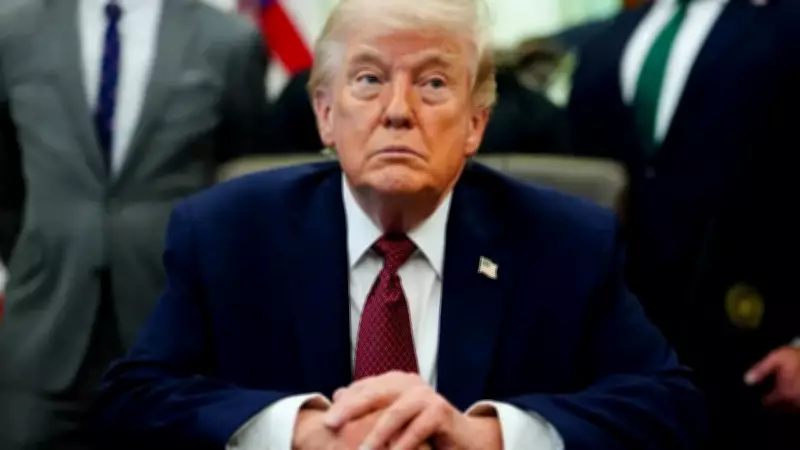
Trump Announces US Delegation for Fresh Iran Talks in Islamabad, Issues Strong Warning
US President Donald Trump declared on Sunday that a US delegation will travel to Islamabad, Pakistan, for renewed negotiations with Iran. This move comes just days after a previous round of talks in the Pakistani capital ended without an agreement.
"My representatives are going to Islamabad, Pakistan. They will be there tomorrow evening, for negotiations," Trump posted on his Truth Social platform.
Stark Warning to Iran Over Proposed Deal
Simultaneously, Trump issued a forceful warning to Iran, stating that the US has presented what he described as a fair proposal. He emphasized that failure to accept it would lead to decisive action.

"We’re offering a very fair and reasonable deal, and I hope they take it because, if they don’t, the United States is going to knock out every single power plant, and every single bridge, in Iran. No more Mr. nice guy!" he asserted.
Trump further elaborated, "They’ll come down fast, they’ll come down easy and, if they don’t take the deal, it will be my honour to do what has to be done, which should have been done to Iran by other presidents for the last 47 years. It’s time for the Iran killing machine to end."
Background of Failed Talks and Key Disputes
The earlier US-Iran ceasefire negotiations, held in Islamabad on April 11, concluded without any consensus. Mediated by Pakistan, these discussions spanned approximately 21 hours but failed to achieve a breakthrough.
The collapse was primarily attributed to disagreements over Iran’s nuclear program and sanctions. The US insisted that Iran reduce its uranium enrichment activities and provide long-term assurances against pursuing nuclear weapons. Iran countered by maintaining that its nuclear initiatives are for civilian purposes only and argued that such demands infringe upon its sovereign rights.
Additionally, there were significant differences regarding sanctions relief. Iran demanded the removal of sanctions and access to billions of dollars in frozen assets held overseas, which it claimed are essential for reconstruction efforts following weeks of US airstrikes.
Escalating Tensions and Recent Developments
Since the breakdown of talks, tensions have intensified. The US imposed a naval blockade on Iranian-linked shipping in the Strait of Hormuz, severely restricting Iran’s oil exports. In retaliation, Iran has kept the Strait either fully or partially closed, vowing not to reopen it until the US lifts the blockade and ends what it terms an illegal siege on its ports and energy routes.
On Sunday, Trump also accused Iran of violating the ceasefire in the Strait of Hormuz. "Iran decided to fire bullets yesterday in the Strait of Hormuz- A total violation of our ceasefire agreement! Many of them were aimed at a French ship, and a freighter from the United Kingdom," he claimed.
Trump highlighted the economic impact on Iran, stating, "Iran recently announced that they were closing the Strait. They are the ones that lose with the closed passage, $500 million dollars a day!" He contended that the US remains unaffected, adding, "The United States loses nothing. In fact, many ships are headed right now to the US, Texas, Louisiana and Alaska to load up, compliments of the IRGC, always wanting to be 'the tough guy.'"
This renewed diplomatic push underscores the volatile state of US-Iran relations, with high stakes for regional stability and global energy markets.






