Trump Escalates Criticism of UK's Starmer Over Iran Military Response
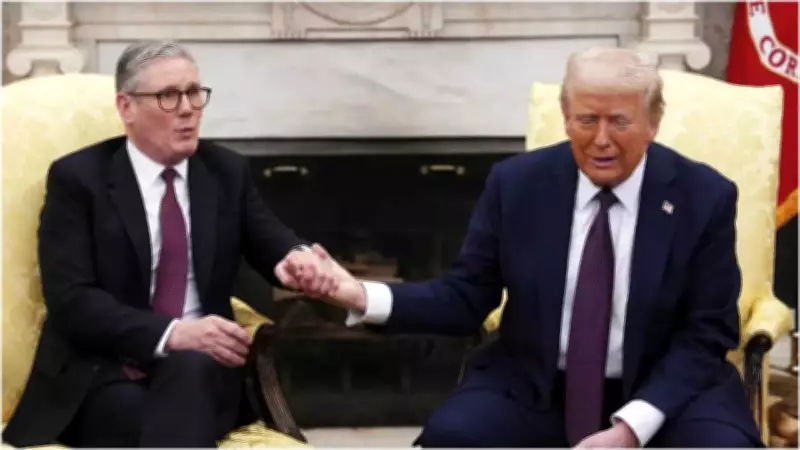
Former United States President Donald Trump intensified his verbal assault on United Kingdom Prime Minister Keir Starmer this Tuesday, condemning the British leader's initial refusal to permit American warplanes to utilize UK military bases for conducting strikes against Iran. In a pointed historical comparison, Trump remarked, "this is not Winston Churchill that we're dealing with", underscoring his disappointment with the current state of transatlantic cooperation.
Diplomatic Strain Over US-Israeli Operations
The diplomatic friction emerged amidst coordinated US-Israeli military actions targeting Iranian sites. Trump, seated alongside German Chancellor Friedrich Merz at the White House, expressed his frustration openly, stating, "The UK has been very, very uncooperative. I'm not happy with the UK. It's taken three, four days for us to work out where we can land." He lamented that the historical bond between the two nations was "not like it used to be", signaling a perceived deterioration in the special relationship.
Starmer's Cautious Stance and Subsequent Concession
Prime Minister Starmer, addressing Parliament on Monday, articulated a principle of restraint, declaring that his government "does not believe in regime change from the skies". This position initially led to a refusal to participate in Washington's military engagement with Iran, provoking Trump's ire. However, following deliberations, Starmer relented, authorizing the use of two British military installations—RAF Fairford in Gloucestershire and the joint UK-US base on Diego Garcia in the Indian Ocean—for what was described as a "specific and limited defensive purpose".

Government Minister Darren Jones defended this measured approach, emphasizing that UK involvement in any military action requires a "legal basis" and a "clear plan" aligned with national interests. "That's why we were not involved in the initial strikes in Iran," Jones clarified, while confirming the subsequent clearance of the two bases for American use.
Historical Shadows and Contemporary Actions
The political sensitivity in the UK regarding Middle Eastern military interventions remains profound, largely due to the legacy of former Prime Minister Tony Blair's contentious support for the 2003 US-led invasion of Iraq. Starmer directly referenced this caution, telling Parliament, "We all remember the mistakes of Iraq, and we have learnt those lessons." He specifically noted that the RAF Akrotiri base in Cyprus was "not being used by US bombers", aiming to assuage domestic concerns.
Concurrently, Starmer announced defensive measures, deploying helicopters equipped with counter-drone capabilities and the warship HMS Dragon to reinforce Cyprus's defences. This move followed an attack by Iranian-made drones on a British Royal Air Force base in eastern Cyprus, which damaged a runway. Starmer affirmed on social media platform X, "The UK is fully committed to the security of Cyprus and British military personnel based there. We will always act in the interest of the UK and our allies."
Trump's Public Rebuke and Alliance Reassessment
In comments to British tabloid The Sun, Trump expressed his disillusionment, stating, "This was the most solid relationship of all. And now we have very strong relationships with other countries in Europe", notably highlighting France and Germany. He added, "Starmer had 'not been helpful'. I never thought I'd see that. I never thought I'd see that from the UK. We love the UK. It's just a much different kind of relationship... It's very sad to see that the relationship is obviously not what it was."
Despite the public criticism, a spokesman for Prime Minister Starmer reiterated the enduring strength of the US-UK alliance, stating, "The UK and the US remain staunch allies. That is reflected in decades of that special relationship, whether it's on national security or trade, or beyond."

Analytical Perspective on Diplomatic Balancing
Evie Aspinall, director of the British Foreign Policy Group think tank, provided context, noting that Starmer navigates a "very tight diplomatic tightrope" with the United States. She emphasized that maintaining robust US ties "remains critical in the context of Ukraine and Greenland", pointing to broader geopolitical imperatives beyond the immediate Iran conflict.
The episode underscores the complex interplay between historical caution, national interest, and alliance management in UK foreign policy. As both nations grapple with evolving security challenges in the Middle East, the foundational pillars of defence cooperation and intelligence sharing that define their special relationship continue to be tested amidst shifting political landscapes and leadership dynamics.