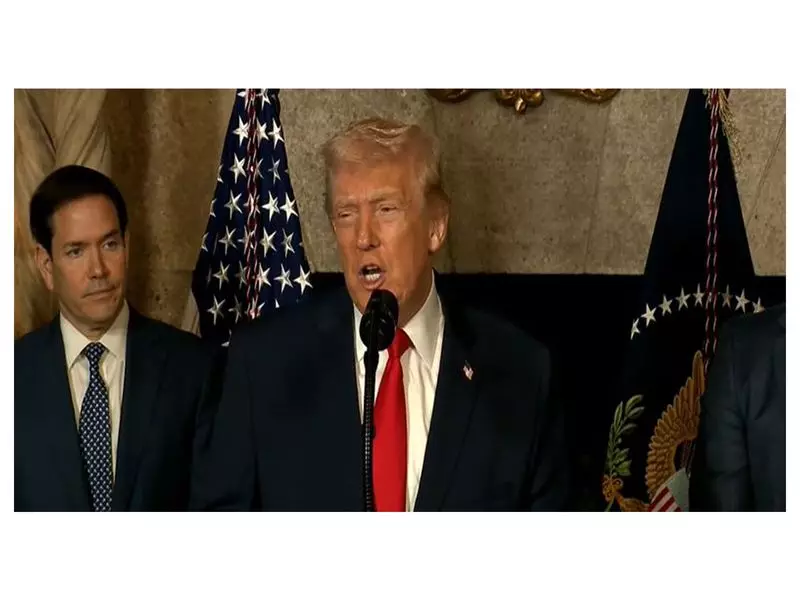
Former United States President Donald Trump has once again made a startling claim regarding a critical moment in South Asian geopolitics. He asserts that his intervention as President prevented a full-scale nuclear war between India and Pakistan in 2019. This reiteration brings back into focus a highly tense period following a deadly terrorist attack in Kashmir.
The Context: Pulwama and the Escalating Crisis
The backdrop for Trump's claim is the February 2019 Pulwama terror attack in Jammu and Kashmir. A suicide bomber affiliated with the Pakistan-based militant group Jaish-e-Mohammed (JeM) targeted a convoy of Indian security personnel, killing 40 Central Reserve Police Force (CRPF) jawans. This attack, one of the deadliest in decades, sent shockwaves across India and led to a severe diplomatic and military confrontation.
In response, the Indian Air Force conducted a pre-emptive airstrike on a JeM terror camp in Balakot, Pakistan, on February 26, 2019. India stated this was a non-military, counter-terrorism operation aimed at eliminating terrorist infrastructure. The following day, February 27, saw Pakistan retaliate with aerial action, leading to a dogfight over the skies of Kashmir.

Trump's Version of Events: A High-Stakes Intervention
Donald Trump, while speaking at a rally, provided his dramatic account of the situation. He stated that the conflict had escalated to a point where "they were going to have a nuclear war". According to him, he received a call from an unnamed Indian official who informed him that Pakistan had launched missiles into India.
Trump claimed his response was immediate and decisive. "I said, 'Where are the missiles going?' 'They are heading to India.' I said, 'You have to get together. You have to make a deal.'" He portrayed his role as that of a crucial mediator who de-escalated the crisis through direct pressure on both nations' leadership.
In a specific and contentious detail, Trump alleged that eight aircraft were shot down during the confrontation. This figure has not been officially corroborated by either the Indian or Pakistani governments. India officially acknowledged the loss of one MiG-21 Bison, whose pilot, Wing Commander Abhinandan Varthaman, was captured by Pakistan and later returned. Pakistan claimed to have shot down two Indian aircraft.
Reactions and Official Records
Trump's narrative has been met with skepticism and has been contradicted by official accounts from the period. Former Indian officials, including those in the diplomatic and national security establishment, have consistently denied that the situation ever reached the brink of a nuclear exchange. The Indian government's position has been that its actions were measured, targeted, and that it maintained strategic restraint throughout.
Analysts point out that while the period was undoubtedly one of extreme tension, the nuclear threshold was likely not as imminent as described. Both India and Pakistan have long-standing protocols and communication channels to prevent such an escalation. However, Trump's repeated claims highlight the perceived gravity of the crisis from Washington's perspective and underscore the persistent role of the United States as an external actor in India-Pakistan relations.
The episode remains a significant chapter in recent history, illustrating the volatile nature of the relationship between the two nuclear-armed neighbors. It also raises questions about public claims made by foreign leaders regarding sensitive security matters. The discrepancy between Trump's story and the official versions from New Delhi and Islamabad ensures that the events of February 2019 continue to be analyzed and debated.
The key facts from the period remain: the Pulwama attack on February 14, the Indian airstrike on Balakot on February 26, the aerial engagement on February 27 resulting in Wing Commander Abhinandan's capture and release, and the subsequent de-escalation. Donald Trump's latest comments add another layer of anecdotal drama to this already charged sequence of events, keeping the focus on the ever-present risks in the region.