

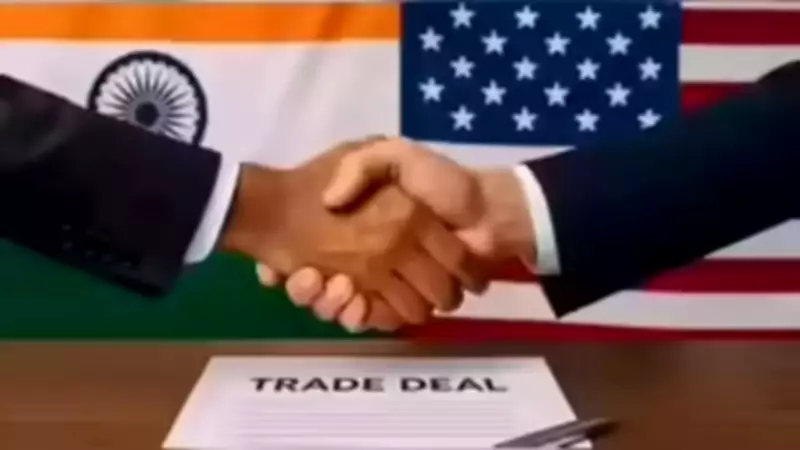
US President Trump Signs Executive Order Removing Tariffs on Indian Imports
In a significant move to restore bilateral relations, US President Donald Trump signed an executive order on Friday that formally eliminates punitive tariffs on Indian imports. This action cements a high-stakes agreement encompassing trade, energy, and security, aimed at returning US-India ties to a state of normalcy after months of economic tension.
Ending a Prolonged Economic Standoff
The executive order, effective immediately, brings an end to a months-long economic standoff that was triggered by India's purchases of Russian oil and New Delhi's resentment over what it perceived as punitive tariffs. Titled "Modifying Duties to Address Threats to the United States by the Government of the Russian Federation," the order removes a 25% additional duty that was imposed on Indian goods in August 2025 under sanctions targeting Moscow. This penalty had been layered on top of an existing 25% reciprocal tariff, pushing effective US duties on some Indian exports to as high as 50%. Under the new framework, tariffs on Indian goods will now fall to 18%, reinstating New Delhi's status as a preferred US trading partner.
Core Commitments and Strategic Alignment
The order formalizes an interim trade agreement reached earlier this week, following a February 2 phone call between President Trump and Prime Minister Narendra Modi. At the heart of this deal is India's commitment to cease all direct and indirect imports of Russian crude oil, a step that Washington views as crucial for tightening economic pressure on the Kremlin over the war in Ukraine. In the order, President Trump stated, "India has taken significant steps to address the national emergency and to align sufficiently with the United States on national security and foreign policy," describing the tariff modification as "necessary and appropriate" to counter the threat posed by Russia.

For much of 2024 and 2025, India had become one of the largest buyers of discounted Russian oil, importing over two million barrels per day at its peak. While these purchases helped cushion India's energy costs, they drew sharp criticism from the Trump administration, which accused New Delhi of undermining Western sanctions. The August 2025 tariff escalation marked a low point in bilateral economic ties.
Expanded US Purchases and Trade Framework
Under the new agreement, India has pledged not only to halt Russian oil imports but also to significantly expand its purchases from the United States. According to the White House, New Delhi has committed to buying $500 billion worth of American energy, technology, and agricultural products over the next five years, more than doubling current purchases. These include:
- Crude oil and liquefied natural gas
- Aircraft and parts
- Advanced technology such as graphics processing units (GPUs)
- Farm commodities
The agreement, presented as a "framework" ahead of an interim trade deal, leaves room for further negotiation in the coming weeks. It states that India will "eliminate or reduce" tariffs on all US industrial goods and a "wide range" of US food and agricultural products, with many details still to be finalized.
India's Energy Security and Enforcement Provisions
While the executive order notes India's commitment to stop importing Russian oil, New Delhi has emphasized that ensuring the energy security of its 1.4 billion citizens remains the supreme priority. The Indian government stated, "Diversifying our energy sourcing in keeping with objective market conditions and evolving international dynamics is at the core of our strategy to ensure this. All of India's actions are taken and will be taken with this in mind." Chief Economic Adviser Anantha Nageswaran added that India's partners, including Moscow, recognize these constraints, and New Delhi does not expect serious disruption if oil prices remain stable.

The executive order also includes strict enforcement provisions. It authorizes the US Commerce Secretary, in coordination with the State Department, to continuously monitor Indian oil imports. Any resumption of Russian crude purchases—whether direct or through intermediaries—could trigger an immediate "snapback" of the 25% punitive tariff. Secretary of State Marco Rubio has been empowered to invoke the International Emergency Economic Powers Act (IEEPA) to impose further sanctions if compliance falters, though the legality of IEEPA itself is awaiting a US Supreme Court ruling.
Strategic Implications and Future Negotiations
Beyond trade, the deal carries significant strategic weight. The executive order affirms that India has entered into a new 10-year defense cooperation framework with Washington, deepening collaboration on military technology, supply chains, and regional security. While the interim framework stops short of a full free trade agreement, officials on both sides indicate that negotiations are underway to finalize a broader bilateral trade pact by mid-March.
This executive order underscores President Trump's transactional approach to foreign policy, using tariffs as leverage and then rolling them back in exchange for strategic alignment. For India, it highlights the limits of neutrality and non-alignment in a sanctions-driven global order, signaling a shift towards closer ties with the United States amid ongoing international tensions.





