US Grants India 30-Day Waiver for Russian Oil Amid Middle East Crisis
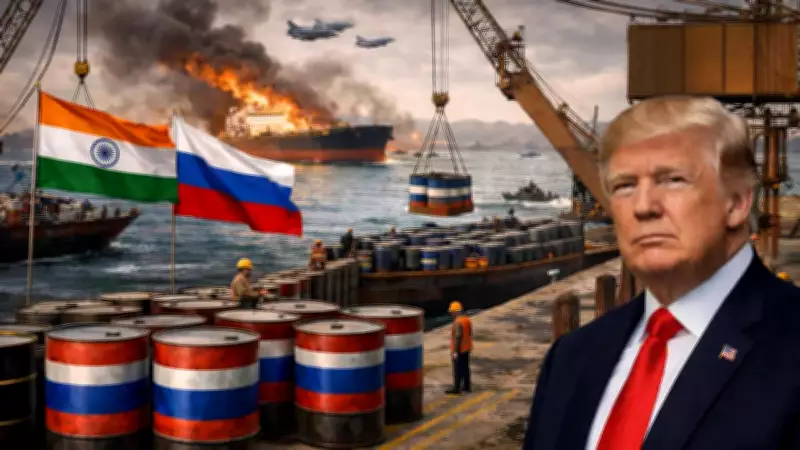
The Donald Trump administration has issued a crucial 30-day waiver permitting India to purchase Russian crude oil, providing immediate relief as Middle East supplies face severe disruption due to the escalating US-Israel-Iran conflict. This strategic move carries significant implications for India's energy security, given its heavy reliance on imported oil.
India's Critical Energy Dependence
India imports approximately 90% of its crude oil requirements, with a substantial 40-50% of these imports traditionally sourced from the Middle East. This dependency has become particularly vulnerable as the conflict threatens key shipping routes, especially the Strait of Hormuz. The strategic waterway, through which 20-25% of global oil transits, has seen tanker attacks that have effectively created a de facto closure, leaving numerous vessels stranded and at risk.
India had significantly reduced its Russian crude purchases following US sanctions against Russian oil majors Rosneft and Lukoil, which helped secure a trade deal with Washington that reduced tariffs on Indian goods to 18%. However, with the US Supreme Court striking down Trump's tariffs, the finalization of that trade agreement remains pending.

The US Waiver: Temporary Relief with Conditions
US Treasury Secretary Scott Bessent announced on social media platform X that the temporary waiver would "alleviate pressure caused by Iran's attempt to take global energy hostage." The authorization specifically covers transactions involving Russian oil already stranded at sea as of March 5, 2026, with delivery required at Indian ports by April 4, 2026.
The waiver represents a calculated compromise - while it provides India with immediate access to approximately 15 million barrels of readily available Russian crude, it deliberately avoids providing significant financial benefit to the Russian government. Bessent emphasized that the US fully anticipates New Delhi will increase purchases of American oil in the future.
India's Strategic Position and Vulnerability
Despite the temporary relief, analysts warn that India's fundamental vulnerability remains unchanged. Sumit Ritolia, Lead Research Analyst at Kpler, notes that "with nearly 50% of India's crude imports transiting the Strait of Hormuz, the country remains highly exposed to potential supply disruptions."
Indian officials have sought to reassure the public about energy security, with Oil Minister Hardeep Singh Puri stating that India maintains crude stocks sufficient for 25 days, with additional petrol and diesel stocks lasting another 25 days. Combined with strategic reserves, this provides approximately 8 weeks of coverage. "We are in a comfortable position right now," a government official confirmed.
Market Dynamics and Economic Implications
The renewed access to Russian crude could push India's imports from Russia to between 1.6 to 2 million barrels per day in the near term, up from recent levels of around 1 million barrels daily. However, competition from Chinese buyers for the same Russian barrels may limit India's benefits.
The timing is particularly critical as Brent crude prices have surged 16.4% since the conflict began, marking the steepest weekly climb since the Russia-Ukraine war started. According to former Niti Aayog CEO Amitabh Kant, every $10 per barrel increase in crude prices adds $13-14 billion to India's annual import bill, potentially widening the current account deficit and putting pressure on the rupee.
Long-Term Strategic Considerations
India has consistently maintained that its crude purchasing decisions will be guided by national energy security interests and availability of cheaper options. The country is also seeking marine cover from the US for vessels transporting oil from the Middle East and continues to receive supplies from West Africa, Latin America, and the United States.

While the waiver provides short-term logistical relief, Ritolia cautions that "it cannot fully offset India's almost 2.6 million barrels per day exposure to Middle Eastern crude." The policy shift may also tighten global availability of Russian export barrels, potentially narrowing the deep discounts previously associated with Russian crude and possibly even creating premium pricing for prompt cargoes if competition intensifies.
The situation remains fluid as the conflict enters its seventh day, with Iran hinting at "unseen" weapons and the US-Israel coalition intensifying strikes. India's energy security strategy continues to evolve in response to these rapidly changing geopolitical dynamics.