US-Spain Diplomatic Row Erupts Over Military Cooperation Claims on Iran
A significant diplomatic dispute has emerged between the United States and Spain following conflicting statements about military cooperation against Iran. The White House claimed Madrid had agreed to assist American military operations, a statement that was swiftly and categorically rejected by Spain's foreign minister.
White House Claims vs. Spanish Denials
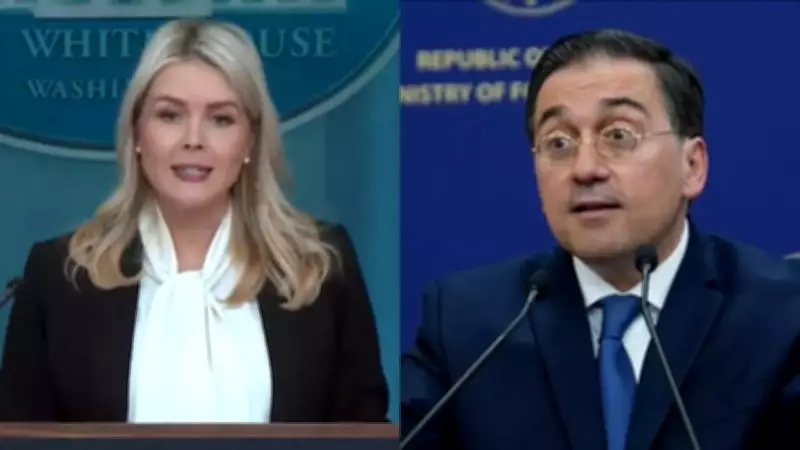
White House press secretary Karoline Leavitt told reporters that Spain had agreed to cooperate with US military efforts against Iran over the past several hours, though she provided no specific details about the nature of this alleged cooperation. "It's my understanding, over the past several hours, they've agreed to cooperate with the US military," Leavitt stated during a press briefing.
However, Spain's Foreign Minister José Manuel Albares strongly denied these claims during an interview with Cadena SER radio. "I categorically deny any change... our position on the use of the bases, on the war in the Middle East, on the bombardment of Iran, has not changed at all," Albares declared emphatically.

Background of Spanish Refusal
The conflicting statements come just days after Spain publicly refused to allow the United States to use jointly operated military bases on Spanish territory for strikes against Iran. The Spanish government specifically declined permission for US forces to operate from the naval base at Rota and the air base at Morón, both of which are jointly managed under longstanding defense agreements between Madrid and Washington.
Spanish Prime Minister Pedro Sánchez had previously criticized the US-Israel campaign against Iran, describing it as "unilateral military action" and warning that it risked creating "a more hostile and uncertain international order." Foreign Minister Albares had also stated earlier that Spain would not authorize any activities beyond existing bilateral agreements or outside international law.
"The bases are not being used – nor will they be used – for anything that is not in the agreement, nor for anything that isn't covered by the UN charter," Albares had emphasized in previous statements.
International Reactions and Broader Context
The disagreement has drawn criticism from US President Donald Trump, who openly criticized Spain's refusal to support the military campaign. "Some of the European nations have been helpful, and some haven't--and I'm very surprised. Germany's been great... Spain has been terrible. In fact, I told Scott to cut off all dealings with Spain," Trump stated. He added, "By the way, I'm not happy with the UK either."
Trump has defended the US strikes on Iran, arguing that Washington acted to prevent a potential Iranian attack and stop Tehran from developing nuclear weapons. "No, Based on the way the negotiation was going, I think [Iran] was going to attack first, and I didn't want that to happen, so if anything, I might've forced Israel's hand," he explained.
Meanwhile, Spain's opposition to the campaign has drawn praise from Tehran, with Iranian officials thanking Madrid for what they described as responsible conduct. Iran stated that Spain's refusal to allow its bases to be used for attacks demonstrated a commitment to international law and restraint as the conflict widened across the Middle East.
Escalating Regional Conflict
The diplomatic dispute occurs as the US-Israel military campaign against Iran intensifies. Washington and Tel Aviv have launched coordinated strikes on Iranian military facilities, missile sites, and naval assets, while Tehran has retaliated with missile and drone attacks targeting US allies and bases across the Gulf region.
Oil infrastructure in Saudi Arabia and shipping routes near the Strait of Hormuz have also come under threat, pushing global energy prices higher and disrupting international travel. President Trump has indicated the campaign could continue for several weeks, stating that US forces aim to dismantle Iran's missile capabilities, cripple its navy, and prevent it from acquiring a nuclear weapon.
The situation remains fluid as diplomatic tensions between the United States and Spain continue to unfold against the backdrop of escalating military operations in the Middle East.