

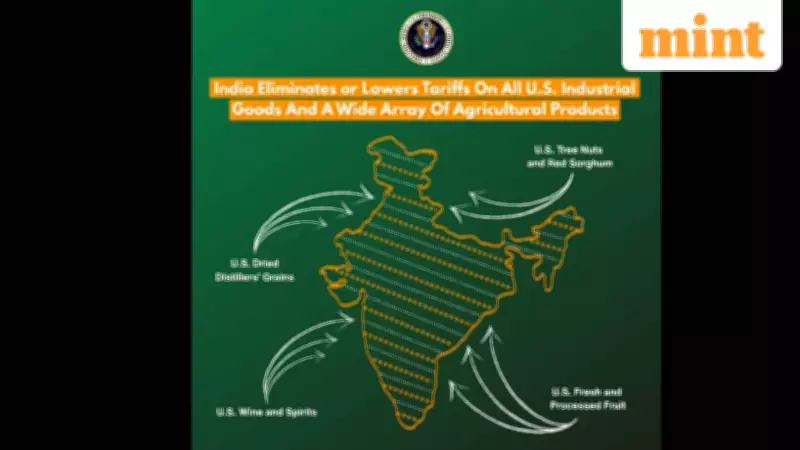
USTR's Trade Deal Announcement Features Map Showing PoK and Aksai Chin as Indian Territory
When the Office of the United States Trade Representative (USTR) published a post on social media platform X to promote the newly finalized India-US trade agreement, it wasn't the economic details that captured immediate attention. Rather, the accompanying map of India became the focal point of widespread discussion and analysis.
Cartographic Departure from Previous US Practice
The map presented alongside the trade announcement depicted India as a single, undivided territory that explicitly includes Pakistan-occupied Kashmir (PoK) and the Aksai Chin region. This representation marks a notable departure from previous maps released by US government agencies, which typically showed clear demarcations reflecting Pakistan's territorial claims in the region.
The USTR's post stated: "From tree nuts and dried distillers' grains to red sorghum and fresh and processed fruit, the U.S.-India Agreement will provide new market access for American products." While the text focused on agricultural trade benefits, the visual representation carried significant geopolitical implications.

Strategic Significance of the Map Representation
India has consistently maintained that Jammu and Kashmir, including Ladakh and the territories currently under Pakistani occupation, constitute an integral and inseparable part of the nation. While New Delhi has always asserted that its territorial claims require no external validation, the US government's deliberate cartographic choice carries substantial strategic weight.
This represents a clear and intentional shift from previous US portrayals that typically acknowledged Pakistan's sensitivities regarding Kashmir. The map issued by the Trump administration appears to disregard Pakistan's claims entirely, presenting what India considers its legitimate territorial boundaries.
Social Media Reactions and Public Response
Social media users responded enthusiastically to the map representation. At the time of reporting, the USTR's post had been shared 1,500 times, received 429 comments, garnered 6,200 likes, and was saved in 494 bookmarks.
Key reactions included:
- "Pakistan keeps bootlicking the USA. Meanwhile, the USA shows the correct map of India."
- "The US Department acknowledges the Indian Map. This is a government handle, and the Map shown is a deliberate acceptance rather than a mistake. Americans never make such mistakes."
- "USA showing PoK and Aksai Chin as part of India!!! Our correct map is a win for us."
- "US is suddenly remembering the actual map of India. A part of the deal? or buttering up Indians?"
- "Thanks for conveying to Pakistan that their Azad Kashmir province belongs to India, by representation of the correct map of India in your graphics."
Official Indian Position on Territorial Integrity
Earlier on August 1, 2025, Minister of State for External Affairs Kirti Vardhan Singh reiterated India's consistent and principled position in a written parliamentary response. He stated: "It has been India's consistent and principled position that the entire Union Territories of Jammu & Kashmir and Ladakh have been, are and will always remain integral parts of India. This was enunciated in the unanimously adopted 1994 Resolution of the Indian Parliament."
Singh further emphasized that official maps published by the Government of India unambiguously represent the entire Union Territories of Jammu & Kashmir and Ladakh, including territories illegally occupied by Pakistan. He noted that Pakistan has been in illegal occupation of parts of Indian Union Territories and that India has consistently called upon Pakistan to immediately vacate all areas under its illegal and forcible occupation.
Background: The India-US Trade Agreement
The map controversy emerged alongside the announcement of a framework for an interim trade agreement between India and the United States. The agreement aims to reduce tariffs on Indian goods, with tariffs dropping from 25% to 18% according to the announced terms.

The joint statement followed US President Donald Trump's announcement to cut import tariffs on India, coming six months after the imposition of higher taxes designed to pressure New Delhi into reducing its dependence on inexpensive Russian crude oil. As part of the deal, Indian Prime Minister Narendra Modi agreed to halt purchases of Russian oil.
This development represents a significant moment in India-US relations, where economic cooperation intersects with geopolitical positioning, particularly regarding territorial representations that align with India's longstanding claims in the Kashmir region.





