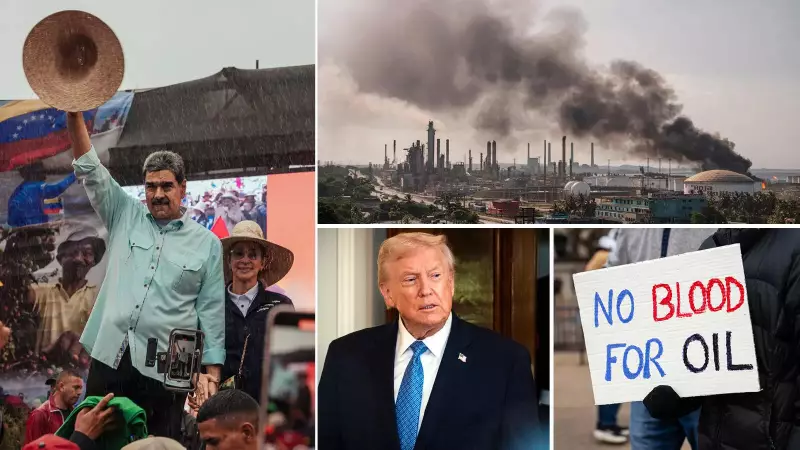
A recent, violent incident at a Venezuelan military installation has ignited a firestorm of geopolitical speculation, pointing fingers far beyond the country's borders. While officially labeled a "terrorist" attack by Caracas, deeper analysis suggests the assault on Fort Tiuna may be intrinsically linked to a resource that has long captivated foreign powers, particularly the United States under former President Donald Trump: Venezuela's colossal oil wealth.
The Attack on Fort Tiuna: A Surface Narrative
In the early hours of a December morning, Venezuelan authorities reported an armed incursion at Fort Tiuna, a key military complex in the capital, Caracas. The government of President Nicolás Maduro was quick to denounce the event as a "terrorist" act aimed at destabilizing the nation. Officials claimed to have repelled the attackers, showcasing captured equipment and making arrests.
This surface narrative, however, is merely the tip of the iceberg. The timing and nature of the attack have led analysts to probe for a more profound, strategic motive—one that aligns with a history of external interest in Venezuela's natural resources.

The Enduring Allure of Venezuelan Oil
Venezuela sits atop the world's largest proven oil reserves, estimated at over 300 billion barrels. For decades, this black gold has been both a blessing and a curse, fueling the nation's economy and its political turmoil. The interest from the United States, particularly during the Trump administration, was far from covert.
Former President Donald Trump repeatedly and publicly expressed his desire to control Venezuela's oil. In 2020, he bluntly stated to reporters, "We're sending ships... very powerful ships, and we have a lot of ships down there. You know what that's about? That's about oil." His administration's maximum pressure campaign, which included severe sanctions designed to cripple the state oil company PDVSA, was widely interpreted as an attempt to force a regime change and gain access to the resource-rich nation.
This historical context casts a long shadow over the Fort Tiuna incident. Experts argue that destabilizing the Maduro government, whether through direct military action or by fomenting internal chaos, remains a pathway for external actors to achieve that long-held objective of controlling the oil flow.
The Guyana-Essequibo Factor and Regional Tensions
Compounding the situation is Venezuela's recent aggressive posture regarding the disputed Guyana-Essequibo region. This territory, administered by Guyana but claimed by Venezuela, has recently become a major flashpoint after significant offshore oil discoveries by ExxonMobil.
Venezuela's renewed claims and military posturing over Essequibo are seen by many as a direct play for those newly tapped oil resources. The attack on Fort Tiuna, therefore, occurs within a highly charged regional environment where control over hydrocarbons is the central theme. It raises a critical question: was the assault an isolated event, or part of a broader strategy to weaken Caracas at a moment when its focus—and its military resources—are divided between internal security and an external territorial dispute?
Analysis: A Coincidence or a Strategic Move?
Connecting the dots reveals a pattern where Venezuela's oil is the constant. The Trump administration's explicit policy goals, the ongoing US sanctions that specifically target the oil sector, and the high-stakes dispute over oil-rich Guyanese territory all create a backdrop of intense resource competition.
The attack on a symbolic military target in the capital fits a classic destabilization playbook. By creating a perception of vulnerability within the Maduro regime, such events can scare off foreign investment, embolden opposition forces, and potentially justify further external intervention—all of which could ultimately serve to pry open access to the country's energy sector.

While no direct evidence publicly links the Fort Tiuna attackers to foreign state actors, the strategic beneficiaries of a weakened Venezuelan state are clear. Entities that have sought to break the state's control over its oil reserves for years would find opportunity in chaos. The incident serves as a stark reminder that in global geopolitics, especially concerning resource-rich nations like Venezuela, internal conflicts are rarely just internal.
The enduring legacy of Trump's openly stated desires regarding Venezuelan oil continues to shape the narrative and the potential motives of actors seeking to influence the country's fate. As long as the oil remains, Venezuela will likely remain in the crosshairs of geopolitical maneuvering.