

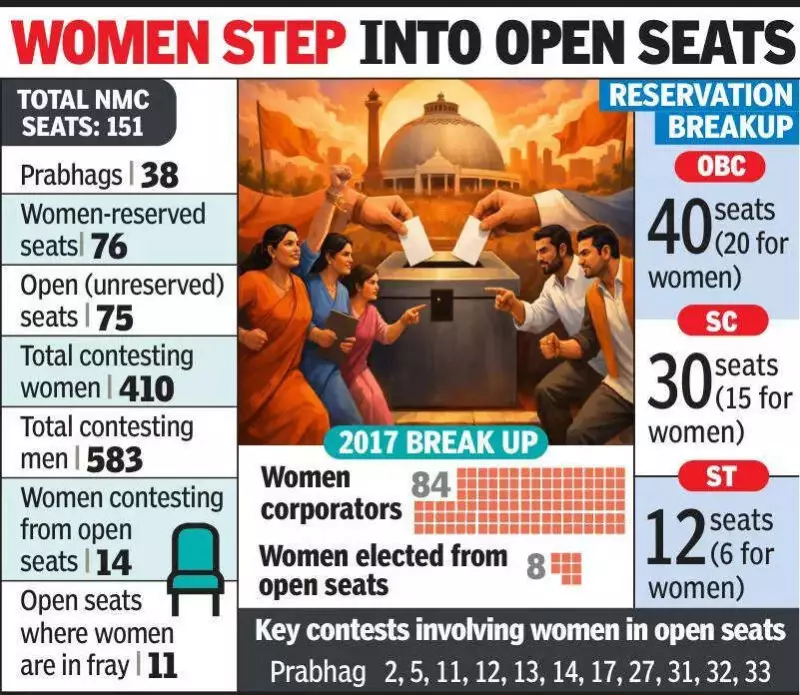
In a significant departure from tradition, the upcoming Nagpur Municipal Corporation (NMC) elections are witnessing a remarkable trend: 14 women candidates are stepping into the fray for 11 open seats, directly challenging male aspirants in contests historically dominated by men.
A Deliberate Choice Beyond Quotas
While the electoral framework reserves 76 of the 151 seats across 38 prabhags for women, these 14 entrants have chosen to test their political strength in general, or open, constituencies. This strategic move is altering the competitive dynamics in several key wards. The development builds on a precedent set in the 2017 NMC general body, where women held 84 seats. Of those, 76 were through reservation, but 8 were won from open seats, demonstrating early success beyond quota lines.
This election cycle, a total of 92 men are competing for 75 open seats, now joined by these 14 women who have opted to compete on an equal footing. The reservation structure itself remains substantial, with 40 seats for Other Backward Classes (20 for women), 12 for Scheduled Tribes (6 for women), and 30 for Scheduled Castes (15 for women), collectively ensuring 76 wards are reserved for women.

Key Wards and High-Stakes Contests
The presence of women in unreserved segments has turned multiple prabhags into closely watched battles. The contests vary widely in scale and composition:
- Prabhag 12 (ST Open): A straight fight between one male and one female candidate.
- Prabhag 13 (SC): Features 10 candidates, including 3 women.
- Prabhag 14 (Open): Has 9 candidates, with 1 woman among 8 men.
- Prabhag 31 (SC): A lone woman is among 5 contestants.
- Prabhag 32 (Open): Includes 1 woman in a field of 10 candidates.
Some wards are witnessing exceptionally crowded fields. Prabhag 27 (Open) has 13 candidates (2 women), Prabhag 5 (Open) has 18 (1 woman), and Prabhag 2 (Open) leads with 19 contestants, including 1 woman.
Political Parties Take Note of the Shift
Major political parties are closely monitoring this emerging trend, which is creating intriguing electoral scenarios. In Prabhag 14, Bharatiya Janata Party's candidate Pragati Patil faces Congress debutant Abhijeet Jha and BJP rebel Sunil Agrawal, forming a triangular contest where gender dynamics add a new layer. In Prabhag 12B, former mayor Maya Iwnate is once again challenging Congress's official candidate, Omprakash Wadwe. Notably, in the 2017 NMC polls, Iwnate had already proven her mettle by defeating a male candidate from an open seat in the same prabhag.
Political analysts interpret this movement as a signal of rising political confidence among women, built through sustained grassroots work, civic activism, and robust local networks. While male candidates still dominate numerically, victories by these women in open seats could profoundly influence future party ticket distribution and shatter long-held assumptions about electability in non-reserved wards.
The final outcome will be determined after the voting concludes. However, the message from the campaign trail is already clear and powerful: women in Nagpur's political arena are no longer confining their ambitions to reserved spaces and are actively reshaping the landscape of urban local governance.






