Bihar's Phase 2 Polling: BJP Pivots to Infiltration Narrative
As Bihar transitions from its political heartland to the border constituencies for Phase 2 of assembly elections, the Bharatiya Janata Party has strategically positioned "infiltration" as its central campaign theme. Prime Minister Narendra Modi, addressing back-to-back rallies in Araria and Bhagalpur on Thursday, launched a sharp attack on alleged illegal migrants, accusing opposition parties of shielding infiltrators for vote bank politics.
PM Modi's Strong Message on National Security
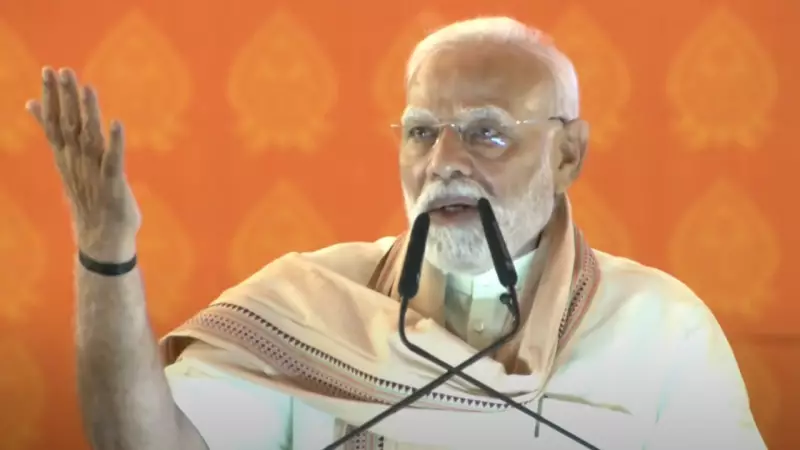
During his rally in Araria, the Prime Minister delivered one of his most direct attacks of the campaign, declaring infiltration as a major governance challenge. "A very major challenge stands before these efforts of ours. That challenge is of the infiltrators," PM Modi stated, emphasizing that the NDA government is working to identify and deport every illegal immigrant.
The Prime Minister accused the RJD and Congress of actively protecting infiltrators and spreading misinformation to shield them. "They spread all sorts of lies to save these infiltrators and take out political tours to mislead the people," he asserted during his speech.

Continuing his offensive in Purnea, Modi linked the infiltration issue to law and order concerns. "Such is vote bank politics that Congress, RJD and their entire ecosystem are busy defending and shielding the foreign infiltrators," he claimed, adding that opposition parties had become "shameless" in their support for illegal migrants.
The Prime Minister concluded with a firm guarantee: "Every infiltrator will have to leave. Putting a lock on infiltration is a firm responsibility of the NDA. In India, the law of the land will prevail, not the whims of infiltrators. This is Modi's guarantee."
Geographical Shift in Campaign Strategy
The Election Commission's phase-wise polling plan has effectively divided Bihar into two distinct geographical zones. Phase 1 covered 121 constituencies in the state's interior regions, focusing primarily on development, welfare, and governance issues. In contrast, Phase 2 encompasses border districts including Purnea, Araria, Kishanganj, and Katihar, forming a peripheral ring along Bihar's borders with Nepal and West Bengal.
This geographical division has prompted the BJP to adjust its campaign messaging accordingly. While interior constituencies heard about development and administration, border regions are now being targeted with narratives around migration, security, and demographic changes.
The Seemanchal region, comprising four districts and 24 assembly seats with a 47% Muslim population according to the 2011 Census (compared to the state average of 17.7%), has emerged as the epicenter of this political battle. The RJD-Congress alliance has traditionally enjoyed strong support here, though AIMIM's emergence in the 2020 elections, where it won five seats, has complicated the political landscape.
Amit Shah Reinforces Security Narrative
Union Home Minister Amit Shah amplified the Prime Minister's message during his campaign across north Bihar, launching scathing attacks on the Congress-RJD alliance. "Should infiltrators be removed from Bihar's voter list or not? Lalu and Rahul say, 'welcome the infiltrators,'" Shah claimed during his speeches.
Shah also criticized Rahul Gandhi for his comments about the armed forces, stating, "Rahul Gandhi should be ashamed for seeking to know about the caste and religion of Army jawans. We do not discriminate among military personnel based on caste or creed."
The Home Minister highlighted what he described as PM Modi's decisive action on national security, referencing Operation Sindoor conducted in response to the Pahalgam attack. "During the Congress regime, Pakistani terrorists would come, detonate bombs and leave. No action would be taken against them. Instead, they were treated to biryani," Shah alleged.

Record Turnout in Phase 1 Sets Stage
The first phase of polling recorded a provisional voter turnout of 64.46%, the highest in Bihar's electoral history according to Chief Electoral Officer Vinod Singh Gunjiyal. A total of 3.75 crore voters were eligible to decide the fate of 1,314 candidates across 121 constituencies, with polling conducted peacefully at 45,341 stations.
Prime Minister Modi interpreted this high turnout as evidence of public trust in the NDA's governance model. "Yesterday, the voters of Bihar broke all records. Never before in the history of the state has there been such a high poll percentage," he said during rallies in Aurangabad and Bhabhua.
The Prime Minister credited "Maatri Shakti (mother power)" for the strong participation and asserted that voters had rejected the "false promises" of the RJD-led opposition.
BJP's Strategic Playbook in Border Regions
The BJP's emphasis on infiltration follows a familiar pattern the party has employed in other border states. The issue of illegal migration has previously featured prominently in election campaigns in Assam, West Bengal, Jharkhand, and Delhi.
BJP Bihar vice-president Santosh Pathak claimed that the government's Summary Inclusion and Revision (SIR) process had identified irregularities in Seemanchal districts. "Even though the matter falls under the Union List, at the local level, people coming from Bangladesh are easily provided with Aadhaar cards," he alleged.
Pathak asserted that while development remains important, the infiltration issue would carry "political weight" in the second phase of voting.
As Phase 2 polling approaches, the BJP's strategic pivot from development to security issues in border constituencies reflects the party's attempt to convert geographical vulnerability into political advantage. The coming weeks will determine whether this narrative resonates with voters in Bihar's peripheral regions and shapes the outcome of the 2025 assembly elections.