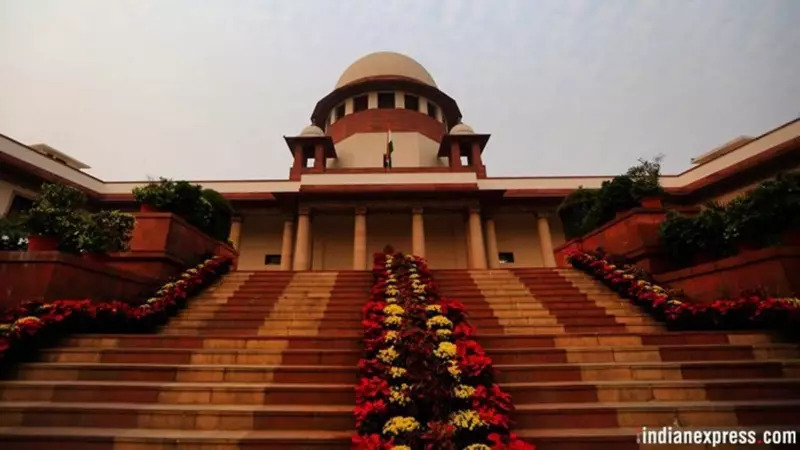
The Election Commission of India (ECI) has firmly asserted its constitutional mandate to verify the citizenship status of individuals for inclusion in or exclusion from electoral rolls. This defense came before a Supreme Court bench comprising Chief Justice of India Surya Kant and Justice Joymalya Bagchi, which is hearing petitions challenging the constitutional validity of the Special Intensive Revision (SIR) of voter lists.
Constitutional Mandate, Not Parliamentary Law
Representing the poll panel, Senior Advocate Rakesh Dwivedi argued that the ECI's power to assess citizenship flows directly from Articles 324 and 326 of the Constitution of India, and is not derived from or diminished by parliamentary statutes like the Citizenship Act, 1955, or the Foreigners Act, 1946. He emphasized that parliamentary legislation cannot contravene or dilute a constitutional mandate.
The EC's submission traced this authority back to the intent of the Constituent Assembly. It cited a resolution moved by Jawaharlal Nehru on January 8, 1949, which required authorities preparing electoral rolls to ensure no non-citizen was included. This resolution was later incorporated into the Constitution as Article 289-B, which was renumbered as Article 326.
Article 324 vests the superintendence, direction, and control of elections in the ECI, while Article 326 establishes elections to the Lok Sabha and State Assemblies on the basis of adult suffrage. The EC contends that reading these articles together assimilates the framers' intent, granting it plenary powers to verify citizenship for electoral purposes.
Distinguishing SIR from NRC and Central Government's Role
The Commission clarified that the SIR exercise is not a parallel National Register of Citizens (NRC). Senior Advocate Dwivedi explained to the bench that while an NRC aims to include all citizens, electoral rolls only include citizens above 18 years of age who are not otherwise disqualified. He stated, "A person who may be of unsound mind, if he is a citizen, he will be excluded from the electoral roll, but he will be part of NRC."
The ECI addressed the petitioners' argument that citizenship determination is the exclusive domain of the Central Government under Section 9(2) of the Citizenship Act. The poll panel countered that Section 9(2) deals specifically with the termination of citizenship due to voluntary acquisition of foreign citizenship, and it is only in this narrow regard that the Central Government has exclusive jurisdiction.
"Other aspects related to citizenship can be inquired into by other relevant authorities for their purposes, including those who are constitutionally obligated to do so, i.e., the ECI," the affidavit stated. It further highlighted that the Constitution itself empowers different authorities, including the ECI, to consider citizenship for specific purposes, as seen in Articles 103(2) and 192(2) concerning the disqualification of legislators.
Legal Precedent and the Need for Intensive Revision
The Election Commission bolstered its position by referencing the Supreme Court's 1995 decision in Lal Babu Hussein v. Electoral Registration Officer, which recognized the ECI's authority to examine citizenship for electoral roll purposes.
Defending the SIR exercise, the ECI argued that a robust electoral democracy necessitates the intensive revision of voter lists based on the conditions prescribed in Articles 325 and 326 and the Representation of the People Act, 1950. "Elections cannot be free and fair unless electoral rolls are intensively revised from time to time," the commission submitted.
The hearing, which concerns the SIR process that has seen significant revisions in draft rolls—including the deletion of nearly 3.68 crore electors nationwide—has been adjourned and is scheduled to resume on January 8.