

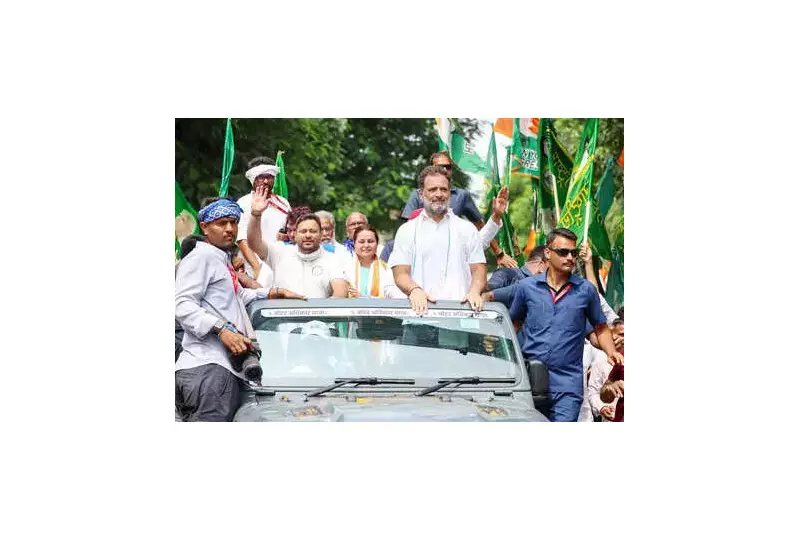
The Grand Alliance in Bihar, which began its campaign with great fanfare led by Rahul Gandhi's 'Vote Adhikar Yatra', is now confronting a starkly different reality on the ground in the key districts of Rohtas and Kaimur. The initial wave of enthusiasm that marked the rally in Sasaram on August 16 has steadily diminished, revealing significant organisational weaknesses and a lack of coordination, according to political observers.
From a Strong Start to Fading Momentum
The journey began with a powerful display in Sasaram, where Congress leader Rahul Gandhi launched the 'Vote Adhikar Yatra' and rally, drawing large crowds of party workers and enthusiastic youth. This event was widely seen as a strong show of the Congress party's organisational muscle within Bihar. However, as the assembly election campaign progressed, that initial fervor has largely dissipated.
This decline is in sharp contrast to the Grand Alliance's performance in the 2020 assembly elections, where it had swept 10 of the 11 seats across Rohtas and Kaimur districts. The Bahujan Samaj Party (BSP) won the remaining one seat. The NDA was virtually wiped out in the region, a setback largely attributed to the "Chirag factor"—where Chirag Paswan's LJP(RV) fielded candidates against its own ally, the JD(U), effectively splitting the NDA vote and proving decisive in at least four constituencies.

Internal Discord and a Lone Star Campaigner
Five years later, the political landscape appears transformed. The Grand Alliance is now grappling with fading public enthusiasm and visible internal discord. A major challenge is the lack of major crowd-pulling figures, with RJD leader Tejashwi Prasad Yadav standing out as the alliance's lone star attraction.
While Tejashwi campaigned vigorously across multiple constituencies, the efforts of other senior leaders have been limited. Congress president Mallikarjun Kharge addressed only one rally in Chenari, and Sachin Pilot led a single roadshow in Karahgar. Political experts note that coordination among the alliance partners has been poor, further hampering their campaign.
Compounding these issues is the alliance's weak organisational structure and growing discontent within the RJD. The denial of tickets to three sitting MLAs has led to simmering resentment and half-hearted campaigning in several constituencies, creating internal friction.
NDA's Calculated Gambit and the BSP's Resurgence
Meanwhile, the NDA has adopted a new strategy. For the first time, the BJP is not directly contesting any seat in Rohtas district. Instead, it has ceded ground to its allies—LJP (RV), RLM, and JD(U)—in a bid to consolidate OBC votes under the NDA umbrella. This move, however, is not without risk. In Sasaram, a traditional BJP stronghold it had won five times since 1990, the seat was allotted to the JD(U) in 2020, which subsequently lost it. A similar outcome was observed in the Nokha constituency.
In neighbouring Kaimur district, which borders Uttar Pradesh, the BSP has emerged as a formidable third force. In the 2020 polls, the BSP narrowly lost to the BJP by just 600 votes in one seat and finished as the runner-up in Ramgarh, where the RJD won by a slim margin of 189 votes. In a subsequent byelection, the JD(U) reclaimed the seat, but the BSP again finished second, pushing the RJD to third place.
Confusion within the RJD camp in Mohania, after its candidate Shweta Suman's nomination was rejected and the party decided to support Independent candidate Ravi Paswan, has further muddled the Grand Alliance's campaign narrative. The political situation across Rohtas and Kaimur remains fluid, shaped by weakened alliances, risky seat-sharing decisions, and the steady resurgence of smaller parties like the BSP.






